I. Introduction
The world has experienced unprecedented trade volatility in recent years due to increased tariffs and sudden policy changes by governments, resulting in a business environment marked by complexity and uncertainty. The specific difficulties SMEs face in this situation stem from their business structure and limited resources. New research by the Andersen Institute (2024) shows that SMEs generate half of private-sector employment and import 97% of U.S. merchandise, underscoring their essential role in economic stability and growth.
The Andersen Institute (2024) indicates that SMEs experience larger trade policy shocks because they are smaller and have weaker negotiation abilities than multinational corporations. Large corporations maintain access to multiple revenue streams, which enables them to negotiate rebates, shift manufacturing sites, or absorb expenses. SMEs may have limited profit margins, be solo suppliers, or face restricted opportunities in financial markets.
The recent tariff increases between 2017 and 2025 have raised international economic questions about trade barriers and supply chain disruptions. Economists describe TPU as a situation in which firms lack clarity about upcoming tariff rates, trade agreements, and retaliatory actions (Handley & Limão, 2022). Businesses face two major consequences of policy uncertainty: immediate tariff costs and strategic difficulties arising from unpredictable future regulations. TPU functions as a trade barrier according to Osnago et al. (2015).
This research fills an essential knowledge gap by examining the effects of tariffs and Trade Policy Uncertainty (TPU) on SMEs’ supply chain operations. Trade policy research has extensively examined aggregate outcomes but offers limited insight into how firms of different sizes adjust to trade disruptions or into their specific adaptation mechanisms. Studying these dynamics is important because SME responses to trade policies determine significant macroeconomic outcomes.
The research draws on four primary theoretical foundations. First, Trade Policy Uncertainty theory examines how uncertainty itself functions as a barrier to trade and investment. Second, Real Options Theory (ROT) explains why firms delay investments under conditions of uncertainty. Third, Transaction Cost Economics (TCE) provides a framework for understanding how tariffs alter the costs of market transactions versus internal production, affecting SME decisions about supplier relationships and vertical integration. Fourth, Supply Chain Resilience Theory identifies the capabilities—flexibility, velocity, visibility, and collaboration—that enable firms to withstand disruptions and illuminates why SMEs’ structural characteristics make them particularly vulnerable to trade policy shocks. This study combines scientific evidence with concrete examples of SME adjustment strategies to provide a comprehensive understanding of how trade policies affect small and medium-sized enterprises (SMEs). The research shows that successful SMEs implement both supplier diversification tactics and strategic investments to enhance supply chain visibility and flexibility.
II. Conceptual Foundations and Theoretical Framework
Tariffs as Exogenous Cost Shocks
Tariffs operate as imposed costs that directly increase the prices of imported goods upon arrival in a country. A government-imposed tariff on intermediate goods taxes all production firms that incorporate these materials into their operations. Several elements determine the extent of this impact, including the extent to which domestic and foreign inputs can substitute for each other, a firm’s pricing power, and the presence of substitute suppliers.
SMEs experience greater negative effects from tariff-related cost changes than larger businesses do. Their operations differ in structure. The research conducted by Today’s Medical Developments in 2024 shows that SMEs cannot take advantage of volume discounts to counter tariff expenses because their size limits their bargaining power, and their restricted product lines prevent them from transferring costs between affected and unaffected products. SMEs rely on single-sourcing practices to strengthen their negotiating position with suppliers; however, this approach leaves them without backup options when tariffs render their primary suppliers’ competitiveness obsolete (Bak et al., 2025).
The time needed to adapt to tariff changes varies substantially across companies, depending on their size. Large multinational corporations have established supplier relationships across multiple nations, enabling them to easily adjust their sourcing networks. In contrast, SMEs require several months to several years to locate new suppliers and integrate them into their supply chain. The duration of adjustment exposes SMEs to increased business risk because they must choose between absorbing higher input costs, raising customer prices, or implementing operational cost reductions.
Trade Policy Uncertainty: Definition and Measurement
Trade policy uncertainty (TPU) represents a less direct yet potentially more destructive problem than tariffs. The inability of firms to predict upcoming trade policies generates an uncertain business environment that makes strategic planning almost impossible. The Federal Reserve study by Caldara et al. (2020) developed complex econometric models to assess TPU and found that U.S. tariff uncertainty increased from 0.09 percentage points to 0.31 percentage points since 2017, according to their estimates.
For the purposes of this research, we adopt an operational definition of TPU specific to the SME context: TPU represents the degree to which small- and medium-sized enterprise decision-makers perceive ambiguity regarding future tariff rates, trade agreement status, and regulatory enforcement, which affects their confidence in making supply chain investments. This definition extends Handley and Limão’s (2022) conceptualization by incorporating bounded-rationality constraints that characterize SME decision-making environments, where owners and managers often lack dedicated trade policy analysis capabilities (Habimana, 2015). Unlike large firms that can employ scenario-planning teams, SMEs experience TPU as a direct cognitive and operational burden on owner-managers who must simultaneously address multiple business functions (Gourlay & Seaton, 2004).
The academic field has developed improved methods for assessing TPU in recent years. Research on trade policy uncertainty initially relied on newspaper coverage of policy developments. However, current studies have expanded to incorporate business executive surveys, stock market volatility measurements, and textual data from corporate earnings calls. The threat of policy changes produces economic impacts even in the absence of tariffs, indicating that policy uncertainty can be as damaging as implemented trade barriers (Caldara et al., 2020).
SMEs face TPU challenges because they lack both large strategic planning teams and sophisticated scenario planning capabilities. According to Fast Company (2024), small business owners experience “tariff whiplash” from rapid trade policy changes (72%) more often than from actual tariff levels (31%). According to this finding, SMEs value the predictability of trade policies over the absolute levels of trade barriers.
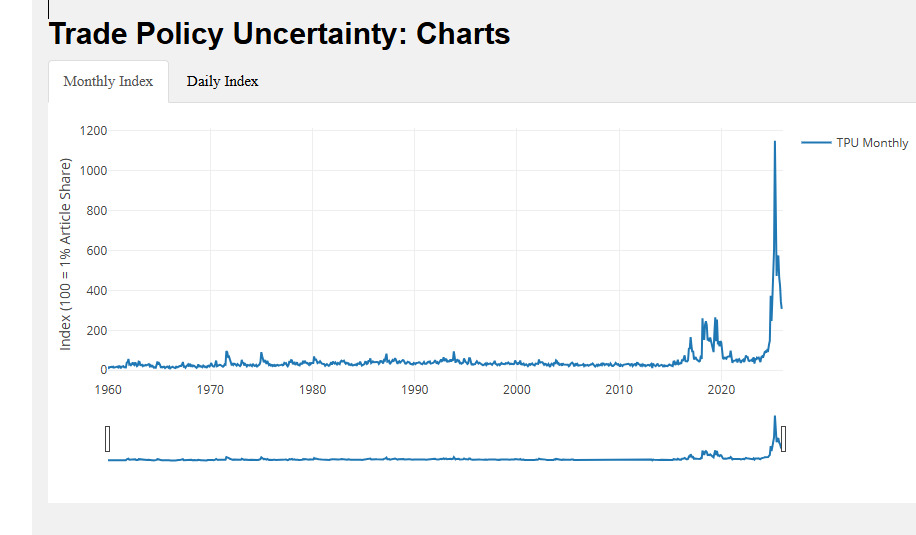
Figure 1 illustrates the dramatic recent rise in TPU. It set records in 2018-2019 but then broke those records by multiples of 3-5 in 2025 (Caldara et al., 2025). [Authors’ Note: Consider replacing the downloaded figure with a custom visualization showing TPU trends from 2010-2025, potentially as a histogram or matrix comparison that highlights SME-relevant policy periods such as Section 301 implementation phases, USMCA negotiations, and recent tariff announcements.
The TPU index is based on searches of the archives of seven newspapers: The Boston Globe, The Chicago Tribune, The Guardian, The Los Angeles Times, The New York Times, The Wall Street Journal, and The Washington Post. The measure is calculated by counting the monthly frequency of articles discussing trade policy uncertainty (as a share of the total number of news articles) for each newspaper. The index is then normalized to 100 for a one-percent article share. The TPU Index starts in 1960. https://www.matteoiacoviello.com/tpu.htm
.png)
Supply Chain Vulnerabilities of SMEs
The economic importance of SMEs stems from their unique organizational features, which simultaneously generate specific weaknesses when trade policies change. The operational constraints of SMEs enhance their sensitivity to both tariff changes and uncertainty events.
SMEs’ operating cash reserves are generally insufficient to meet their daily business requirements. According to Thomson Reuters (2024) research, SMEs maintain median cash reserves covering their operating expenses for 45 days, while large corporations maintain 120 days of operating expenses. This finding aligns with earlier research by Berger and Udell (1998), who documented systematic differences in liquidity management between small and large firms related to their differential access to external capital markets. SMEs face significant challenges during customs clearance, particularly when tariffs increase working capital requirements, as they usually lack sufficient financial reserves to absorb temporary cash flow problems (Gregory et al., 2005).
The practice of single-sourcing enables SMEs to negotiate better deals with suppliers by limiting their sourcing to a single supplier. The procurement cost benefits of single-sourcing disappear when primary suppliers are affected by tariffs or other disruptions. Large firms often establish dual or multiple sourcing arrangements as a risk management strategy; however, SMEs struggle to justify the added operational costs of managing additional supplier relationships. Research on supply chain governance structures indicates that smaller firms face proportionally higher relationship-specific investments when establishing new supplier ties (Thomas et al., 2018; Williamson, 1985).
SMEs must pay higher interest rates for external finance and face more stringent collateral requirements to expand their supplier networks and develop supply chain infrastructure. The requirements of banks and other lenders demand higher interest rates and stricter collateral from smaller firms, which results in increased costs for SMEs to adapt to trade policy changes. Research on small business financing documents that credit constraints systematically limit SME strategic flexibility (Abdulsaleh & Worthington, 2013; Caglio et al., 2021). SMEs often become stuck with inferior supply chain arrangements due to a lack of access to the necessary finance to adopt better alternatives. The intersection of financial constraints and supply chain adaptation needs represents a critical vulnerability that distinguishes SME responses to trade policy from those of larger firms (Adhim & Mulyono, 2023; Crozet et al., 2022).
III. Theoretical Perspectives on SME Response to Trade Policy
Real Options Theory and Investment Under Uncertainty
Real Options Theory (ROT) helps explain how TPU influences SME investment choices. The theoretical framework presents investment opportunities through financial options. Uncertainty makes choosing among those options more difficult. It causes firms to delay their expenditures until they gain additional information. The foundational work of Dixit and Pindyck (1994) established that irreversible investments under uncertainty create option value in waiting, a principle with particular salience for resource-constrained SMEs.
ROT suggests that the value of delaying capital expenditures increases when firms face tariff uncertainty. SMEs are more sensitive to poor investment timing because they lack diversified cash flow streams. Diverse cash flows can mitigate the negative effects of bad timing. Caldara et al. (2020) support this theory through their empirical analysis, which shows that firms that discuss TPU in their public communications have a 2.5% lower capital stock one year after the announcement. This effect is most significant among small firms. Additional empirical support comes from Bloom, Bond, and Van Reenen (2007), who demonstrated that uncertainty significantly reduces the responsiveness of investment to demand shocks, an effect amplified for firms with limited financial flexibility.
The ROT framework explains why SMEs underinvest in supply chain flexibility even though these investments would bring strategic value. The investments required to establish relationships with multiple suppliers, implement supply chain visibility systems, and maintain higher inventory levels can be costly. They may not yield benefits if trade policies remain stable. During times of high uncertainty, these investments gain insurance value that may help justify their associated costs. Trigeorgis and Reuer (2017) extend this analysis to show how real options logic applies to strategic flexibility investments, while Driouchi and Bennett (2012) demonstrate that smaller firms systematically undervalue flexibility options due to cognitive and resource constraints.
Proposition 1: SMEs facing higher levels of trade policy uncertainty will exhibit greater delays in supply chain capital investments than during periods of policy stability, with the magnitude of the delay inversely related to firm financial reserves.
Transaction Cost Economics and Supply Chain Governance
The transaction cost economics (TCE) framework offers an alternative perspective on how tariffs influence SMEs’ supply chain decisions. The Coase and Williamson framework illustrates how firms choose between internal production and market transactions by considering production costs versus transaction costs. SMEs often struggle more with uncertainty, a product of information shortage (Coase, 1937, 1960; Habimana, 2015; Williamson, 1975).
The introduction of tariffs modifies transaction costs by making imported inputs more expensive for businesses. Grossman and Helpman (2021) present a model that demonstrates how tariffs influence supplier contract renegotiation and show that these contracts create conditions in which suppliers gain bargaining power and prices exceed the set tariff amount. SMEs face additional disadvantages in bargaining power against their suppliers due to their limited negotiating capabilities and information shortages (Habimana, 2015).
The TCE framework suggests that smaller firms need more time to adjust to tariff modifications than larger corporations do. The process of building new supplier connections requires substantial transaction expenses, as it involves supplier identification and assessment, followed by contract development and ongoing relationship maintenance. SMEs face higher transaction costs that consume a greater proportion of their total costs, so they avoid supplier changes despite economic advantages. And, of course, alternative suppliers are not always available (Rynarzewska et al., 2024).
Proposition 2: SMEs will exhibit longer supplier adjustment periods following tariff implementation than large firms, with adjustment duration positively correlated with the asset specificity of their current supplier relationships.
Supply Chain Resilience Theory
The theory of supply chain resilience examines an organization’s ability to operate during disruptions. Diva Portal (2021) identifies four essential supply chain capabilities for resilience: flexibility, velocity, visibility, and collaboration. SMEs suffer disproportionately from tariffs and TPU because they affect all of these.
The ability to modify supply chain configurations represents a form of flexibility in managing supply chain disruptions. The implementation of tariffs leads to supplier uncompetitiveness, which forces businesses to adopt limited sourcing practices. SMEs face limited flexibility because they lack the purchasing capacity to source from multiple suppliers across different geographic locations.
The speed at which supply chains respond to changes in demand or supply conditions defines velocity. SMEs need to maintain larger inventory buffers when tariffs are in place because they decrease velocity, which can lead to supply chain disruptions. The requirement of additional inventory consumes operational capital while diminishing operational speed.
Firms achieve visibility by observing their supply chains and detecting potential disruptions. The lack of advanced supply chain monitoring systems at SMEs prevents them from detecting how tariff changes affect their entire supply network. Supply chain disruptions occur more frequently at organizations with restricted visibility, as they fail to identify potential disruptions with adequate information.
Collaboration is the process of working together with supply chain partners to handle disruptions. SMEs usually have informal relationships with suppliers. This circumstance restricts their ability to establish coordination protocols that handle tariff-related disruptions effectively.
Nonetheless, SMEs often show great agility in responding to supply chain disruptions. Their weaknesses have another side that can become strengths. Their flatter organizational structure may mean less red tape and quicker decision processes. They may diversify suppliers, adjust production schedules, and modify products to maintain operations during disruptions. They may even create alliances with similar firms (Bak et al., 2025; Rynarzewska et al., 2024).
These advantages can offset the weaknesses and problems described in the section on ROT. But the two circumstances can exist simultaneously. Large firms have the advantages of scale. This scale enables them to reconfigure supply chains, renegotiate supply chain terms, and buffer resources in ways that may not be available to SMEs (Mao et al., 2024). Agility and flexibility are not identical. While smaller firms may respond more quickly, their limited resources may hinder their ability to thrive or survive during certain disruptions (Mao et al., 2024; Rynarzewska et al., 2024).
Proposition 3: SMEs with higher levels of supply chain visibility and collaborative supplier relationships will demonstrate greater resilience to tariff shocks, as measured by recovery time and the preservation of profit margins.
IV. Industry Evidence and Market Analysis on Tariff and TPU Effects
Note: This section synthesizes industry data, survey findings, and secondary research rather than primary empirical data collection. Sources include peer-reviewed economic studies (e.g., Caldara et al., 2020), industry surveys (e.g., NFIB, SupplyChainBrain), and trade publications. Readers should note that industry surveys and trade publications provide practitioner perspectives and may employ different methodological standards than peer-reviewed empirical research.
Firm-Level Studies
The latest research conducted at the firm level indicates that tariffs, combined with trade policy uncertainty, hurt SME operations. The most extensive peer-reviewed research about impacts on U.S.-listed companies was conducted by the Federal Reserve across 7,500 businesses from 2005 to 2018. This Federal Reserve study revealed that firms that communicated trade policy uncertainty to the public experienced a 2.5% reduction in capital stock during the following year, with the effect primarily affecting smaller companies (Caldara et al., 2020).
Industry survey data provide complementary practitioner perspectives. According to SupplyChainBrain’s 2025 industry survey, logistics costs increased by 10-15% due to tariffs affecting 60% of firms, but SMEs struggled to offset these costs through operational improvements or supplier negotiations. This cost increase prevents other investments, as firms divert resources to handling tariff-related disruptions instead of growth opportunities.
Peer-reviewed studies of specific industrial sectors show diverse patterns in how various types of SMEs react to changes in trade policies. The investment response of SMEs with manufacturing operations shows a higher elasticity when their import expenses exceed 40% of their cost of goods sold, compared to those with minimal import expenses (Caldara et al., 2020). Electronic SMEs require more adjustment efforts than apparel manufacturers because their products have complex structures and longer product qualification processes for new components.
SMEs face greater negative effects from tariffs than large firms. They face direct cost pressures and have fewer choices for mitigation. It is more difficult for them to switch sources when the supply is limited. They often must choose among price increases, cost absorption, or operational cuts (Rynarzewska et al., 2024). Sector-level evidence shows SMEs are more likely to be concentrated in niche import-dependent sectors, leaving them especially vulnerable to cost shocks from tariffs that target specific countries or products. Larger firms, by contrast, often have diversified supply chains and can shift production or redesign sourcing strategies in response to trade policy shifts (Wagner, 2012).
SMEs hit by tariff-related cost increases often respond by scaling back hiring, delaying investments, or reducing R&D activity—decisions that can create longer-term competitive disadvantages (Gourlay & Seaton, 2004). Larger firms are typically able to maintain these strategic expenditures despite similar shocks, insulating them from the same degree of long-term harm. These effects may be seen in niche supply chains where SMEs become more strongly dependent on specific, dedicated suppliers (Rynarzewska et al., 2024).
Aggregate Economic Studies
The macroeconomic effects of trade policy uncertainty are supported by aggregate vector autoregression (VAR) models in peer-reviewed research. The analysis of data from 1960 to 2024 reveals that a two-standard-deviation TPU shock results in a 1-2% reduction in non-residential investment in the U.S. economy the following year (Caldara et al., 2020). These aggregate results show the combined effects of thousands of individual firms, including numerous SMEs, that make up the entire number.
The sequence of these aggregate effects reveals essential insights about how the transmission processes work. TPU increases trigger investment reductions during the first few quarters before tariffs take effect. The investment timing pattern suggests that expected trade policy changes have an equivalent impact to actual policies, as per Real Options Theory, which posits that uncertainty leads to investment delays.
The National Federation of Independent Business (NFIB) industry survey data demonstrate that SMEs directly experience the effects described by peer-reviewed research findings. The 2024 NFIB survey results showed that 72% of small business owners identified tariff uncertainty as their primary planning challenge, surpassing their concerns about tax policy and regulation, as well as labor costs (Fast Company, 2024). The survey results demonstrate value because they track the reactions of smaller businesses that remain out of reach for public company databases.
Cost Pass-Through and Margin Effects
SMEs need to understand the key aspect that determines their response to rising costs from tariffs. Research conducted by Armstrong Consulting (2024) and Harvard Business School (2025) indicates that small to medium-sized enterprises pass about 75% of tariff costs to their end consumers, whereas large firms pass around 50%. SMEs often demonstrate a reduced capacity to reduce costs through operational enhancements or lower profit margins due to their limited ability to absorb price increases.
The remaining 25% of tariff costs that SMEs cannot pass through to customers must be absorbed through other adjustments. The survey data show that businesses use three different methods to handle price adjustments, including decreasing profit margins, reducing credit lines, freezing employee hiring, and delaying capital expenditures. SMEs that faced tariff price increases were found to experience both a 40% higher rate of credit access challenges and a 25% longer period before planned expansion implementation, according to research from Harvard Business School (Cullen et al., 2025).
The geographical distribution of these effects helps researchers understand how the transmission mechanisms work. The responses of SMEs to tariff changes become more significant when they operate in locations with numerous trade-intensive businesses, even though they do not participate in international trade themselves. Local supply chain adjustments made by customers result in tariff effects that spread through networks to domestic SMEs, who experience these indirect effects.
Supply Chain Reconfiguration Patterns
According to industry evidence, multiple distinct patterns exist in how SMEs adjust their supply chain systems in response to tariff changes. Industry reports indicate that SMEs in apparel manufacturing diversified their supply chain by moving 10% of their Chinese imports to Vietnam and Bangladesh when Section 301 duties reached 25% (SupplyChainBrain, 2025). The diversification process produces substantial transition expenses alongside brief periods of deteriorating quality.
Firms often choose inventory pre-buying as a response when they expect rising tariffs. NFIB survey respondents increased their inventories at a record rate during April 2025 after the government announced 145% tariffs (Andersen Institute, 2024). The protection of working capital is a benefit of this strategy, though it locks up capital and creates storage challenges for smaller firms.
Small- to medium-sized enterprises in specific industries have adopted nearshoring as their long-term strategic response because transportation costs eat into substantial portions of total landed costs. Automotive suppliers transferred their wire harness assembly facilities to Mexico to avoid Chinese steel tariffs, resulting in 15% shorter delivery times despite rising delays in cross-border trucking, according to industry reports (SupplyChainBrain, 2025). Implementing nearshoring requires substantial initial capital investment, and firms must spend time learning about new suppliers in unfamiliar markets.
Comparative Impact Analysis
Table 1 synthesizes the evidence presented in this section, comparing the differential impacts of tariffs and TPU on large firms versus SMEs across key operational and strategic dimensions.
V. Mechanisms Affecting SME Supply Chains
Cash Flow and Working Capital Impacts
The implementation of tariffs creates immediate cash-flow problems for SMEs because it requires additional working capital. Companies must pay additional duties when importing goods before clearing customs, as these duties must be paid before the goods can be sold to generate revenue. SMEs that maintain minimal cash reserves face substantial liquidity challenges due to mismatches in their cash flows.
Working capital requirements imposed by tariffs on imported goods depend on several factors, including the inventory turnover rate, customer payment terms, and access to trade financing. The cost of trade financing is higher for small and medium-sized enterprises than for large firms, making it more difficult for them to finance the gap between tariff expenses and customer payments. SMEs without access to the bond market, according to the Andersen Institute (2024), must use costlier operating loans to meet their working capital needs resulting from tariffs.
The cash flow situation worsens because businesses cannot determine if the present tariff rates will stay in place. Companies face complex decisions about inventory levels and supplier payment arrangements because they lack clarity on current tariff levels. Businesses face poor cash management choices due to uncertainty, as they must choose between prolonged inventory storage and inferior payment terms to maintain supply continuity.
Forecast Error Amplification and Safety Stock
Uncertainty about trade policies makes it difficult for businesses to predict market demand while managing their inventory. Traditional inventory management systems base their calculations on stable patterns in input prices and delivery times, enabling businesses to determine appropriate reorder levels and safety stock levels. These inventory management models become unreliable because tariff changes create uncertainty, leading to either stockouts or increased carrying costs.
SMEs face greater risks from forecast errors because they often operate with basic inventory management systems, whereas larger businesses typically use more sophisticated versions. Uncertain effective tariff rates increase material cost variability according to Thomson Reuters (2024), while safety stock models increase their recommended reorder points. Small to medium-sized enterprises with limited warehouse capacity and financial resources face difficulties due to increased inventory requirements driven by safety stock levels.
The increased variability of forecasts generates impacts that reach throughout the entire supplier networks of individual firms. Tariff uncertainty leads SMEs to increase their safety stock levels, causing them to place larger, more unstable orders with their suppliers. The bullwhip effect occurs when supply chain costs rise throughout the network due to upstream-propagating demand volatility.
Contract Renegotiation and Supplier Power
Tariffs fundamentally change the negotiation dynamics between SMEs and their suppliers. Certain suppliers who become less competitive due to tariffs will face pricing pressure, as they risk losing their business. Suppliers operating in countries with favorable trade policies will gain enhanced bargaining power, enabling them to request higher prices or more favorable contract terms.
The Harvard economists Grossman and Helpman (2021) developed a formal model that demonstrates how tariffs impact the renegotiation process between firms and their suppliers. The actual price increase from tariffs surpasses the official rate because suppliers use switching costs to negotiate higher profit margins. SMEs face an estimated 20% duty-related cost increase above the statutory rate, thus producing a substantial amplification of the direct duty impact.
SMEs experience both increased expenses and unpredictability during the renegotiation process. The absence of dedicated procurement teams at SMEs hinders their ability to effectively negotiate with suppliers during periods of trade policy volatility. SMEs face an unfair disadvantage, resulting in unfavorable contract terms, while requiring them to adapt more slowly to changing market conditions.
Market Access and Export Constraints
SMEs face substantial obstacles from retaliatory tariffs imposed by trading partners on imports. The production diversification options that large multinational corporations can use to avoid retaliatory duties are unavailable to SMEs, as they have a restricted geographic reach in both customers and facilities.
According to the 2024 study by Harvard Business School, retaliatory duties negatively impact SME exporters because these companies lack distribution networks across multiple countries, which would enable them to redirect sales to untaxed markets. The inability to shift sales to other markets due to retaliatory tariffs creates a barrier, forcing SMEs to focus on domestic markets or accept lower prices.
Market access difficulties become more complex due to extensive administrative challenges associated with intricate, shifting trade regulations. Most SMEs lack the legal and regulatory expertise to rapidly adapt their export methods in response to changes in tariff schedules, rules of origin, or anti-dumping regulations. The administrative challenges posed by these rules create market entry restrictions that are comparable to the impact of tariffs.
Integrated Summary: Theory, Evidence, and Mechanisms
Table 2 integrates the theoretical frameworks from Section III with the industry evidence from Section IV and the operational mechanisms described above, providing practitioners with an actionable synthesis of how theory translates to observed effects and recommended responses.
VI. Heterogeneity in SME Responses
Trade Intensity and Exposure Levels
The impact of tariff changes and trade policy uncertainty varies across SMEs. Businesses with high import intensity, measured as imports as a percentage of the cost of goods sold, will exhibit substantial responses to trade policy changes. According to peer-reviewed research by the Federal Reserve, the investment responses of firms with COGS import ratios exceeding 40% were twice as strong as those with low import levels (Caldara et al., 2020). This finding aligns with theoretical predictions from both TCE and ROT frameworks regarding resource dependency.
The observed heterogeneity among firms has significant implications for evaluating how trade policy affects the overall small-business sector. SMEs with predominantly domestic supply chains will either face minimal disruptions from tariff changes or benefit from reduced competition among import-dependent rivals. The distribution of trade intensity levels across SMEs determines how trade policy adjustments affect the entire small-business sector. Research on firm heterogeneity in trade responses suggests that average effects may mask substantial variation in how different firm populations experience policy changes (Bernard et al., 2012).
The geographic aggregation of trade-intensive industries leads to additional variations in how tariffs affect different businesses. Small enterprises in areas with numerous manufacturing and technology businesses experience greater indirect effects from tariff changes, even if they are not directly involved in international trade. Trade policy effects exhibit strong regional characteristics, with different areas experiencing either substantial economic changes or remaining largely unaffected (Autor et al., 2016; Kovak, 2019).
Sectoral and Technological Differences
The various technological aspects of different industries result in distinct levels of sensitivity to trade policy changes. Small businesses in the electronics industry must invest heavily to adapt, as their products require precise specifications and supplier approval processes that are both time-consuming and demanding. The process of switching suppliers under tariff pressure requires electronics firms to perform extensive testing and certification procedures, which might take several months to multiple years to finish. Research on supplier qualification processes in technology industries documents the substantial investment required to establish quality-assured supplier relationships (Bode et al., 2014).
The product specifications within apparel and textile SMEs remain simpler, and supplier qualification periods are shorter, resulting in lower switching costs for these businesses. Industry reports indicate that apparel SMEs moved 10% of their sourcing to Vietnam and Bangladesh within 18 months following Section 301 tariff implementation (SupplyChainBrain, 2025). However, electronics companies needed 24-36 months to achieve comparable levels of supply chain diversification. These sectoral differences align with TCE predictions regarding asset specificity and switching costs (Williamson, 1985).
The speed of adaptation varies across industries due to different regulatory environments. Medical device and aerospace component SMEs face additional challenges when switching suppliers, as new suppliers must obtain industry-specific approvals and certifications. Regulatory barriers create obstacles that prevent SMEs from switching suppliers, even though economic benefits from alternative sources exist. The intersection of regulatory compliance requirements and trade policy creates compound challenges for SMEs in regulated industries (Pierce & Schott, 2016).
Financial Structure and Access to Capital
SMEs face varying levels of response capability to trade policy changes, depending on their financial structure. Owner-managed businesses with limited collateral pay higher interest rates and face tighter loan conditions than SMEs with professional management and strong financial stability. These financial limitations prevent SMEs from investing in supply chain diversification and maintaining inventory buffers during periods of tariff uncertainty. Research on small business financing demonstrates that capital constraints systematically shape strategic options (Abdulsaleh & Worthington, 2013; Berger & Udell, 1998).
Peer-reviewed research shows that financially limited SMEs reduce their input purchases more significantly than financially stable SMEs when tariffs increase. The reduction in purchases from all suppliers by financially stressed SMEs creates additional shocks to domestic tier-2 suppliers (Berkeley Economic Analysis, 2021). This amplification effect illustrates how financial constraints propagate through supply networks (Caglio et al., 2021).
SMEs have varying access to trade financing because their banking relationships and credit profiles determine their financing options. Companies with established relationships with banks that specialize in trade finance receive improved access to letters of credit, trade insurance, and other financial tools to mitigate tariff-related cash flow issues. SMEs without these banking connections may struggle to sustain their international supply chains because higher tariffs increase their working capital requirements. The role of trade finance in enabling supply chain flexibility has received increased research attention following recent supply chain disruptions (Adhim & Mulyono, 2023; Crozet et al., 2022).
VII. Strategic Responses and Adaptation Mechanisms
Multi-Sourcing and Geographic Diversification
Many businesses adopt multi-sourcing across various tariff zones as their leading solution to manage tariff uncertainty. The strategy enables SMEs to adapt their sourcing choices in response to changes in tariffs. The establishment of practical multi-sourcing requires substantial investment in vendor management capabilities, but it leads to higher procurement overhead expenses.
The advantages of multiple sourcing methods support better supply chain reliability beyond just reducing tariffs. Organizations with suppliers across multiple regions maintain superior abilities to respond to supply interruptions caused by natural disasters, political instability, and other trade policy-independent events. The Diva Portal (2021) reveals that businesses sourcing from three or more countries face 30% less supply disruption risk than companies with single-country supplier bases.
SMEs face difficulties implementing multi-sourcing due to limited financial resources. SMEs need to allocate additional staff resources to manage multiple suppliers because these relationships require expanded quality-control systems and higher minimum order quantities, which strain their working capital. Purchasing cooperatives formed by some SMEs address vendor management challenges by aggregating volume with suppliers, thereby distributing vendor management expenses among members.
Nearshoring and Reshoring Strategies
Nearshoring has become a preferred business strategy because it minimizes both transportation expenses and trade policy uncertainties. The preferential trade agreements between the U.S. and Mexico, Canada, and Central America allow numerous SMEs to benefit from cost advantages and supply chain control through nearshoring their operations.
The LMA Consulting Group (2024) demonstrates through an extensive case study how a Midwest machinery producer successfully executed nearshoring. The company divided its production activities between Ohio for precise machine work and Mexico’s Foreign Trade Zone for plastic sub-assembly operations. The company achieved a 12% decrease in landed costs and a 30-day reduction in lead times through this setup, despite Chinese components facing a 25% tariff.
A nearshoring strategy requires businesses to invest substantial amounts of capital upfront and undergo extensive learning periods. To establish nearshore supplier relationships, SMEs must establish new business ties, adjust their quality control systems for various manufacturing settings, and sometimes support their suppliers in meeting specification requirements. The high costs of transitioning prevent smaller SMEs from nearshoring because it requires stronger financial stability and more complex operations.
Tariff Engineering and Product Redesign
SMEs with suitable technical capabilities can utilize tariff engineering as a sophisticated approach to modify their products for more favorable tariff categories. The approach to tariff engineering involves modifying product details, sourcing methods, and manufacturing steps to achieve better HTS codes with reduced duty rates.
The Supply Chain Management Review (2024) illustrates how various organizations employ successful tariff engineering approaches. An electronics SME redesigned its products to meet the “component” classification rather than the “finished product” classification, which lowered its effective tariff rate from 25% to 5%. The company relocated its production facility to receive trade agreement benefits, while maintaining its existing suppliers.
SMEs face difficulties in implementing tariff engineering because it requires advanced legal and technical knowledge that many small businesses lack. HTS classification complexity, together with rules of origin requirements, usually requires costly specialized consulting services that exceed the potential cost savings. Businesses must conduct thorough assessments of tariff engineering plans to prevent violations against anti-circumvention rules or trade regulations.
Technology and Digital Supply Chain Solutions
SMEs can mitigate tariff uncertainty complexities through investments in supply chain technology and the implementation of visibility systems. The application of AI-driven cost-to-serve analytics enables businesses to pinpoint which products and customers are most impacted by tariff changes and respond accordingly. Digital platforms help businesses maintain supplier relationships and provide instant tracking of supply chain disruptions.
Several AI-powered supply chain platforms have emerged that specifically target SME adoption with scalable pricing models. Platforms such as Flexport provide end-to-end visibility and tariff calculation tools accessible to smaller shippers. Sourcemap offers supply chain mapping and risk monitoring that enables SMEs to visualize their exposure to tariff-affected regions. Project44 delivers real-time visibility across transportation modes, helping SMEs track shipments affected by customs delays. For inventory optimization under uncertainty, tools like Inventory Planner and Cin7 offer demand forecasting that can incorporate tariff-related cost scenarios. Coupa and SAP Business Network provide supplier management capabilities that can help SMEs diversify their supplier bases more efficiently.
RSM Consulting (2024) demonstrates through their research how consumer businesses should employ technology to defend themselves from tariff price hikes. Through digital supply chain platforms, businesses can automate complex operations for supplier management and regulatory compliance tracking, as well as inventory optimization across multiple scenarios. Small to medium enterprises find great value in these platforms because they lack enough internal staff to handle supply chain complexity through manual processes.
The primary challenge for many SMEs is the expensive and time-consuming initial setup and ongoing maintenance requirements associated with complex supply chain technology systems. The implementation of these technologies through cloud-based solutions has made them more accessible to smaller firms; however, staff time and technical expertise remain in limited supply. To access advanced technologies, SMEs partner with third-party logistics providers or supply chain consultants who deliver these solutions while bypassing the need for internal implementation.
Financial Risk Management
SMEs now utilize financial instruments to mitigate the uncertainties associated with tariffs. The financial risks associated with unpredictable trade policies can be mitigated through the use of currency hedging, commodity price hedging, and trade credit insurance. Several financial instruments exist that require advanced financial knowledge, which many small enterprises lack.
Old National Bank (2024) offers SMEs a pathway to handle financial risks stemming from tariffs. According to the bank, firms should establish credit lines in advance while maintaining multiple banking relationships and utilizing supply chain financing programs to manage working capital fluctuations. These financial strategies provide the necessary flexibility for businesses to cope with cash flow pressures resulting from tariffs.
Some SMEs have started including tariff escalation provisions in their customer agreements to enable automatic tariff price adjustments, rather than requiring periodic contract renegotiations. This strategy helps protect profits, but it might make businesses less competitive against companies that either bear tariff expenses within their operations or have adjusted their supply networks to reduce tariff impacts.
VIII. Policy Implications and Recommendations
Gradualism and Policy Transparency
The research data shows that trade policy uncertainty poses a greater threat to SMEs than the actual tariff levels do. As documented in Section IV, NFIB survey data reveal that 72% of small business owners identify uncertainty as their primary planning challenge. The findings about trade policy design imply that slow and transparent policy implementation would decrease the economic costs that businesses face during adjustments.
Phasing in tariffs allows businesses to avoid the severe inventory buildup and cash flow problems that affect SMEs most severely (Cullen et al., 2025). Policymakers should implement multi-year tariff phase-in schedules that give businesses enough time to adjust their supply chains step by step. The industry evidence in Section IV demonstrates that SMEs require 6-24 months to qualify new suppliers; phased implementation aligned with these adjustment timelines would reduce the TPU premium documented by Caldara et al. (2020), thereby lowering the real options value of delay and enabling SMEs to make more efficient long-term investments. Gradual phase-in also reduces the forecast error amplification and bullwhip effects that Section V identifies as key mechanisms of SME vulnerability.
Trade policy development requires complete transparency as an essential element. The criteria and timelines of policy decisions become accessible to firms, which enables them to make better strategic decisions. The National Foreign Trade Council (2024) proposes that trade policy agencies should maintain regular dialogue with business organizations while giving warnings about upcoming policy modifications whenever possible.
SME-Focused Trade Adjustment Assistance
Trade adjustment assistance programs directed at workers have had limited success, primarily focusing on worker retraining activities. The most effective approach to support SMEs dealing with trade policy disruptions would include credit guarantees, technical assistance for supply chain diversification, and technology adoption grants.
Research from Harvard Business School (Cullen et al., 2025) suggests that credit guarantees designed explicitly for SMEs would be most beneficial in preserving supplier relationships when tariffs are introduced. As documented in Section IV, SMEs face a 40% higher rate of credit access challenges following tariff increases and maintain only 45 days of cash reserves compared to 120 days for large firms. Credit programs should address these specific vulnerabilities through several mechanisms. First, working capital bridge loans with extended terms (90-180 days) would cover the cash flow gap between duty payment and revenue recovery. Second, tariff duty deferral programs, similar to bonded warehouse provisions but available to smaller importers, would reduce immediate liquidity demands. Third, supplier diversification credit lines would provide dedicated financing for the upfront costs of qualifying and onboarding alternative suppliers, addressing the 6-24 month adjustment period documented in Section IV. Fourth, inventory financing at preferential rates would support the safety stock buildups that Section V identifies as a key SME response to uncertainty. Government guarantees for these credit programs would enable community banks and CDFIs to extend financing that SMEs cannot currently access through traditional channels.
The development of skills for SMEs to handle diversified, complex supply chains can be supported through technical assistance programs. The programs should deliver training on supplier qualification procedures, along with trade compliance guidance and support for implementing a supply chain visibility system. The Small Business Administration should play a central role in designing and delivering these programs.
Permanent Exclusion Mechanisms
The current tariff exclusion system, based on products, is time-consuming and unpredictable, which prevents meaningful assistance for SMEs. A better solution would be to establish permanent exclusion systems for essential domestic manufacturing inputs that domestic suppliers cannot supply.
The National Foreign Trade Council (2024) claims that standardized processes for tariff exclusions will decrease the premiums of uncertainty that suppliers include in their quotes and long-term contracts. Policymakers should establish specific criteria for automatic exclusion approvals and clarify which products receive preferential treatment, ensuring transparency about these products.
A potential objection to permanent exclusion mechanisms is that they may conflict with the stated objective of using tariffs to promote domestic manufacturing. However, exclusions and domestic production incentives can operate complementarily rather than contradictorily. Exclusions should apply specifically to inputs where domestic supply does not exist and cannot be reasonably developed within planning horizons—typically specialized components, rare materials, or products requiring production scale unavailable in domestic markets. The Section IV evidence shows that SMEs in niche sectors face particular vulnerability precisely because their specialized inputs often lack domestic alternatives. Permanent exclusions for such inputs would enable SMEs to maintain operations while broader industrial policy supports domestic capacity development in feasible production categories. This targeted approach preserves the incentive effects of tariffs where domestic alternatives exist while preventing punitive effects on SMEs dependent on inputs without domestic substitutes. The evidence in Section VI on sectoral heterogeneity suggests that such targeting is administratively feasible.
Digital Capacity Building Support
The strategic measures available to SMEs need technological abilities that exceed their current capabilities. Government programs that enhance digital capabilities enable SMEs to handle complex supply chains as well as changes in trade policies.
RSM Consulting (2024) states that supply chain analytics tools represent a vital capability that enables SMEs to understand their tariff exposure and create stronger response plans. Small businesses lack the technical expertise and initial financial resources needed to implement these tools. The government should establish grants and subsidized consulting programs to bridge the capability gap between SMEs.
Digital trade platforms that connect SMEs with potential suppliers decrease the expenses involved in diversifying supply chains. These platforms offer standardized supplier qualification processes combined with automated compliance checking and integrated financing solutions that enable SMEs to build multi-sourcing capabilities.
IX. Future Research Directions
Further research on the subject is needed to enhance our understanding of how trade policies impact SMEs’ supply chains. Further research is needed to investigate the lasting effects of trade policy ambiguity on business competition. The current body of research focuses on short-term adjustments, yet it does not clarify the long-term effects on industry structure and innovation incentives.
Research must continue to evaluate different policy approaches that assist SMEs during trade policy transitions. The theoretical rationale behind various forms of assistance appears strong, but researchers lack sufficient empirical data to determine which methods produce the best practical results.
Research must continue to explore how SMEs located in different geographic areas respond when trade policies change. The existing studies primarily examine overall effects; however, the literature may reveal substantial differences in how companies within particular locations and industrial clusters respond to trade interruptions.
Research into the international aspects of SME supply chain adaptation would offer essential knowledge for national policy coordination. SMEs in different countries that experience identical trade policy uncertainty challenges might benefit from international cooperation to develop mutual support programs and best practices.
A critical gap in the current literature concerns the lack of empirical measurement tools designed specifically for the SME population. Existing measures of trade policy uncertainty, such as the Caldara et al. (2020) TPU index, rely on newspaper coverage and public company disclosures—data sources that capture aggregate uncertainty but cannot assess firm-level uncertainty perceptions among private businesses. Similarly, measures derived from earnings call transcripts (Hassan et al., 2019) are unavailable for the SME context because privately-held firms do not produce such public communications.
SME Perceived Uncertainty as a Latent Construct. We suggest that SME Perceived Uncertainty (SMEPU) represents a latent construct ripe for theoretical development and empirical validation. SMEPU would capture the subjective uncertainty experienced by SME owner-managers regarding trade policy, encompassing both cognitive dimensions (perceived ambiguity about future policy states) and operational dimensions (perceived inability to plan supply chain investments). This construct would be theoretically distinct from aggregate TPU measures, reflecting the bounded rationality constraints and information processing limitations that characterize SME decision-making environments.
Development and validation of a multi-item SMEPU scale would enable researchers to test the propositions advanced in this paper (Section III) at the firm level. Such a scale could incorporate items assessing: (a) perceived clarity of current trade policy affecting the firm’s suppliers; (b) confidence in predicting policy changes over 6-month, 12-month, and 24-month horizons; (c) perceived adequacy of information sources for trade policy monitoring; and (d) self-assessed capability to respond to policy changes. Factor analytic validation across diverse SME samples would establish the construct’s dimensionality and psychometric properties.
Beyond SMEPU, researchers should develop proxy measures for key constructs identified in this analysis that currently lack SME-appropriate operationalizations. These include: SME supply chain visibility (currently measured through technology adoption surveys that assume enterprise-scale systems); SME financial flexibility for trade adaptation (beyond simple liquidity ratios); and SME supplier relationship quality (incorporating the informal relationship structures typical of smaller firms). The development and validation of such measures would significantly advance empirical research on SME trade policy responses and enable rigorous testing of the theoretical frameworks reviewed in Section III.
X. Conclusion
The detailed analysis reveals that trade policy uncertainty and tariffs pose multiple complex problems for SMEs, extending far beyond basic cost increments. SMEs face their most significant strategic planning and investment constraints due to the ongoing uncertainty surrounding future trade policies, although the implementation of tariffs creates direct financial pressure. The empirical evidence suggests that trade policy volatility disproportionately affects SMEs due to their limited resources and inherent structural weaknesses.
The operational mechanisms behind these effects are intricately linked. The cash flow limitations of SMEs prevent them from handling price increases resulting from tariffs, while their forecast errors, which increase due to policy uncertainty, cause them to make suboptimal inventory choices. The process of renegotiating contracts has a negative impact on smaller businesses, while export market access limitations block their potential exports entirely. The difficulties faced by SMEs become more pronounced because trade-intensive firms, along with manufacturers operating in complex sectors and financially limited businesses, experience the most severe obstacles.
According to the research findings, Strategic SMEs adapt successfully to trade policy volatility through a mix of tactical and strategic responses. Companies with resources and expertise can successfully implement three strategies to adapt to volatile trade policy: multi-sourcing across tariff zones, nearshoring to preferential trade agreement partners, and investing in digital supply chain capabilities. The most successful adaptations succeed through quick tactical moves followed by enduring strategic investments to build supply chain flexibility and visibility.
The findings from this study carry significant implications for policy-making. Current trade policy procedures overlook SMEs’ uneven exposure to trade policy changes, which demonstrates a need for slower implementation timelines, transparent policy development processes, and specialized support systems. The economic efficiency benefits from reduced policy uncertainty exceed the importance of reducing absolute trade barriers, according to the evidence.
The future success of SMEs in complex global trade environments will depend on their own strategic choices and the established policy rules. The most resilient firms will be those that combine supply chain adaptability with multiple vendor networks and technology-based supply chain monitoring. The full realization of SME competitiveness benefits for the economy depends on policy stability, which enables smaller businesses to make efficient long-term investments.
The research shows that trade policy impacts on SMEs extend beyond standard business implications because they affect employment rates, innovation levels, and economic dynamism. Policymakers must prioritize SME impact when designing trade policy because they manage international trade relations in this era of great power competition. The analysis of specific vulnerabilities among small firms enables policymakers to develop trade policies that achieve their objectives without causing avoidable economic disruptions.
Future research should investigate the impact of trade policy uncertainty on industry structures and innovation rates, evaluate various policy intervention methods, and examine how different countries respond to trade disruptions. The global economy requires continuous monitoring of SMEs’ adaptation to changes in international trade policy, as their stability depends on it.