In 2021, Harvard Business Review published a list of common phrases employees might use regarding a workplace family. They are: “We are family” or “Welcome to the [company name] family” (Luna, 2021). Workplace families, that is, a workplace coming together as a “family” (Luna, 2021), have been discussed in the popular press over the last few years. What exactly is a “workplace family?” It is not necessarily a place where you work with your family, although it could be. Rather, some would say, it means employees might share a bond or “look out for one another” (Pinsker, 2022). A workplace family, as described in an article on Medium, is “loyalty without limits” (Kernan, 2025). Oftentimes, companies refer to themselves as a “workplace family” to encourage employees to become emotionally attached to their work (Alakavuklar, 2009). Employees usually develop positive feelings because the workplace is a family, and thus feel more strongly connected to the company (Alakavuklar, 2009). Often, we spend more time with our coworkers than with our own family; this can result in stronger relationships with coworkers (Baum, 1991).
With strong family-like relationships can also come strong family-like issues. It has been found that when a workplace has a family-like atmosphere, it can result in conflict, blurred boundaries, or guilt (Brotheridge & Lee, 2006). Alakavuklar found that calling a workplace a family is often used as a controlling mechanism to get employees to “comply, obey, identify, and associate with the business” (2009, p. 7). This can become toxic for a workplace’s culture, with boundary lines blurring and employees being taken advantage of (Luna, 2021).
Given the idea that workplace families can create potential conflicts at work, toxic positivity (TP) will also be examined because it could yield similar outcomes. In currently unpublished work, I have defined toxic positivity (TP) as an individual’s insistence on positivity to intentionally suppress negative emotions and attitudes in oneself and others.
Workplace families most likely stem from a positive place, yet they can lead to potential conflict. This paper will theoretically discuss the potential role that toxic positivity (TP) may play in small business “work families” through a social identity lens, arguing that a healthy workplace culture will increase profits. In contrast, a toxic workplace culture can negatively impact a company’s bottom line.
Literature Review
Workplace Families
The idea of a workplace family can also serve as a metaphor for the type of company a business may want to appear as (Alakavuklar, 2009). However, there is limited academic research on this idea. What is recognized is the use of the workplace family metaphor across different industries, including manufacturing, hospitals, and restaurants (Casey, 1999). There are many reasons that a company may try to brand itself as a workplace family to its employees. Some reasons include trying to encourage closer relationships among the employees (Baum, 1991). However, it is also possible that, because some companies are family-owned businesses and this has a positive connotation in the marketplace (Botero & Litchfield-Moore, 2021), non-family-owned businesses might be trying to adopt that type of branding. This, however, is only speculation.
Businesses that utilize the metaphor of a workplace family tend to value dedication, loyalty, and teams (Casey, 1999). Additionally, this type of workplace culture can increase “commitment to the organization and its goals” (Obiekwe, 2018, p. 14). When a business expands its workplace family culture, it sometimes can be unintentional (Baum, 1991). Nevertheless, a workplace family environment can serve as a method of controlling employees (Baum, 1991).
Internal Branding
Internal branding “is based on the principle that brand values are characterized by employees” (Dechawatanapaisal, 2018, p. 676). Internal branding, also referred to as employee branding by Miles and Mangold (2005), was previously defined as “the process by which employees internalize the desired brand image and are motivated to project the image to customers and other organizational constituents” (Miles & Mangold, 2004, p. 68). The general idea is that internal branding is used so that employees “buy into” a company and share their knowledge and “brand promise to external stakeholders” (Barros-Arrieta & García-Cal, 2020, p. 134). Internally branding a company through the metaphor of a workplace family helps develop workplace culture (Kaplan, 2017). Calling a workplace a “family” signals the general idea behind an actual family (respect, empathy, caring, etc.) and how a company wants its employees to think of the company brand, which, in turn, should reflect externally to customers, further building the culture.
The idea of creating an environment of respect and care is not inherently bad. In fact, internal branding is key to an organization’s success (Punjaisri & Wilson, 2011). Research has shown that when a company creates an internal brand image, it experiences higher brand performance(Iyer et al., 2018). Research has also shown that internal branding can increase employee loyalty, potentially reducing employee turnover (Iyer et al., 2018; Kucherov et al., 2018; Matanda & Ndubisi, 2013). It could also be an effective tool for employee training (Kucherov et al., 2018).
Toxic Positivity
As previously mentioned, TP is an individual’s insistence on positivity to intentionally suppress negative emotions and attitudes of oneself and others. Snediker et al. have stated that TP “occurs when positive statements or behaviors are expected to minimize or eliminate painful emotions creating pressure to be unrealistically optimistic in the face of real negative circumstances” (2024). The idea of maintaining a generally positive demeanor has been around for many, if not thousands, of years. One such instance of this dates back to 1952 from the bestselling book, The Power of Positive Thinking, which states that one should “always picture ‘success’ no matter how badly things seem to be going at the moment” (Peale, 1952, p. 14). TP expands on this idea, generally meaning that, no matter the circumstances, one should always be positive (Cherry, 2023) and avoid negative emotions (Rozen, 2023). TP is what someone may respond with to someone else’s or their own negative emotions and attitudes in order to keep positive (Princing, 2021), which is the dark side of positivity (Rozen, 2023). Because TP denies reality (Kaufman, 2021), it invalidates people’s real work experiences and can replace them with “false reassurances” (Rozen, 2023).
Effects of Toxic Positivity
Many of the effects of TP are anecdotally reported in the popular press. It has been noted that those engaging in TP typically do not notice they are doing so (Rozen, 2023), leading to the idea that the need for constant positivity has slowly transformed and is now called an “epidemic” (Russell, 2021). However, research has also shown that TP is said to have detrimental mental health effects (Feltner, 2023) and can decrease enjoyment (Lew & Flanagin, 2025). Claims have in popular press have also been made that TP in the workplace creates feelings of despair, denial, isolation, ostracization, burnout, and decreased productivity (Shipp & Hall, 2024) because TP totally invalidates “genuine human emotional experiences” (Wyatt, 2024, p. 1).
Theoretical Framework
Social Identity Theory
Social identity theory (SIT) was originally published by Tajfel and Turner in the 1980s and looked at relationships within a group as a result of individuals’ ideas, thoughts, preconceptions, motivations, and beliefs (Tajfel & Turner, 2004).oup as a result of individuals’ ideas, thoughts, preconceptions, motivations, and believes (Tajfel & Turner, 2004). SIT assumes that a person finds their identity within a social group (Stets & Burke, 2000). It comprises four components: social categorization, social comparison, self-esteem, and social identity (Trepte, 2013). One of the most important distinctions in social identity theory is that it does not focus on a person’s identity but rather on the social group to which the person belongs (Trepte, 2013).
Self-Categorization Theory
Developed by Turner (1987), self-categorization theory can be broken down into three types (Leonardelli & Toh, 2015). These include ingroup, outgroup, and a combination called intergroup (Leonardelli & Toh, 2015). When reviewing these groups, the example of a student-athlete tennis player will be used. An ingroup is used by an individual to perceive others who are similar to themselves (Leonardelli & Toh, 2015). For example, this would include every other individual on the tennis team—people with whom individuals identify. An outgroup is a group of people that an individual perceives to be different from themselves (Leonardelli & Toh, 2015). Continuing with the tennis player example, this could include non-athlete students or even the golf team versus the tennis team, since they are on different teams. Finally, an intergroup is a group that could be considered both an ingroup and an outgroup (Leonardelli & Toh, 2015). This could be a rival university’s tennis team or athletes competing against non-athletes at the university.
Social Categorization
The first component of SIT is social categorization. Oftentimes, the social identity approach is combined with both SIT and self-categorization theory (Hornsey, 2008). Social categorization means that a person not only sees themselves as an individual but also as part of a group. For example, a student may be a member of a Greek life organization, an individual may be a member of a bicycling team, or a senior citizen (Trepte & Loy, 2017). Social categorization refers to how an individual fits into different groups; however, individuals can also be part of several groups simultaneously (Crisp & Hewstone, n.d., p. 39).
Social Comparison
The next component of SIT is social comparison. To categorize ourselves, it is believed that we must compare ourselves to others to mentally determine our group membership (Trepte, 2013). Three requirements for social comparison include individuals internalizing “their group membership as a part of their self-concept. Second, the situation must allow for social comparison,” and the individuals in the outgroup have to be relatively similar and close to the individual (Trepte, 2013). Focusing on the last part, this means that in the student-athlete tennis player example, someone at a small university in North Texas would not necessarily be in the out-group of a student-athlete tennis player at a university in Southern California because they do not share regional proximity, such as competing in the same university conferences.
Social Identity
When an individual begins to form their social identity, they tend to focus on the positives within the group to which they belong (Trepte, 2013). This means an individual may focus on their Greek Life membership as a positive social identity because they have strong friendships they identify with, or they place high regard on the philanthropic work the group does. However, these identities can change. For example, suppose a student is involved in a Greek Life group and the group experiences a hazing incident. In that case, the student may no longer identify with the group because the positive feelings associated with it could dissipate (Trepte, 2013). However, because social identities individuals create can motivate behavior, they can also lead individuals to engage in hazing-like behaviors (Kalin & Sambanis, 2018).
Self-Esteem
Finally, the last component of SIT is self-esteem. When looking at self-esteem, it “refers to an individual’s subjective evaluation of his or her worth as a person” (Orth & Robins, 2014, p. 381). Self-esteem “implies that people strive to confirm aspects of their own self-definition” (Trepte, 2013, p. 259). While self-esteem is relatively stable (Orth & Robins, 2014), it can be a significant individual motivator (Trepte, 2013) and a strong predictor of success and well-being (Orth & Robins, 2014). It can also give a key insight into how one defines oneself within a group (Trepte, 2013).
SIT and Workplace Families
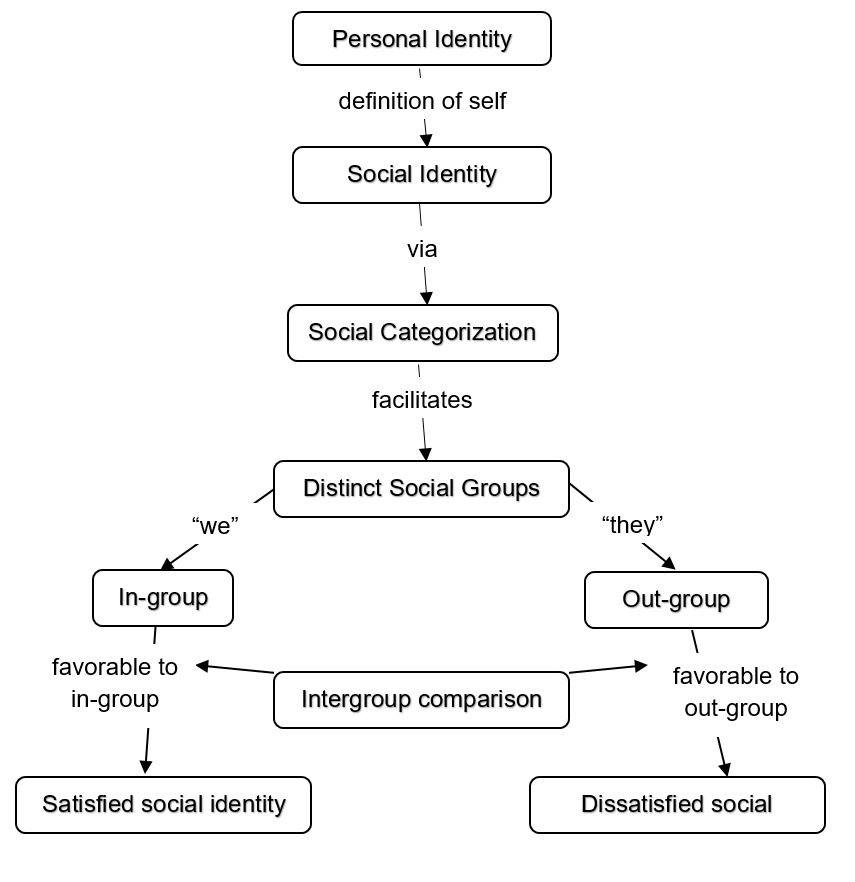
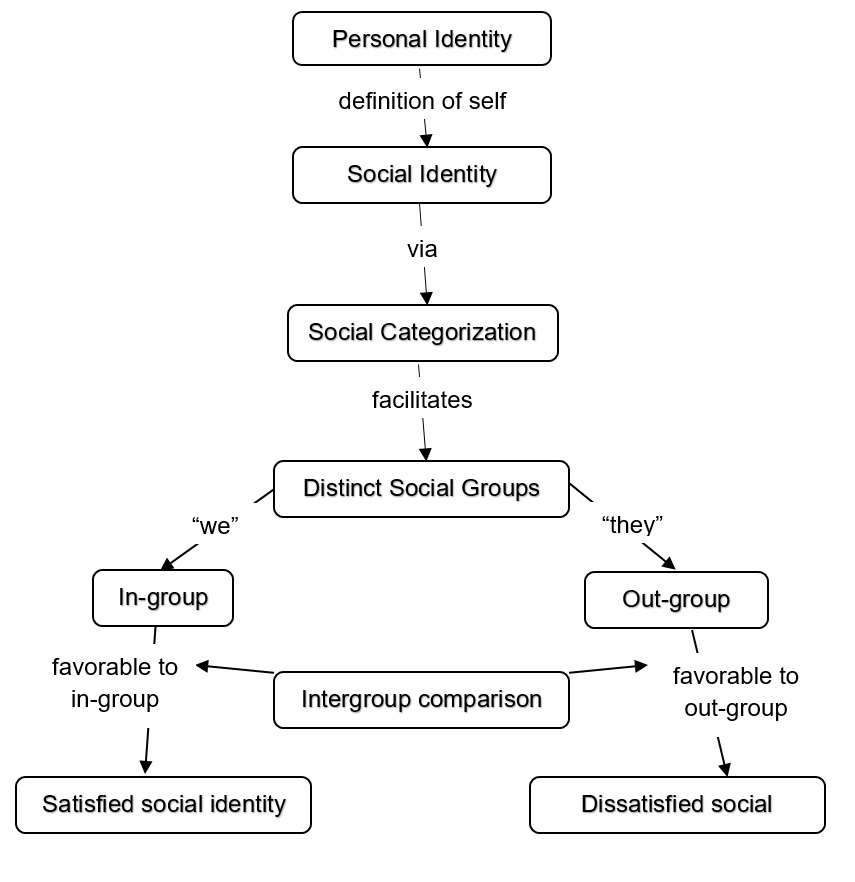
In Figure 1 (below), adapted from Tajfel and Turner’s 1979 work and replicated by Roman-Tamesis (2023), the SIT model is presented. This model illustrates how a personal identity contributes to an individual’s satisfaction or dissatisfaction with their social identity. Although this paper will not fully address satisfaction, this part of the model was included to illustrate the complete pathway. The paper will also not focus on personal identity.
According to the model, and using internal branding, if an organization begins to develop a culture of a “workplace family,” it is branding its workplace as such. To obtain a social identity, an individual must buy into the workplace culture and view it positively (Trepte, 2013). Workplaces can achieve this by hosting happy hours, organizing group volunteer days, or planning off-site team-building activities. Creating positive experiences allows an individual to begin identifying with the “family.”
Once this happens, a company needs to find ways to distinctly differentiate itself from other companies so employees can also recognize this difference. A basic example is that Target employees wear red shirts, while Walmart employees wear blue vests. Creating an ingroup versus an outgroup through physical identification markers allows employees to solidify themselves as part of the “workplace family further.” This can also occur in other ways, such as race, sex, or financial status (Trepte, 2013). Another example is the comparison between employees of Ramsey Solutions and those of Her First $100K. Allowing employees to see methodological differences and socially compare themselves to members of either group helps to solidify the internal brand further. These processes build (or tear down) an individual’s self-esteem, allowing them to feel either excited or dissatisfied with their social identity.
Theoretical Model and Propositions
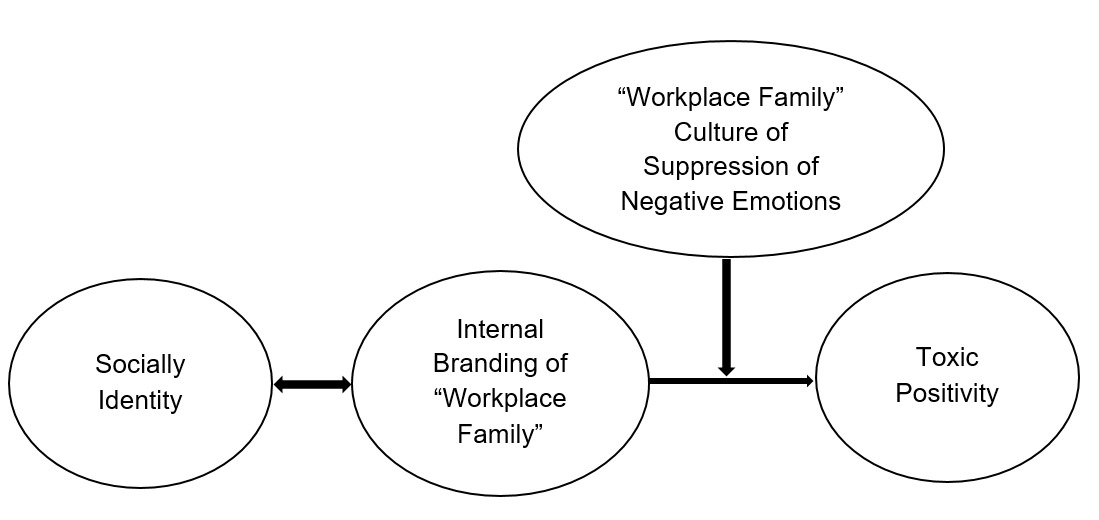
While many employers and employees alike may want to conform to their company culture of caring and respect as part of their “workplace family” image, this can create the potential to cross boundaries. An example would be oversharing in the workplace because colleagues feel close. Sharing life happenings outside of work can create a sense of closeness, as it crosses a boundary. Employees who are on the receiving end of this news may feel the potential need to react positively or in an upbeat manner. It is my hypothesis that this ultimately creates the potential to engage in TP behaviors and, over time, to create a workplace culture of TP because employees want to align with the organization. As mentioned, when someone engages in TP, the potential for isolation and increased burnout (Shipp & Hall, 2024) is very real. Examining the potential effects of internal branding as a workplace strategy to create a “workplace family” that leads to increased levels of toxic positivity could resemble the model shown in Figure 2 below.
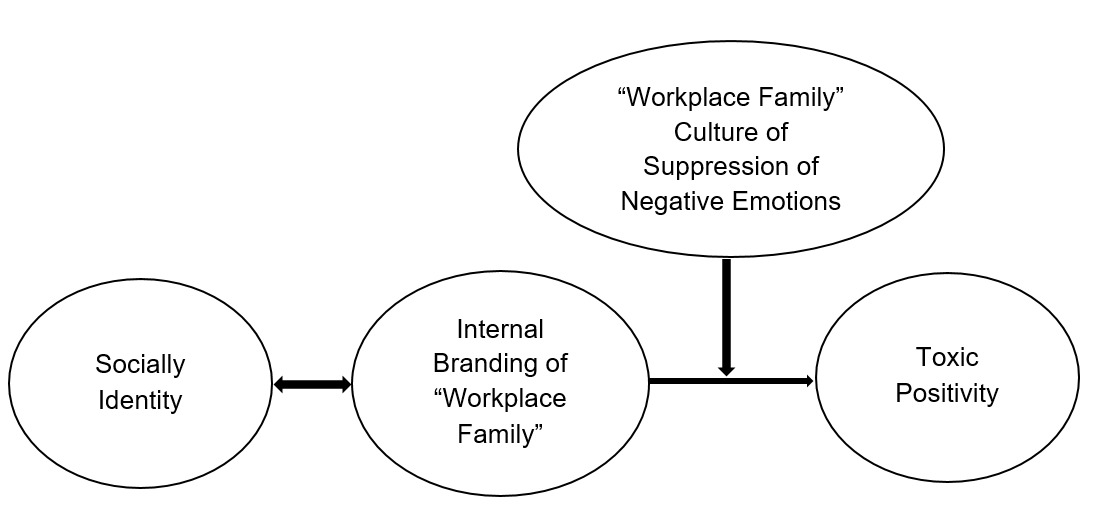
Proposition 1: If someone’s social identity levels with an organization are high, internal branding of a “workplace family” positively increases, and if the internal branding in a workplace as “family” is high, the social identity could also positively increase.
When someone strongly identifies with an organization, the potential for increased internal branding is high, and the reverse is also true. This creates a feedback loop.
Proposition 1: If internal branding is high, then toxic positivity increases.
When employees begin to identify socially with an organization, internal branding can play a significant role. The potential for toxic positivity to increase due to internal branding is high, as internal branding is used to increase employee commitment (King & Grace, 2007). Therefore, if employees want to seem committed to the brand, they may try to act more positively, which could be incongruent with their typical behavior or beliefs. This could increase TP levels in the workplace.
Proposition 2: “Workplace family” culture moderates the relationship between internal branding and toxic positivity, such that when internal branding is strong, toxic positivity is more likely to increase.
A “Workplace family” culture would moderate the relationship between internal branding and TP, as it emphasizes creating a sense of extreme belonging. This only exacerbates the strategy behind internal branding and therefore strengthens the relationship between internal branding and TP.
Discussion
This idea, although highly theoretical, highlights that using internal branding to create a “workplace family” culture can potentially create unintended negative issues within a workplace. Because many employees want to identify with their colleagues and spend a significant amount of time at work, the social identity they find within their organizational culture accompanies this strategy and has the potential to cause very detrimental side effects. Additionally, a “family identity and its values are at the centre of the decision that determines the reputation” of a company or business (Cuevas Lizama et al., 2021, p. 11). Because companies may want to align with a family identity so closely, this can have an impact on a company’s bottom line.
When “workplace families” are described, they are often viewed as a significant benefit for a company. It could potentially be a workplace that has its employees’ backs, so to speak. However, creating a “workplace family” as a strategy to build a strong employee foundation can be hazardous, as employees may feel they cannot speak honestly to colleagues in anything but a positive manner, since a “workplace family” culture is supposed to be a positive environment. Internally branding a company as a “workplace family” could be counterproductive, potentially creating an environment where TP thrives. Instead of having a team that works together, this could lead to ostracism if someone does not feel part of the “family” or to lower productivity. However, further research is needed to determine the most effective way to measure a “workplace family” culture.
As previously mentioned, workplace TP can create isolation (Shipp & Hall, 2024), decrease productivity and engagement (Kelly, 2023), and increase stress and anxiety (Rozen, 2023). Suppose a company creates an internal branding strategy. In that case, it is advisable to exercise caution to avoid creating a “workplace family” culture, as it is likely to lead to a toxic environment rather than the positive space desired. This research has the potential to impact future business strategies for internal branding by not only highlighting the negative ways a workplace culture can develop through potentially good and well-meaning ideas of creating social identities, but also by identifying more positive ways to create a workplace that is actually supportive and respectful.
Conclusion
“Workplace Families” have been researched, but there is still more to uncover. Internal branding through SIT has the potential to explore the downside of creating such a company culture within a business. Coupled with TP, internal branding could be very disastrous and cause financial impacts for small or medium enterprises that cannot afford the side effects. This research could identify successful methods and the best way to prevent the development of a “workplace family.”