In the United States, approximately half of new firms dissolve within five years, and less than one-third survive beyond a decade (U.S. Bureau of Labor Statistics, 2016). In contexts where early-stage fragility is the norm, brand trust becomes a central outcome that shapes small to medium enterprise (SME) survival and maturation over time (Oduro & Mensah-Williams, 2023). Because early-stage SMEs lack performance histories and institutional legitimacy, customers rarely evaluate them on product or service attributes alone (Keller, 1993; Mutsikiwa & Eniola, 2024). Instead, stakeholders decide whether a young firm is trustworthy based on symbolic and relational cues that stand in place of the missing market proof (Aaker, 1997; Ashforth & Mael, 1996; Fisher, 1984). Brand archetypes are culturally shared symbolic prototypes (e.g. Sage, Hero) that help stakeholders interpret the brand’s character, motives and promises (Mark & Pearson, 2001). We define Sage-led SMEs as firms whose dominant strategic identity and value proposition center on truth-seeking, expertise and guidance by asking customers to trust the firm’s knowledge as a core basis for value (Keller, 1993; Mark & Pearson, 2001; Merlo et al., 2023).
For founder-led SMEs, these cues are often assembled under resource constraints and across uneven touchpoints, increasing the risk that signals meant to build trust instead generate confusion (Oduro & Mensah-Williams, 2023; Wertime, 2002). This risk is particularly salient for Sage-led SMEs because their value proposition depends on being perceived as knowledgeable, competent, and trustworthy sources of insight (Keller, 1993; Mark & Pearson, 2001). In such firms, trust functions as a prerequisite for engagement, advice-following, and referral behavior, especially in early stages of the lifecycle where uncertainty and information asymmetry are highest (Celuch et al., 2007; Mutsikiwa & Eniola, 2024). Therefore, founder-led SMEs face a unique strategic problem: they must communicate why they should be trusted, while operating with limited brand slack, uneven coordination across touchpoints, and heavy reliance on the owner-manager as the primary brand representative (Oduro & Mensah-Williams, 2023; Wertime, 2002). Existing research on SME branding and trust offers limited guidance on how different symbolic cues interact to strengthen or weaken brand trust formation as founder-led firms mature across lifecycle stages (Keller, 1993; Merlo et al., 2023; Oduro & Mensah-Williams, 2023). We address this gap by developing a conceptual model that explains how multi-archetype interactions shape trust formation and changes in trust for Sage-led SMEs over their lifecycles.
Brand archetypes offer a compact symbolic language for communicating trust under conditions of limited information (Mark & Pearson, 2001). Archetypes function as culturally legible templates that allow audiences to infer a firm’s intentions, competence, and relational characteristics from limited cues (Mark & Pearson, 2001). Most archetype research treats archetypes as a stable identity position that offers limited insight into how archetypal cues interact when deployed simultaneously. In contrast, SME branding is often constructed through bricolage and iterative experimentation, making multi-archetype signaling common in practice (Merlo et al., 2023; Razeghi et al., 2016). This disconnect raises a core strategic question for founder-led SMEs: which archetypal interactions facilitate trust formation under early-stage constraints, and which interactions strengthen or weaken brand trust as firms grow and credibility expectations increase?
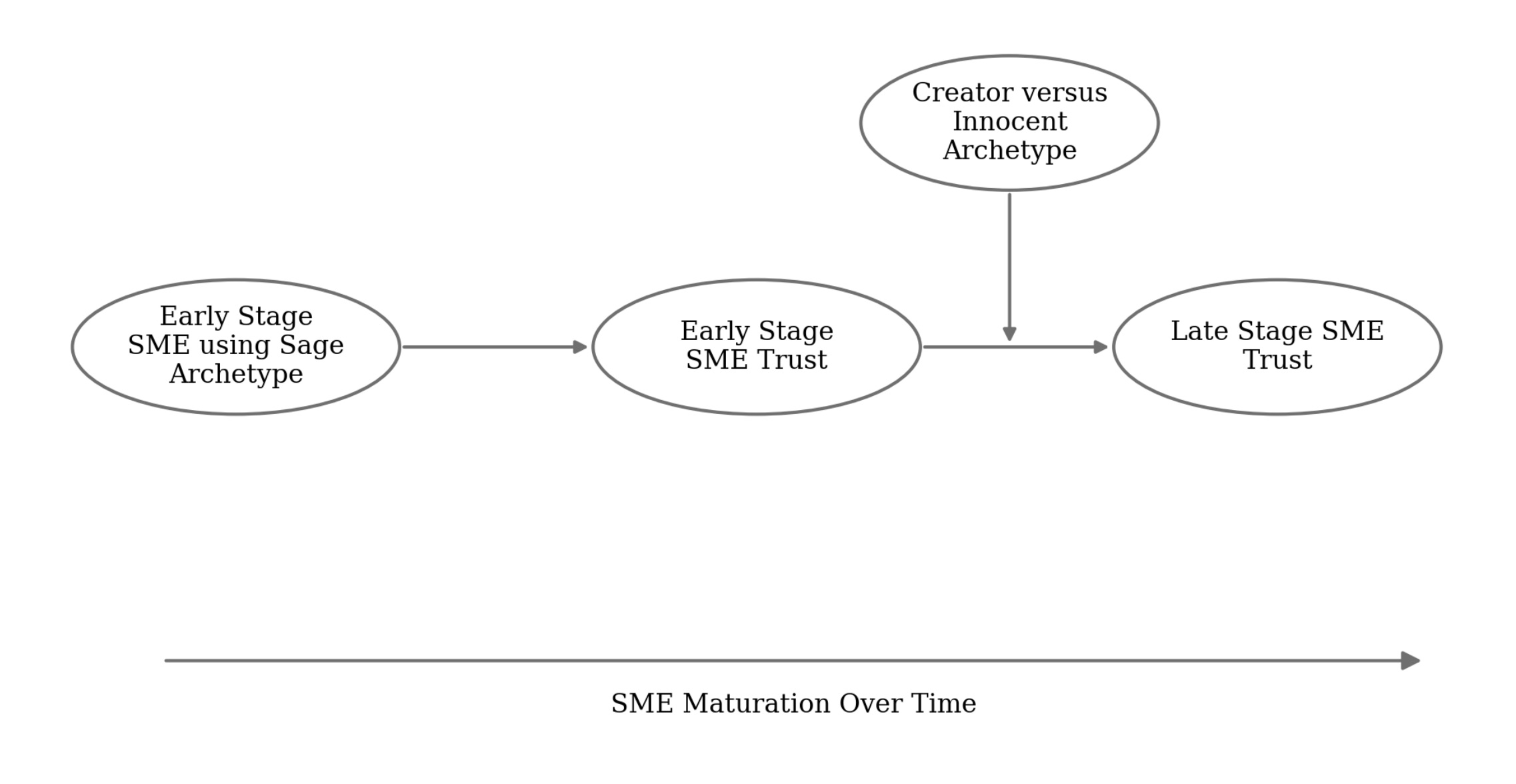
This paper develops a lifecycle-based conceptual model to address this question in the context of Sage-led SMEs. We define a Sage-led SME as a firm whose value proposition centers on expertise, truth-seeking, and guidance. The central issue is how Sage archetype signaling shapes trust formation in early-stage SMEs, and how the use of secondary archetypes increases or decreases trust over time. Specifically, we argue that early-stage SMEs using Sage-led archetypes will have a positive association with brand trust. Whether that leads to late-stage trust depends on which secondary archetype the SME employs. SMEs who use innocent archetypes will weaken their later-stage brand trust, while those using the creator archetype will strengthen their later-stage brand trust.
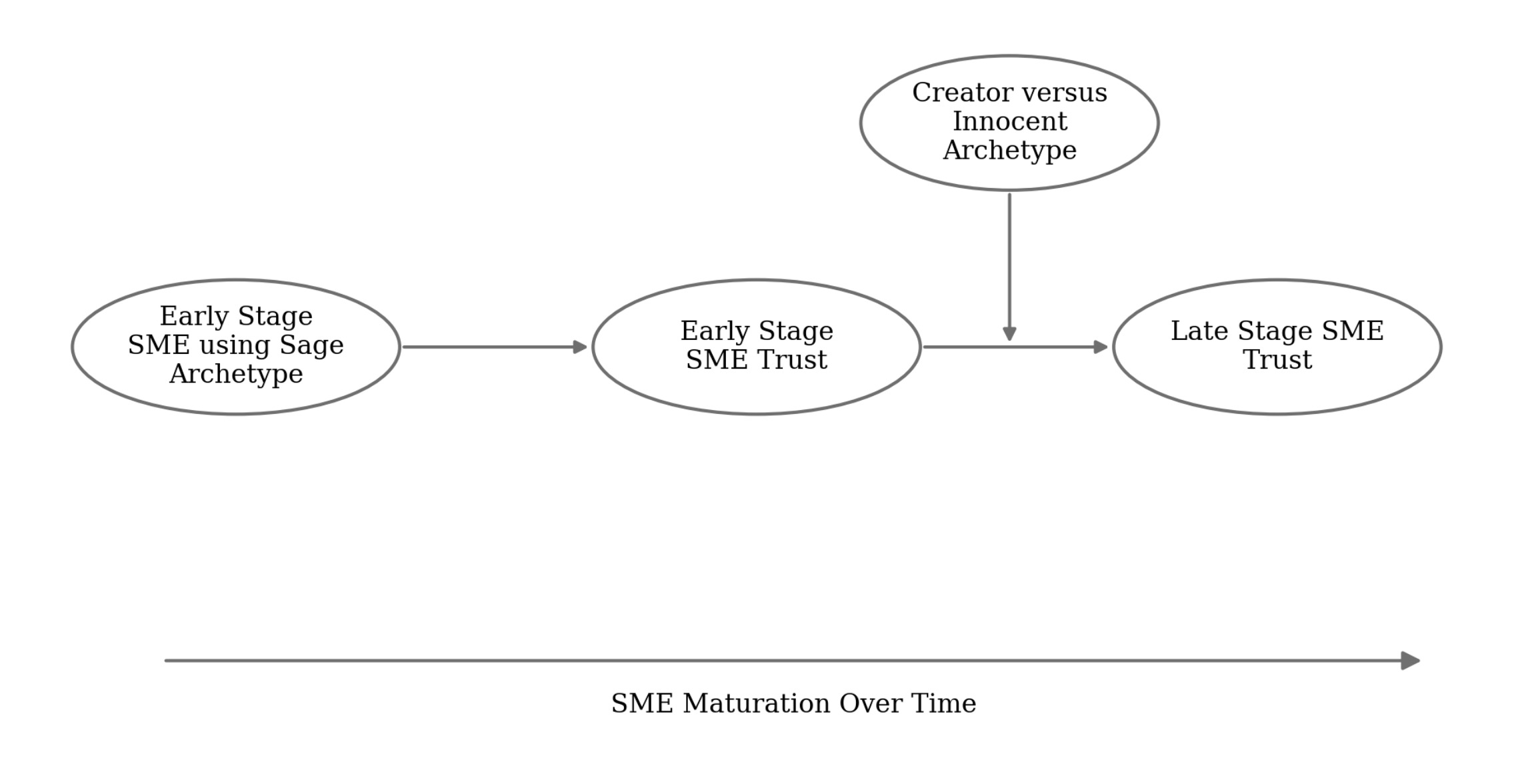
Figure 1 summarizes the proposed model of brand archetypes and SME trust development across the maturation stage, positioning schema congruity as the mechanism through which archetypal cue patterns shape trust formation and trust carryover (Huang & Tsai, 2013; Merchant, 2016; Merlo et al., 2023). Lifecycle stage is treated as the context in which brand trust is evaluated rather than as a direct moderator; in the model, moderation arises from secondary archetype use (Creator versus Innocent), which shapes whether early brand trust carries forward as SMEs mature.
This study offers three contributions to understanding trust formation in founder-led SMEs. First, we reconceptualize brand archetypes as adaptive rather than static, aligning archetype theory with how founder-led SMEs iteratively assemble and govern brand meaning across touchpoints (Hatch & Schultz, 2010; Mark & Pearson, 2001). Second, we develop a lifecycle-based trust pathway that explains how the basis of trust shifts as SMEs mature, demonstrating the impact of archetypal configurations at key growth transitions. Third, we translate the conceptual model into actionable guidance for owner-managers by offering a framework for identifying mixed archetypal signals and strategic principles for sequencing archetypal cues so that early trust converts into sustained trust over time.
Literature Review
Using brand archetype, trust, and SME-lifecycle literature, we establish the theoretical foundations for examining how archetypal interactions shape trust formation and trust carryover in Sage-led SMEs (e.g., Huang & Tsai, 2013; Keller, 1993; Merchant, 2016; Merlo et al., 2023).
Trust Formation in Founder-Led SMEs
Early-stage founder-led SMEs face a unique trust challenge: stakeholders must decide whether to engage before credible performance signals exist (Ashforth & Mael, 1996; Keller, 1993). Because institutional signals are underdeveloped at early stages in the firm lifecycle, credibility assessments are rarely grounded in observable outcomes (Huang & Tsai, 2013). Instead, stakeholders rely on symbolic and relational cues that stand in for missing market proof when evaluating whether a young firm is credible enough to try (Aaker, 1997; Ashforth & Mael, 1996; Fisher, 1984). These cues function as interpretive shortcuts that allow audiences to infer a firm’s intentions, competence, and relational stance under conditions of uncertainty (Levy, 1959; Zaltman, 2003).
For founder-led SMEs, these symbolic and relational cues are often assembled under conditions of resource constraint and across uneven touchpoints, increasing the likelihood that signals intended to build trust instead generate confusion (Oduro & Mensah-Williams, 2023; Wertime, 2002). Founder centrality further amplifies this risk, as early trust judgments are closely tied to perceptions of the owner-manager’s credibility, authenticity, and expertise rather than to formalized brand systems or institutional signals (Ashforth & Mael, 1996; Razeghi et al., 2016). As a result, trust in early-stage founder-led SMEs functions less as a reward for demonstrated performance and more as a prerequisite for engagement, advice-following, and referral behavior (Ganassali & Matysiewicz, 2021; Keller, 1993).
Early trust can enable market entry and initial growth; however, it is vulnerable to reinterpretation as firms expand and evaluation criteria shift (Huang & Tsai, 2013; Keller, 1993). Signals that facilitate early trust formation may fail to sustain brand trust as firms mature, particularly in knowledge-based contexts where expectations of expertise, coherence, and legitimacy intensify over time (Merchant, 2016; Merlo et al., 2023). As a result, trust functions at a strategic level that must be actively managed as founder-led SMEs mature across lifecycle stages (Oduro & Mensah-Williams, 2023).
Trust Across SME Lifecycle Stages
Over time, trust shifts in founder-led SMEs as firms move from early-stage market entry toward organizational stabilization and growth (Huang & Tsai, 2013; Oduro & Mensah-Williams, 2023). As SMEs mature, the way stakeholders evaluate credibility changes, altering which signals are interpreted as trustworthy and which introduce doubt (Keller, 1993; Merchant, 2016). The lifecycle stage becomes a contextual condition that shapes how trust is interpreted and sustained in founder-led firms (Oduro & Mensah-Williams, 2023).
As SMEs transition into later stages, trust becomes increasingly credibility-based, centering on confidence in the firm’s expertise, consistency, and legitimacy as a knowledge-producing or solution-providing entity (Huang & Tsai, 2013; Keller, 1993). Late-stage SMEs are characterized by market continuity and organizational stabilization, including repeated transactions, increased visibility, and reduced dependence on founder-centric signals (Huang & Tsai, 2013; Oduro & Mensah-Williams, 2023). Late-stage trust is reflected in perceived competence and intellectual authority, coherence across brand touchpoints, demonstrated track record and repeatability, and alignment between claimed expertise and observable outputs (Keller, 1993; Merlo et al., 2023). At this stage, trust functions primarily as credibility rather than interpersonal reassurance, making audiences more sensitive to symbolic inconsistency and mixed signals (Merchant, 2016; Merlo et al., 2023).
Firm maturation over time can be understood as a transition in trust development as the firm moves from early-stage to late-stage market positioning (Huang & Tsai, 2013; Oduro & Mensah-Williams, 2023). This maturation process is documented through decreasing reliance on founder-centric signals, increasing formalization of brand systems and knowledge artifacts, shifts in customer expectations from warmth to authority, and heightened sensitivity to symbolic inconsistency across touchpoints (Ashforth & Mael, 1996; Keller, 1993; Merlo et al., 2023). Within this framework, symbolic cues are interpreted in light of whether they reinforce or undermine brand trust as SMEs grow (Merchant, 2016; Merlo et al., 2023). Because trust expectations shift as firms mature, the strategic consequences of symbolic signals depend on when they are deployed across the SME lifecycle (Huang & Tsai, 2013; Merchant, 2016; Merlo et al., 2023).
Bricolage Signals
SME branding is often constructed through iterative experimentation, making multi-archetype signaling common (Merlo et al., 2023; Razeghi et al., 2016). In founder-led SMEs, branding work is frequently conducted alongside daily operations, with limited slack for formalized systems that standardize communication across touchpoints (Oduro & Mensah-Williams, 2023; Wertime, 2002). Because stakeholders interpret firms through symbolic meaning systems, founder-led SMEs need a compact vocabulary for signaling credibility that remains coherent even as touchpoints increase (Mark & Pearson, 2001; Merlo et al., 2023).
Brand Archetypes as Symbolic Shorthand
Archetypes function as culturally legible templates that allow audiences to infer a firm’s intentions, competence, and relational characteristics from limited cues (Mark & Pearson, 2001). Brand archetypes translate symbolic meaning into recognizable identity claims by integrating values, personality characteristics, and narrative associations into a coherent framework for market communication (Keller, 1993; Mark & Pearson, 2001; McCracken, 1989). Because consumer judgments often operate through subconscious meaning systems, archetypal cues can shape credibility assessments through narrative resonance and symbolic fit (Lindstrom, 2008; Zaltman, 2003).
Early archetype applications emphasized a dominant archetype that guides differentiation through consistent identity positioning (Mark & Pearson, 2001). Subsequent research has largely adopted this single-archetype logic, using archetypes as categorical identity markers to explain brand meaning, resonance, and personality effects (e.g., Aaker, 1997; Escalas & Bettman, 2005; Xara-Brasil et al., 2018). Within this stream, archetypes are typically treated as relatively stable identity positions that anchor brand narratives and support meaning transfer through consistency rather than interaction. As a result, the literature offers limited insight into how archetypal cues operate when combined, layered, or unevenly expressed across platforms.
Although not well-researched, multi-archetype signaling is now common across platforms and brand experiences, creating more complex narrative systems that can either enrich meaning or generate friction when cues conflict (Mark & Pearson, 2001; Merlo et al., 2023). Merlo et al. (2023) demonstrated that 72% of top global brands apply multiple archetypes simultaneously, suggesting that archetypal branding is frequently executed through combinations (Merlo et al., 2023).
Most archetype research treats archetypes as stable identity positions or as single-archetype strategies, offering limited insight into how archetypal cues interact when deployed simultaneously (Mark & Pearson, 2001; Merlo et al., 2023). This limitation is particularly consequential for SMEs, where bricolage-driven brand building makes mixed archetypal signals more likely and consistency harder to maintain across touchpoints (Merlo et al., 2023; Razeghi et al., 2016).
Proposition Development
Early-stage founder-led SMEs operate under conditions of pronounced uncertainty, where stakeholders must decide whether to engage in the absence of performance histories, reputational intermediaries, or institutional legitimacy (Huang & Tsai, 2013; Keller, 1993). In these contexts, brand trust functions less as an outcome of demonstrated performance and more as a prerequisite for initial engagement, advice-following, and referral behavior (Celuch et al., 2007; Oduro & Mensah-Williams, 2023). Because formal signals of quality and credibility are underdeveloped, stakeholders rely heavily on symbolic cues that allow them to infer whether a firm is competent and reliable (Aaker, 1997; Ashforth & Mael, 1996; Fisher, 1984).
The Sage archetype is particularly well-suited to supporting brand trust under these early-stage conditions. Sage archetype cues emphasize expertise, truth-seeking, and guidance, signaling that the firm possesses valuable knowledge (Mark & Pearson, 2001). In founder-led SMEs, where the owner-manager often functions as the primary brand representative, Sage signaling further reinforces perceptions of competence and authority by aligning the founder’s personal credibility with the firm’s value proposition (Ashforth & Mael, 1996; Razeghi et al., 2016). As a result, consistent Sage archetype use can substitute for missing institutional proof by offering culturally legible signals of expertise that reduce perceived risk and support early trust judgments.
Proposition 1: Early-stage SMEs using Sage archetypes have a positive association with brand trust.
Strong brands often rely on multiple brand archetypes simultaneously rather than a single archetype, particularly as brands expand across platforms and experiences (Merlo et al., 2023). While multi-archetype branding is increasingly common in practice, as measured in Merlo et al’s (2023) multi-archetype research, systematic theory explaining how different archetypal combinations shape trust outcomes, especially in SMEs, remains understudied. Prior work suggests that employing multiple archetypes can increase narrative richness and support differentiation under constraint (Merlo et al., 2023; Wertime, 2002), but it also raises the risk of mixed signals when archetypal cues are not strategically coordinated across touchpoints. This tension is particularly consequential for founder-led SMEs, where symbolic cues substitute for missing institutional proof and trust judgments are highly sensitive to perceived coherence. We extend this literature by theorizing how specific archetypal combinations interact with shifting trust expectations across SME lifecycle stages, identifying when multi-archetype use strengthens trust carryover and when it undermines credibility (Keller, 1993; Mark & Pearson, 2001; Merlo et al., 2023; Oduro & Mensah-Williams, 2023). When secondary archetype cues conflict with audience expectations for an expertise-driven brand, meaning transfer breaks down, producing schema incongruity that undermines brand trust (Keller, 1993; Merchant, 2016; Merlo et al., 2023).
SME Maturation, Multi-Archetype Use and Trust Outcomes
In this study, multi-archetype branding is theorized through a schema-congruity mechanism in which archetypal cues operate as observable symbolic indicators that activate audience expectations for what an expertise-driven brand should look, sound, and feel like (Levy, 1959; Mark & Pearson, 2001; Merchant, 2016). Because the basis of trust shifts with firm maturation, the meaning and evaluation of brand trust differ across lifecycle stages, shaping how archetypal cue patterns affect trust carryover over time (Huang & Tsai, 2013; Merlo et al., 2023). Building on these operationalized constructs, we develop propositions regarding Sage–Creator and Sage–Innocent interactions and trust carryover (Huang & Tsai, 2013; Merchant, 2016; Merlo et al., 2023).
Table 1 summarizes the symbolic indicators and core narratives associated with the Sage, Innocent, and Creator archetypes that we use to operationalize archetypal cues as observable signals in the subsequent model and propositions (Mark & Pearson, 2001; Merchant, 2016; Merlo et al., 2023). This mechanism is lifecycle-based because the basis of trust shifts from relational assurance in early-stage SMEs toward epistemic credibility in later-stage SMEs, increasing sensitivity to symbolic inconsistency over time (Celuch et al., 2007; Huang & Tsai, 2013; Merchant, 2016). Firm maturation is operationalized as a temporal progression from early-stage to late-stage trust evaluation, within which archetypal cue patterns influence whether early brand trust carries forward into later-stage brand trust (Huang & Tsai, 2013; Keller, 1993; Merlo et al., 2023).
Over time, trust shifts in founder-led SMEs as firms move from early-stage market entry toward organizational stabilization and growth (Huang & Tsai, 2013; Oduro & Mensah-Williams, 2023). Because evaluation standards change with maturation, credibility assessments become more sensitive to coherence, legitimacy, and consistency across touchpoints as SMEs grow (Keller, 1993; Merchant, 2016; Merlo et al., 2023). The same credibility signals can drive brand trust early but differentiation and legitimacy outcomes later as lifecycle stage changes what stakeholders treat as trustworthy evidence (Huang & Tsai, 2013; Keller, 1993; Oduro & Mensah-Williams, 2023). However, we argue that not all archetype combinations will be successful at enhancing late-stage SME trust.
Sage–Creator Archetype Interaction and Trust
Creator archetypes focus on vision, innovation, and bringing ideas to life. As a complement to the Sage, the Creator can transform abstract wisdom into tangible products such as white papers, systems, or designs that reinforce an intellectual foundation (Mark & Pearson, 2001). This pairing works because of motivational alignment, as both archetypes are rooted in independence and truth-seeking while expressing those motivations through different symbolic indicators and core narratives (Mark & Pearson, 2001; Maslow, 1954). From a cognitive perspective, consumers hold stable mental models of each archetype, which serve as interpretive shortcuts for brand meaning and credibility assessment (Lindstrom, 2008; Woodside, 2010; Zaltman, 2003). When the Sage and Creator are combined, their shared motivational drivers and complementary symbolic cues minimize schema incongruity, allowing meaning to transfer smoothly and reinforcing trust and engagement (Merchant, 2016; Merlo et al., 2023). In this configuration, the Sage seeks insight while the Creator gives that insight physical, visual, or experiential expression, which increases coherence between expertise claims and observable outputs (Keller, 1993; Mark & Pearson, 2001).
Brand examples such as Apple and Accenture have been documented as embodying Sage–Creator alignment, illustrating how innovation and design execution can amplify perceptions of knowledge, precision, and expertise (Merlo et al., 2023; Xara-Brasil et al., 2018). Research also suggests that when secondary characteristics are perceived as compatible, such as the insights of the Sage and the vision of the Creator, audiences experience stronger coherence and authenticity in brand meaning (Keller, 1993; Merchant, 2016). This compatibility works because the archetypes fit within consumers’ schemas, avoiding the mental model disruption that can trigger cognitive dissonance and weakening of credibility judgments (Mark & Pearson, 2001; Merchant, 2016). Working together, the Sage’s intellectual depth and the Creator’s inventive execution strengthen meaning transfer and enhance brand resonance by making expertise legible through designed outputs (Merchant, 2016; Merlo et al., 2023). The Creator, therefore, supports and amplifies the Sage by delivering its insights in credible, practical, and visible ways that function as substitute signals for missing performance histories in founder-led contexts (Keller, 1993; Merlo et al., 2023).
Proposition 2: The relationship between early-stage brand trust and later-stage brand trust is moderated by the use of Creator archetypes, such that the positive relationship is strengthened by higher use of Creator archetypes.
Sage–Innocent Archetype Interaction and Trust
The Innocent brand archetype emphasizes simplicity and optimism. When firms rely on Innocent cues, campaigns are commonly associated with youth, nostalgia, and emotional reassurance (Brown et al., 2003; Mark & Pearson, 2001; Merlo et al., 2023). These characteristics can support emotional connection and brand warmth, but they often pose challenges in markets where credibility and knowledge-based authority are central to evaluation (Keller, 1993; Mark & Pearson, 2001). When Innocent and Sage archetypes appear together without a clear narrative structure, Innocent indicators such as pastel palettes, moral clarity, and simplicity can dilute the Sage’s perceived intellectual authority by sending signals that counter tolerance for complexity and expert positioning (Mark & Pearson, 2001; Merchant, 2016). This contrast can undermine the consumer’s schema for what a knowledge-bearing brand should look, sound, or feel like, increasing interpretive friction in credibility judgments (Keller, 1993; Merchant, 2016).
In knowledge-based contexts, Innocent signals may unintentionally imply reduced complexity or immature authority, which can create confusion or diminished trust when paired with Sage claims (Maslow, 1954; Merchant, 2016; Merlo et al., 2023). Although Sage brands may use multiple archetypes to offer authenticity across channels, not all secondary archetypal cues are symbolically compatible with Sage authority in the same way (Mark & Pearson, 2001; Merlo et al., 2023). It is therefore argued that the Innocent’s primary signals of simplicity, purity, and optimism weaken the Sage’s value of mature insight because they defy the mental model associated with expertise-driven positioning, increasing schema incongruity (Mark & Pearson, 2001; Merchant, 2016). Under founder-led SME conditions where audiences already face uncertainty and limited institutional proof, this incongruity is expected to undermine trust formation rather than strengthen it (Merchant, 2016; Oduro & Mensah-Williams, 2023).
Boundary Conditions and Counter Examples
Innocent-coded signals do not uniformly weaken Sage-led positioning. In contexts where reassurance, psychological safety, or approachability is the primary decision criterion, Innocent cues may support engagement. However, when expertise and competence are the purchase criterion, particularly under high-stakes or high-knowledge decisions, stand-alone Innocent cues can conflict with the expected schema of an authority-bearing brand, increasing incongruity and lowering perceived credibility. Practically, Innocent cues should not be eliminated, but used selectively and supported by clear Sage authority and structured Creator signals when credibility matters most. We therefore expect this weakening effect primarily in credibility-dependent contexts; when reassurance is central, Innocent cues may strengthen engagement rather than undermine trust.
Proposition 3: The relationship between early-stage brand trust and later-stage brand trust is moderated by the use of Innocent archetypes, such that the positive relationship is weakened by higher use of Innocent archetypes.
Discussion
To offer managers guidance based on the conceptual model, we summarize the trust implications of the reviewed archetypal patterns in Table 2. Drawing on symbolic branding theory, schema congruity, and SME lifecycle research, the table maps archetypal configurations to their proposed effects on brand trust as firms mature, which explains how brand trust is evaluated as SMEs mature over time. (Huang & Tsai, 2013; Keller, 1993; Mark & Pearson, 2001; Merchant, 2016; Merlo et al., 2023). The table serves as a diagnostic framework to support owner-managers in evaluating archetypal signal strategy as their firm matures over time based on the need for brand trust.
The table demonstrates that archetypal combinations shape symbolic meaning and are dependent on when and how they are deployed across the SME lifecycle. Archetypal configurations that make expertise tangible can facilitate trust carryover across firm maturation periods. The table provides a framework for diagnosing why some multi-archetype combinations strengthen brand trust, while others introduce schema incongruity that undermines brand trust in founder-led SMEs (Keller, 1993; Merchant, 2016; Merlo et al., 2023).
Sector Illustrations: Applied Implications During Lifecycle Transitions and Repositioning
To illustrate the diagnostic logic in Table 2, below, three stylized examples show how archetypal configurations can either support trust carryover as SMEs mature or introduce schema incongruity as credibility expectations intensify. These examples are not intended as empirical cases; they demonstrate how the model can be used to ascertain secondary archetype compatibility across common SME growth conditions.
Illustration 1: Boutique Consulting and The Approachability Overcorrection (Sage + Innocent Tension)
Consider a small strategy consultancy whose expertise is credible but difficult to verify before purchase. The firm’s long-form content communicates Sage cues (expert voice, evidence, tolerance for complexity), while its visual identity and social media lean heavily on the Innocent archetype (pastels, playful tone, “good vibes” messaging, simplified claims). In early interactions, these cues may increase warmth and lower perceived interpersonal risk. However, as engagements become higher-stakes, decision makers increasingly rely on coherence and authority as credibility signals. Under these later-stage evaluative conditions, Innocent-coded cues can dilute perceived seriousness and weaken trust carryover by introducing interpretive friction between expert claims and youthful presentation.
As the managerial diagnostic (Table 2) indicates, SMEs in this scenario should audit the highest-leverage touchpoints (homepage, proposal deck, LinkedIn), keep warmth cues, but anchor them beneath explicit Sage evidence (credentials, methods, data), and add Creator artifacts that make expertise visible (e.g., diagnostic tools, frameworks, sample deliverables).
Illustration 2: Design/technology Studio and Making Expertise Legible (Sage–Creator Alignment)
Consider a small UX/design studio positioning itself as research-driven and evidence-based. Rather than relying on abstract claims (“we are experts”), the firm materializes knowledge through Creator-coded artifacts: a published toolkit, a repeatable research-to-prototype process map, case studies structured as learning systems, and simple diagnostic assessments used in sales conversations. As the firm grows, these tangible outputs reduce ambiguity by aligning knowledge claims with observable proof. This illustrates Proposition 2: Creator cues translate Sage expertise into credible artifacts that strengthen trust carryover across expanding touchpoints. As the managerial diagnostic (Table 2) indicates, SMEs in similar situations should ask whether stakeholders can see how the firm’s knowledge produces value. If not, formalize and standardize Creator artifacts that travel across channels and remain coherent as the firm scales.
Illustration 3: Industrial services SME Shifting Into Sustainability Consulting (Sage–Innocent Tension, Creator Correction)
Consider a long-established industrial services SME with over a century of operating history, transitioning from founder-led origins through family stewardship to external professional leadership. Historically, the firm built trust through Sage-coded authority, deep operational expertise, regulatory knowledge, and experience-based credibility. As it repositioned toward sustainability-oriented consulting, its branding shifted sharply toward Innocent-coded cues emphasizing youthfulness, approachability, and optimism (playful geometric visuals, upbeat tone, broad aspirational language). While this shift can support engagement during market expansion, it can also conflict with stakeholder expectations for authority in expertise-driven consulting decisions, especially as the firm attempts to convert historical credibility into a modern advisory identity.
This illustration clarifies a central implication of Proposition 3: Innocent cues may help early approachability but can weaken later-stage credibility if they displace or obscure expertise signals. The corrective move is a Creator-led translation of accumulated expertise into innovations and repeatable consulting outputs (proprietary methods, tools, and demonstrable sustainability solutions). Creator artifacts allow modernization without forfeiting the credibility foundation built over the firm’s lifecycle. As the managerial diagnostic (Table 2) indicates, SMEs in similar situations should re-center explicit Sage authority, then make what they create visible, methods, tools, assessment instruments, and evidence of outcomes, so the repositioning is anchored in demonstrable competence rather than tone alone.
Across the three illustrations, the framework indicates that the core strategic task for Sage-led SMEs is sequencing and structuring cues so early engagement converts into later-stage credibility. When credibility standards intensify, trust carryover is most likely when Sage signals are stabilized by Creator artifacts, and most vulnerable when Innocent cues dominate without a clear authority anchor.
Conclusion
Archetype-based brand stories can improve the perceived quality and emotional value of brands among consumers (Ganassali & Matysiewicz, 2021). Through symbolic meaning, a brand’s archetype embodies specific feelings (e.g., bravery for ‘hero’, adventure for ‘explorer’, love for ‘lover’, generosity for ‘caregiver’) (Ganassali & Matysiewicz, 2021). Brand archetype interaction can apply across firm sizes to include SMEs. By tracing how the Innocent’s signals of youth can weaken knowledge-domain clarity, while the Creator’s goal to give form to insight strengthens perceived expertise, the model offers multi-archetype interaction to inform how a brand can move away from traditional single archetype marketing to replace it with a living narrative ecosystem. The model gives researchers and practitioners a method for multi-channel marketing without sacrificing symbolic value. It offers practical guidance for adjusting tone, design, and touchpoint behavior so that every encounter deepens a brand’s emotional connection with customers. Future empirical work could assess archetype interaction effects through attribute-importance methodologies that quantify how consumers prioritize symbolic cues and meaning coherence, enabling measurement of perceived fit and dissonance across archetypal signals (Garver et al., 2010; Merlo et al., 2023).