
Introduction
In recent years, disruptive events such as economic downturns, trade conflicts, the COVID-19 pandemic, and geopolitical tensions have created an increasingly complex, volatile, and uncertain global market environment (Lim & Mandrinos, 2023). These events often result in waves of de-internationalization, i.e., withdrawal from foreign markets (Jafari-Sadeghi et al., 2023) and reflect the fragility of SME international foothold in the face of external shocks (Doan et al., 2024; Henryanto et al., 2025). For instance, during the 2008 financial crisis, around 1.8 million SMEs closed in the U.S. alone (SBA, 2021), global exports contracted by over 10% (OECD, 2020), and many firms exited foreign markets (Apedo-Amah et al., 2020). Similarly, the 2011 Eurozone debt crisis resulted in the loss of over a quarter of SMEs in countries like Greece and prompted further de-internationalization (IMF, 2011; OECD, 2015). More recently, the COVID-19 pandemic forced over 25% of small businesses worldwide to temporarily shut down (Bartik et al., 2020; Kirti et al., 2022), accompanied by a widespread retreat from international operations.
Despite harsh statistics, some international SMEs demonstrated remarkable resilience in crises, stabilizing operations, preserving their foreign market presence, and even innovating under adverse conditions (Greene et al., 2020; Mulyadi & Hendrayati, 2021). This contrast raised academic questions about the conditions that allow some internationalized SMEs to endure and adapt while others fail (Eriksson et al., 2022). In this vein, recent studies have examined whether certain factors driving SMEs’ initial market expansion also enhance their resilience. For instance, Bai et al. (2021) found that social networking, a key factor in SME internationalization (Chetty & Stangl, 2010; Peljhan et al., 2014), mediates successful SME strategies to increase performance in foreign markets, while knowledge sharing, another critical internationalization driver (Zhou et al., 2007), reduces the risk of losses associated with international operations. Supply Chain (SC) management is also a key facilitator of SME internationalization (Elsharnouby et al., 2024; Giovannetti et al., 2015). Studies indicate firm-level SC practices, such as risk management and operational control, enhance organizational resilience and mitigate the impacts of disruptions during crises (El Baz & Ruel, 2021). In the same token, the International Business (IB) literature consistently emphasizes the role of digitalization and ICT adoption as fundamental drivers for SME internationalization (Aspelund & Moen, 2004; Gaweł & Pietrzykowski, 2023; Leonidou et al., 2007). These capabilities were also found to be key enablers of firm resilience (Abidi et al., 2023; Eriksson et al., 2022; Sharma et al., 2024).
Although these studies support the relationship between internationalization drivers and organizational resilience in an international context, they use linear, variance-based methods that examine only the independent effects of these drivers on SME resilience, overlooking their combinational power. This is particularly problematic because the prevailing resilience frameworks may not capture the phenomenon in its totality: they typically operationalize resilience with narrow, static proxies (e.g., short-term performance or time-to-recovery), overlooking its multi-phase (prepare–absorb–adapt–renew), multi-level (individual–organizational–network), and path-dependent nature. As a consequence, they risk mis-specifying the construct, masking feedback loops, thresholds, and trade-offs that jointly shape SME resilience in foreign markets.
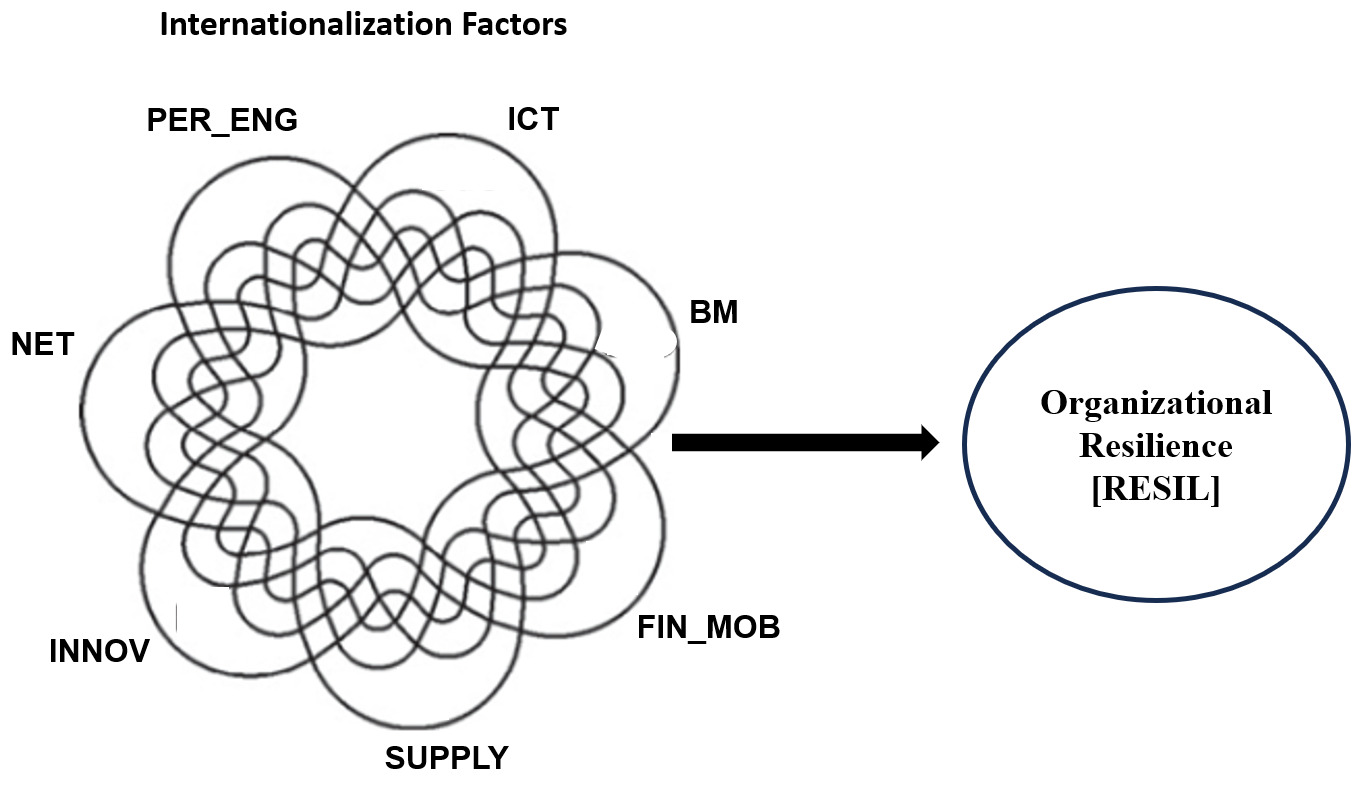
This study aims to fill this gap by examining how the combination of different internationalization factors leads to resilient firms in foreign markets. We demonstrate that although individual internationalization factors may not, in isolation, lead to resilience, their combination can. We draw on survey data from 46 Brazilian SMEs engaged in international operations that have endured recent economic shocks, including the COVID-19 pandemic. We apply Qualitative Comparative Analysis (QCA), a set-theoretic data analysis method used to explore how configurations of conditions relate to an outcome (Ragin, 1987) by identifying which conditions are necessary, sufficient, or both. Our model includes seven internationalization factors as causal conditions: (1) digitalization/ICT adoption (Information and Communication Technologies), (2) financial mobility, (3) networks, (4) supply chain redundancies, (5) managerial soft skills, (6) business model adaptability, and (7) innovation capacity.
Our findings reveal that while certain internationalization factors are necessary for achieving resilience in foreign markets, they are not sufficient on their own. In other words, resilience emerges from bundles of interdependent internationalization factors and contextual conditions rather than any single driver, which operate as viable “recipes” that enable SMEs to sustain long-term performance in foreign markets.
Our contribution redirects the focus from single-factor explanations to the configurational interplay of drivers that underpins SMEs’ international resilience. This is particularly relevant because it helps align resilience research with complexity and dynamic-capabilities theory, yielding mechanisms closer to how international resilience actually emerges. Moreover, it paves the way to contingent, context-sensitive prescriptions for SMEs rather than one-size-fits-all claims that may be replicated and extended across industries, regions, and phases of internationalization.
Theoretical Framework
The internationalization of SMEs is influenced by factors that shape their strategic decisions, commitment levels, and ultimate success in foreign markets (Hollensen, 2008; Leonidou et al., 2007). Foundational studies have referred to these factors using various terminologies, including stimuli (Acedo & Galán, 2011), antecedents (García-Cabrera et al., 2017; Heiß, 2017), and drivers (Demeke & Chiloane-Tsoka, 2015). They reflect internal capabilities and external conditions that collectively shape a firm’s internationalization trajectory (Falk et al., 2014). The interplay between those drivers suggests that SME internationalization is not a linear process but a multifaceted and dynamic phenomenon (Jones et al., 2011). While some firms follow a gradual expansion path based on knowledge accumulation (Johanson & Vahlne, 1977, 2009), others experience a rapid and early internationalization, by leveraging knowledge-based and innovative capabilities (Autio et al., 2000; Knight & Cavusgil, 2004), entrepreneurial orientation (Cavusgil & Knight, 2015), digitalization (Hervé et al., 2020), and international networks (Cavusgil & Knight, 2015; Lakshman et al., 2025; McDougall et al., 1994). These factors operate interdependently: networks can facilitate knowledge acquisition (Masango & Marinova, 2014; Peljhan et al., 2014), entrepreneurial orientation can drive proactive market success (Sarman et al., 2025), and digitalization can lower operational barriers (Autio & Zander, 2016; Gaweł & Pietrzykowski, 2023).
Despite these factors encouraging and facilitating a firm’s initial contact with international markets, they are not always sufficient to secure a stable foothold abroad. Internationalized firms are required to develop resilience to overcome the challenges that come with their international presence, allowing them to convert exposure into durable advantage (Eriksson et al., 2022).
Resilience is the ability of an organization to positively adapt to challenging circumstances (Duchek, 2020). The concept comes from the physical sciences, where it represents the ability of a system to return to its initial state after a disturbance (Barasa et al., 2018). It has been adapted to study organizations, receiving multiple definitions: a capability, an attribute, a process, a behavior, or a strategy (Hillmann & Guenther, 2021). Due to this multiplicity, the concept is sometimes criticized for lack of clarity (Hillmann & Guenther, 2021), but several literature reviews have contributed to its development (e.g., Bhamra et al., 2011; Conz & Magnani, 2020; Hillmann & Guenther, 2021). Resilience can be a proactive attribute, being able to anticipate and prepare to face a negative event, an adaptive one, to quickly sense and react to it, or a reactive one, to be able to recover swiftly after a shock (Conz & Magnani, 2020). Thus, organizational resilience is the ability to anticipate, cope with, and recover from disruptive events, returning to either the initial state or a superior, improved one (Coutu, 2002). When viewed as a dynamic attribute, it can vary over time, depending on the organization’s context, its objectives, leadership style, and employees’ ability to adapt to change, and it is not merely a reactive attribute but a capability that firms actively develop through strategic choices (Korber & McNaughton, 2018). Within the internationalization concept, resilience is shaped by a diverse set of factors, including diversification strategies (Acquaah et al., 2011; Sawalha, 2015), innovation capabilities (Alberti et al., 2018), and resource optimization (Seville et al., 2015). Moreover, resilience is deeply embedded in a firm’s structure and operations. Shrader & McConnell (2002) argue that resilience emerges from the interplay of network membership, leadership behavior, and the firm’s core competencies. Gunasekaran et al. (2011) further elaborate on this by conceptualizing resilience as a function of supply chain integration, managerial adaptability, and financial sustainability. Similarly, Pal et al. (2014) emphasize the role of resourcefulness, relational networks, and strategic flexibility in enabling firms to respond effectively to crises. These perspectives suggest that certain factors that serve as SME internationalization drivers also enhance the firm´s resilience.
While research momentum is evident, the conceptualization of organizational resilience is still in its infancy (Duchek, 2020). The literature has not yet fully uncovered how different combinations of internationalization factors influence resilience (Eriksson et al., 2022). Furthermore, configurational approaches, which replace overly reductionist linear models, remain underutilized (Fainshmidt et al., 2020).
Methodological Approach
Research Design
We employed the Qualitative Comparative Analysis (QCA) technique to explore the complex configurations of a preselected set of internationalization factors (conditions) that lead to firm resilience in international markets (outcome). Unlike traditional correlational methods, which estimate the average effect of independent variables in explaining the maximum variance in the dependent variable (Leischnig et al., 2016), the primary aim of QCA is to uncover combinations of conditions that are sufficient for achieving a specific outcome (Fiss et al., 2013). QCA assesses a case’s membership in specific attribute sets or combinations of these attributes and their alignment with the outcome set (Ragin, 2008). This allows the identification of conjunctural causation, where multiple factors combine to create an outcome, and equifinality, where different configurations can lead to the same result (Rubinson, 2019). Among the different variants of QCA, we adopted the crisp-set mode (csQCA), which relies on binary logic, which is particularly useful in identifying necessary and sufficient configurations of dichotomous conditions (Schneider & Wagemann, 2012). We chose for csQCA because our study involves a small number of cases (n=46) and a dichotomous measure of resilience (achieved vs. not), making a crisp-set, Boolean approach more appropriate and interpretable than other QCA calibration modes.
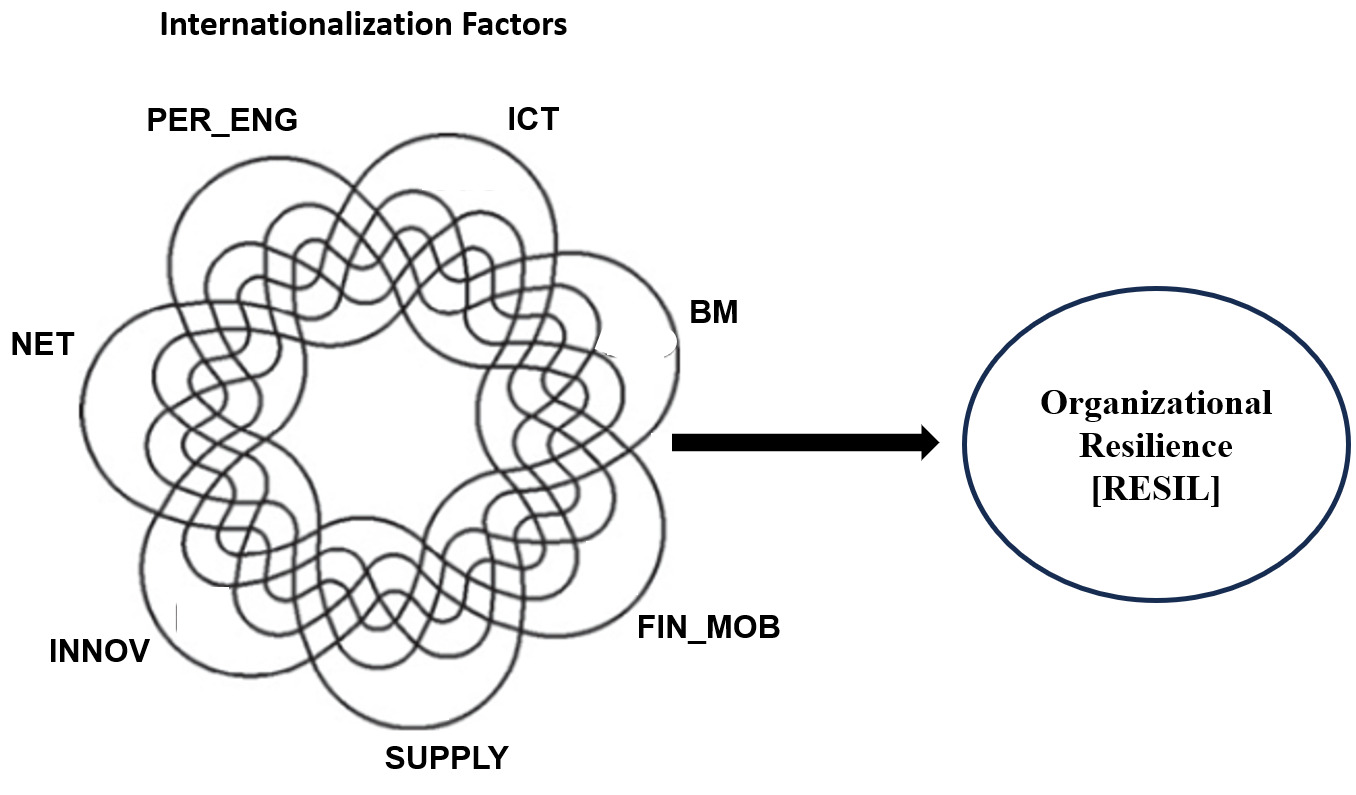
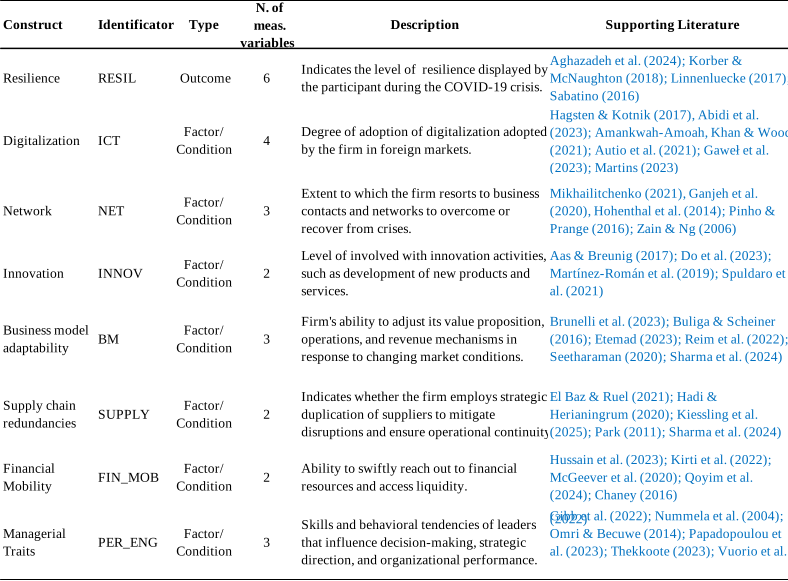
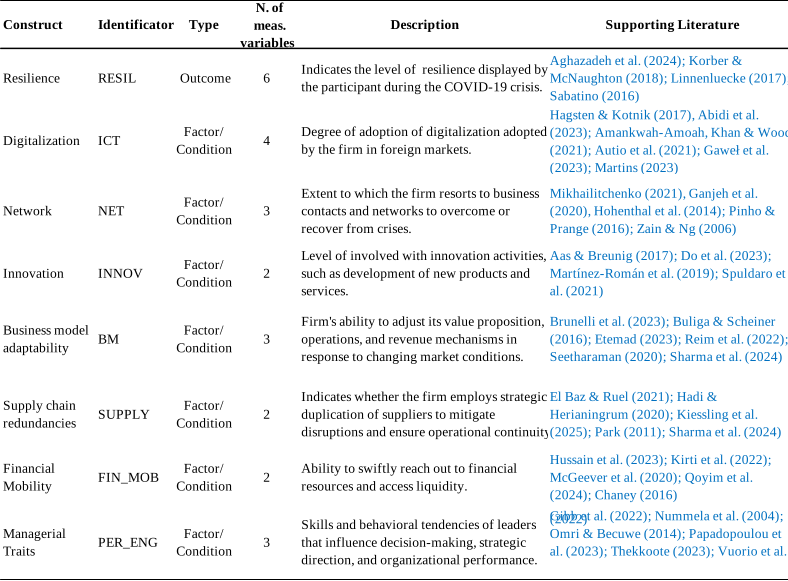
In our research model, the dichotomous conditions are represented by seven internationalization factors from the International Entrepreneurship (IE) literature: [1] adoption of digitalization (ICT) - ICT adoption and digitalization are treated as synonymous terms; [2] financial mobility (FIN_MOB); [3] business connections and networking (NET); [4] supply chain redundancies (SUPPLY); [5] managerial soft skills (PER_ENG); [6] business model adaptability (BM); and [7] innovation (INNOV). The outcome of those factors is Resilience (RESIL). Table 01 provides an overview of the constructs and the supporting literature.
Data Collection
Data collection occurred between March and July 2024, through an online survey distributed to 156 Brazilian national SMEs operating in foreign markets. Participating firms belong to the automotive, chemical, and agro-industrial sectors, which display high internationalization rates in the Brazilian economy. The survey comprised four sections: (1) Firm profile and industry background; (2) Overview of the firm’s international operations; (3) Identification of key internationalization drivers; and (4) Evaluation of the firm’s resilience during the COVID-19 crisis. A five-point Likert scale was adopted to measure the statements in the measurement items, ranging from 1 (strongly disagree) to 5 (strongly agree). Participation was restricted to firms that met SME criteria and had been engaged in international operations for at least five years. A total of 46 responses were received, yielding a response rate of 29.49%. The questionnaire was designed to capture key elements of the firms’ resilience during the COVID-19 crisis. Respondents were key decision-makers or managers, ensuring the data reflected the firm’s strategic level.
Data Analysis
We followed a structured seven-step procedure to conduct crisp-set Qualitative Comparative Analysis (csQCA), integrating empirical calibration with theoretical grounding. First, we developed a PLS-SEM model in SmartPLS 4.1.1.1 (Ringle et al., 2024) to estimate outer loadings, which were then used to compute weighted averages from the original 5-point Likert scale indicators. These composite scores were subsequently calibrated into binary values: scores from 1.00 to 3.00 were coded as 0 (absence), and scores from 4.00 to 5.00 as 1 (presence), in line with csQCA thresholding principles (Ragin, 2008). Then, we assessed the necessity and sufficiency of each condition using the QCA package in R (Dușa, 2023). Conditions reaching a consistency score inclN ≥ 0.90 classified as necessary, while conditions with consistency scores 0.80 ≤ inclS < 1.00 were considered as sufficient for the outcome (Schneider & Wagemann, 2010). The relevance of necessity (RoN) score was also considered to distinguish substantive necessity from trivial associations (Ragin, 2006).
Based on these findings and the theoretical relevance of each internationalization factor, we selected a subset of conditions to construct a truth table, applying a minimum consistency threshold of 0.80 to identify empirically sufficient configurations for the outcome (RESIL). Logical minimization was then performed to reduce complex configurations into simplified causal pathways. We assessed three solution types: complex, parsimonious, and intermediate solutions. We selected the intermediate solution because it balances empirical evidence and theoretical plausibility.
The resulting configurations were interpreted in terms of core and peripheral conditions, with attention to equifinality and context-dependent causal structures. To account for causal asymmetry, we replicated the analysis for the negated outcome (~RESIL), enabling us to evaluate whether different configurations explain the absence of resilience than its presence. Finally, we conducted a robustness check by varying consistency thresholds to test the sensitivity and stability of the results.
Results
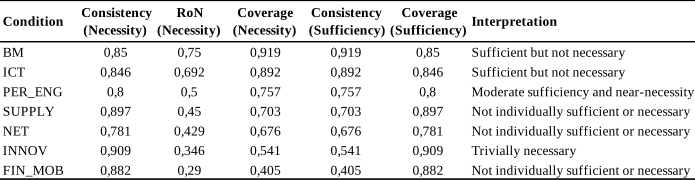
Our analysis on the necessity and sufficiency of the individual internationalization factors showed that business model adaptation (BM) and digitalization (ICT) exhibit high consistency scores for sufficiency (0.919 and 0.892), indicating that these factors, when present, frequently lead to organizational resilience among the respondents. While this confirms previous studies (Amankwah-Amoah et al., 2021; Krenn & Chiarvesio, 2024), their necessity scores remained below the 0.90 threshold, suggesting that although these capabilities often support resilience, they are not required in all resilient firms. The condition PER_ENG showed moderate consistency for necessity (0.800) and sufficiency (0.757), suggesting it may function as a context-dependent contributor, i.e., important in some configurations but not decisive alone. Other conditions, such as SUPPLY, NET, and FIN_MOB, were neither necessary nor sufficient when considered individually, pointing to a likely role as peripheral or complementary factors within broader causal combinations. Interestingly, INNOV met the consistency threshold for necessity (0.909) but displayed a very low relevance of necessity (RoN = 0.346), indicating that while innovation is often present in resilient SMEs, it may be a trivially necessary condition that lacks distinct explanatory power when isolated. Table 02 indicates the scores for the individual conditions.
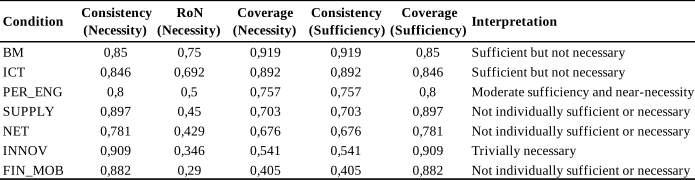
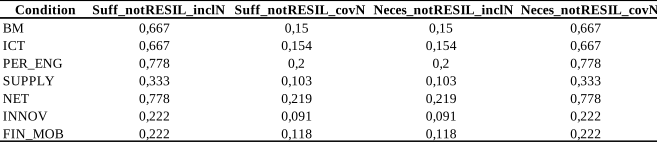
Next, we conducted a similar analysis of sufficiency and necessity of individual conditions for the negated outcome (~RESIL). The results revealed that no single condition is sufficient or necessary to consistently explain the absence of resilience. Sufficiency tests showed low consistency (incl ≤ 0.778) and minimal coverage across all conditions, indicating that no single factor reliably predicts non-resilience. Likewise, necessity tests for ~RESIL returned low consistency scores (incl ≤ 0.219), meaning that none of the conditions were systematically present in all non-resilient cases. Table 03 summarizes the scores for the negated outcome (~RESIL).
.svg)
Even conditions frequently present in failure cases, such as PER_ENG and NET, did not reach thresholds typically used to claim necessity. Our results confirm that organizational withdrawal during crises (i.e., absence of resilience) cannot be traced back to any one condition acting consistently across all failure cases. Thus, failure emerges through a combination of multiple preexisting vulnerabilities (Bosio et al., 2020), where firms may fall short in different areas. From the QCA theoretical perspective, these findings support that the absence of resilience is characterized by multiple causal paths, aligning with the principle of causal asymmetry – the notion that the conditions producing an outcome may differ from those associated with its absence (Fainshmidt et al., 2020).
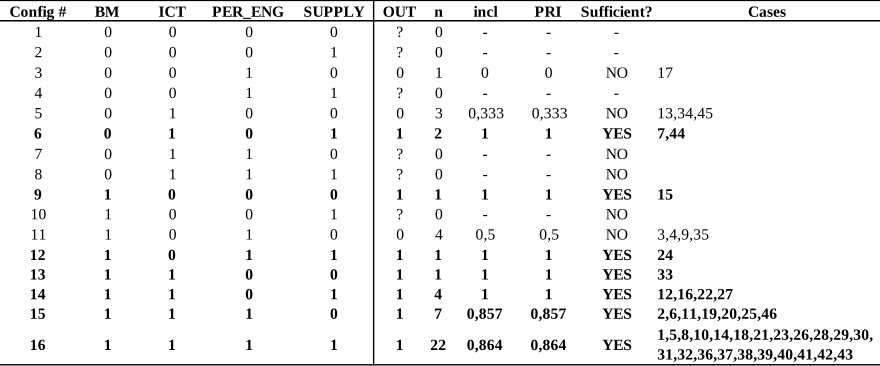
The selection of conditions for inclusion in the truth table followed empirical criteria and theoretical justification in line with best practices in QCA (Schneider & Wagemann, 2010, 2012). Thus, we selected conditions that exhibited: i. high consistency for sufficiency (≥ 0.80); ii. non-trivial levels of necessity (RoN ≥ 0.60); or iii. moderate consistency in both directions when supported by strong theoretical relevance. As a result, only the following conditions were eligible: BM, ICT, PER_ENG, and SUPPLY. The remaining conditions, i.e., INNOV, NET, and FIN_MOB, were excluded as they did not meet the inclusion conditions. Table 04 shows the truth table with the selected conditions.
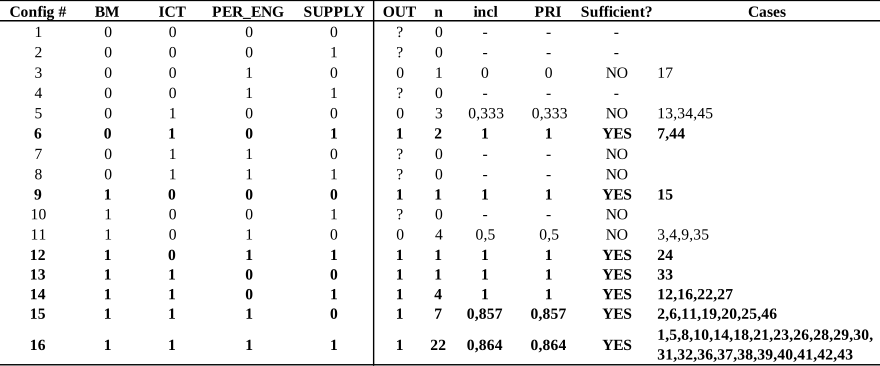
The truth table displays all configurations of causal conditions and their empirical link to the outcome. Each row represents a unique combination of present (1) or absent (0) conditions. “OUT” shows the observed outcome (1 = resilient, 0 = non-resilient, “?” = unobserved). “n” indicates the number of matching cases. “incl” reflects consistency, while “PRI” adjusts for contradictions, helping distinguish true from spurious sufficiency. The “Cases” column lists associated case identifiers.
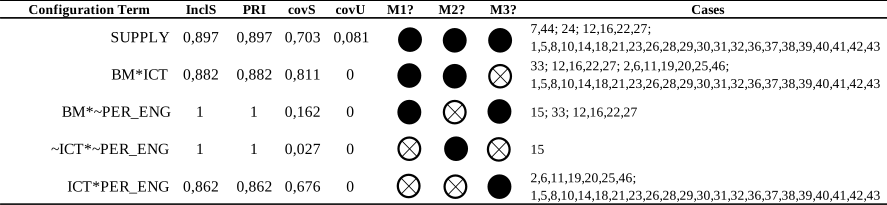
Configurations 6, 9, and 12–16 meet the consistency threshold (incl ≥ 0.8) and are empirically sufficient for resilience, covering a substantial share of resilient cases. In contrast, configurations 3, 5, and 11 are insufficient and linked to non-resilient cases. Configurations 1, 2, 4, 7, 8, and 10 are logical remainders, unobserved in the data and thus not empirically testable. The Quine–McCluskey algorithm yielded an intermediate solution with three sufficient models (M1–M3; incl > 0.80) combining BM, ICT, PER_ENG, and SUPPLY to explain resilience. Table 05 displays the intermediate solutions comprised of three configurational models (M1-M3).
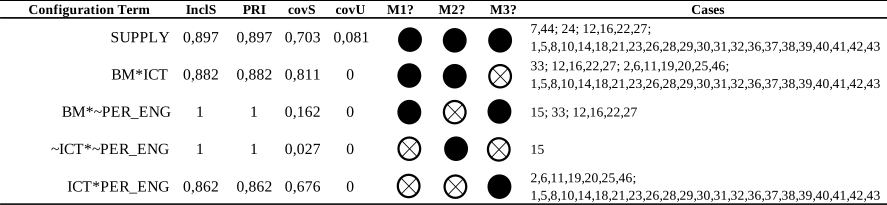
M1 [SUPPLY + (BM*ICT + BM*~PER_ENG) → RESIL] indicates that resilience can result either from supply chain redundancies (SUPPLY) alone or through the joint presence of business model adaptability (BM) and digitalization (ICT) (BM*ICT), or BM and insufficient managerial traits (BM*~PER_ENG). In other words, business model adaptability is key in enabling organizational resilience through digitalization or compensating for a lack of managerial traits. Alternatively, redundant supply chains alone may be enough.
Similarly, M2 [SUPPLY + (BM*ICT + ~ICT*~PER_ENG) → RESIL] suggests that supply chain redundancies alone can lead to firm resilience, or the combination of BM and ICT, or low ICT capacity and insufficient managerial traits. A plausible interpretation of M2 is that even when both digitalization (ICT) and managerial traits (PER_ENG) are not present or are insufficient, organizational resilience may still emerge, likely due to the compensatory effect of other conditions, such as redundant supply chain capabilities (SUPPLY). This finding illustrates the causal asymmetry principle and highlights multiple, context-specific pathways to resilience.
Finally, M3 [SUPPLY + (BM*~PER_ENG + ICT*PER_ENG) → RESIL] supports that resilience can arise either from a strong supply chain alone or through two alternative combinations: business model adaptability coupled with insufficient managerial traits, or digitalization paired with high levels of managerial traits. M3 shows how different pairs of conditions can produce resilience, either adaptive but disengaged leadership or engaged and digitally capable leadership.
To test the robustness of our results, we ran a sensitivity analysis by varying the consistency threshold from 0.70 to 0.90 in ±0.05 steps. Results were stable from 0.70 to 0.85, with the same three configurations (M1–M3) showing consistent consistency (0.895) and coverage (0.919), reinforcing their reliability and the role of SUPPLY, BM, ICT, and PER_ENG. At 0.90, solutions became narrower and perfectly consistent but with low coverage (0.243), reflecting a trade-off between precision and empirical relevance. These findings validate the original 0.80 threshold. Table 06 summarizes the analysis.
.svg)
Discussion
Three key internationalization factors emerged as core components across the three sufficient configurations (M1, M2, M3). They are: Business model adaptability (BM), digitalization (ICT), and supply chain redundancy (SUPPLY). Their repeated appearance suggests they play a consistent role in fostering resilience, though how they combine with other conditions differs across configurations. For example, BM adaptability consistently appeared in conjunction with either digitalization or limited managerial engagement, highlighting its flexibility as a resilience driver: it supports resilience either by enabling digital transformation or by compensating for weaker managerial involvement. While recent studies support the former (Amankwah-Amoah et al., 2021; Reim et al., 2022), the latter remains underexplored in the literature. It suggests that BM adaptability is the configurational pivot of international resilience, evidence of structural flexibility as the foundation of robustness in foreign markets. The role of supply chain redundancy deserves particular consideration. Its presence across all three configurations indicates that resilient firms tend to incorporate slack or buffering capacity into their operations. For SMEs, typically constrained in resources, this finding challenges the assumption that lean operations are always optimal (Hoffmann & Torres, 2019). Instead, redundancy in supply chains may be a form of pre-emptive, proactive risk management, providing flexibility to absorb shocks and maintain continuity in foreign markets. In this particular sense, our findings align with (El Baz & Ruel, 2021; Li et al., 2024). However, the fact that SUPPLY alone can lead to resilience across several configurations indicates it can act as a stand-alone enabler, especially when other strategic capacities (such as ICT or managerial traits) is underdeveloped. The literature on supply chain resilience is well developed, and emphasizes the need of financial resources and social capital (Williams et al., 2017), operational flexibility and organizational culture (Pal et al., 2014), and redundant resources (Katsaliaki et al., 2022). Among those developing social capital, flexibility and organizational culture are feasible antecedents, indicating that soft capabilities can offset lack of hard ones (e.g. ICT). The effect of managerial traits (PER_ENG) is contingent and shaped by its interaction with other conditions. It did not emerge as a consistent standalone factor for resilience, but it played both complementary and compensatory roles depending on the configuration. In M3, for example, strong managerial engagement paired with digitalization (ICT) was sufficient for resilience, suggesting that managers’ attitudes associated with the strategic adoption of business-centric technologies are enough to secure a robust, adaptable presence in foreign markets.
However, in other configurations, such as M1 and M2, resilience was achieved even when managerial engagement was low, suggesting that firms can compensate for weak leadership through strong systems or processes (e.g., adaptive business models or robust supply chains). In family-owned SMEs where owners naturally occupy top roles, ownership often overrides leadership. In such contexts, M1 and M2 may suggest a temporal component: first, ownership drives the implementation of a robust PMT (processes, methods, and tools). Then, this structure reinforces coordinated work and ensures team outputs are traceable to enterprise targets. This may indicate that resilience may also emerge from ownership when leadership traits are not recognized among the firm’s managers.
This insight points to a principle of what we call "coherent sufficiency: the idea that SMEs do not necessarily need to excel in all areas simultaneously. What matters is assembling a coherent mix of enablers that collectively support resilience.
Conclusions
This study aimed to investigate how the interplay of individual internationalization factors enhances organizational resilience in the context of SMEs operating in foreign markets. Recognizing that traditional approaches often assess the effect of individual factors in isolation (e.g. Sharma et al., 2024; Thekkoote, 2023), the study aimed to adopt a configurational perspective using crisp-set QCA technique to uncover and explore causal patterns that lead to a resilient presence overseas. Our results support that resilience does not always stem from the influence of factors in isolation. Instead, it often emerges from the complex combination of multiple drivers. This view offers important empirical and theoretical implications. From a theoretical perspective, they contribute to a more refined understanding of resilience as a multi-dimensional and path-dependent construct. Rather than viewing internationalization and resilience as separate or sequential processes, our results suggest that resilience is embedded in how internationalization is configured and enacted.
For practitioners and policymakers, the insights here point to the importance of capability orchestration over maximization. Efforts to support internationalized SMEs should not focus solely on promoting individual capabilities (e.g., digital tools or managerial capacities) but on enabling firms to develop and combine these capabilities in ways that help maximize organizational resilience in international markets.
Despite its relevant contributions to Organizational Resilience and International Entrepreneurship, our study has some limitations. First, the analysis was based on a relatively small sample of 46 Brazilian SMEs from three sectors, which may limit the generalizability of the findings to other industries or regions. Second, the use of crisp-set QCA required dichotomizing continuous data, which may have reduced the granularity of the analysis. Third, by focusing exclusively on firms that survived the pandemic, the study may be affected by “survivorship bias”, limiting its ability to fully capture the contrasting configurations that lead to non-resilience.
Building on the findings of this study, future research could look at how the combinations of internationalization factors that support resilience change over time, by using longitudinal QCA to capture patterns before, during, and after a crisis. Another proper direction is to estimate the mediating and moderating pathways through which dynamic capabilities translate internationalization drivers into resilient performance. In addition, studying how SME leaders think about risk and adaptation, particularly how their decisions influence or compensate for structural limitations, could add important insights. Finally, applying the same type of analysis to different types of crises, like political or environmental disruptions, could help identify which resilience strategies work in different situations and which are specific to particular challenges.