Introduction
Food trucks have exploded from curbside curiosities into a multi-billion-dollar global industry, redefining what it means to run a small business in foodservice. In the United States alone, industry revenues have surpassed $1.4 billion annually and continue to grow at a rapid pace (IBISWorld, 2023; National Restaurant Association, 2024). Food trucks embody the spirit of entrepreneurship—lean, agile, and opportunity-driven—while competing with established restaurants and quick-service chains under conditions of limited resources and heightened uncertainty (Brännback & Carsrud, 2016; Markman & Baron, 2003). For owner-operators, success is not only about cooking good food but also about orchestrating strategy: selecting the right markets, leveraging digital platforms, cultivating loyal followings, and adapting quickly to shifting consumer expectations.
Despite this momentum, scholarship has struggled to keep pace with the entrepreneurial realities of mobile foodservice. Much of the literature focuses on hospitality, service quality, or event logistics (Kim & Lee, 2021; Myung & Jung, 2019), offering limited insight into how entrepreneurs align offerings with segmented consumer markets. Yet segmentation is vital. Generational cohorts represent not just age brackets but cultural communities shaped by shared experiences, values, and technologies (Schewe & Meredith, 2004; Strauss & Howe, 1991). A taco truck that Millennials see as adventurous and Instagram-worthy may be framed by Baby Boomers as convenient and affordable, while Generation Z interprets it as a digitally integrated, socially visible lifestyle marker (Wang, 2025; Yoon et al., 2023). Without accounting for these cohort-based orientations, small business owners risk adopting “one-size-fits-all” strategies that dilute scarce resources and undermine profitability.
This paper responds to that gap by integrating Generational Cohort Theory (Inglehart, 1997; Kamenidou et al., 2020), Consumer Culture Theory (Arnould & Thompson, 2005), and experiential consumption perspectives (Holbrook & Hirschman, 1982; Pine & Gilmore, 1999) into a conceptual framework of food-truck patronage. Eight drivers—convenience, price–value, novelty, social influence, ambiance, situational conditions, digital enablement, and localism—are theorized as cultural practices filtered through generational orientations.
The contribution is threefold. First, we extend small business and entrepreneurship research by framing food trucks as mobile servicescapes (Lin & Mattila, 2021; Sherry, 1998), temporary yet strategic environments where value is co-created through symbolism, atmosphere, and identity performance. Second, we conceptualize generational cohorts as cultural orientations that shape the relative salience of patronage drivers, producing distinct value propositions that entrepreneurs can leverage for segmentation and positioning. Third, and most importantly for JSBS readers, we translate these insights into strategy-relevant considerations for food-truck operators and city marketers, clarifying how menu design, price framing, site selection, event participation, and digital promotion may be interpreted differently across generational cohorts.
Theoretical Foundations
Food Trucks as Strategic and Symbolic Entrepreneurial Forms
Schifeling and Demetry (2021) deepen our understanding of food trucks by framing them as authenticity-based entrepreneurial ventures embedded within local geographic communities. Rather than viewing food trucks as marginal or informal businesses, their work shows how legitimacy, place-based identity, and authenticity narratives play a central role in entrepreneurial success. This perspective is particularly relevant for small business strategy because it highlights how value is often co-created through symbolic and contextual cues, not simply through scale or formalization. Building on this insight, the present study shifts attention from how authenticity is constructed by entrepreneurs to how it is interpreted by consumers, asking how different generational cohorts evaluate and prioritize food-truck attributes in ways that ultimately shape patronage.
Research on market categorization and category spanning further suggests that hybrid ventures challenge established evaluative boundaries by blending multiple organizational forms, prompting audiences to reassess legitimacy and value in ways that extend beyond traditional classifications (Durand et al., 2017). Extending this logic, the present study explores whether generational cohorts differ in their receptivity to such hybridity, proposing that cohort-specific value logics shape how food trucks are perceived, evaluated, and patronized.
Generational Cohort Theory as a Strategic Lens
Generational Cohort Theory suggests that individuals shaped by common historical and cultural experiences develop enduring values and consumption logics that persist across the life course (Inglehart, 1997; Strauss & Howe, 1991). Unlike simple age categories, cohorts are cultural communities that share reference points—wars, economic cycles, technological breakthroughs, or cultural icons—that shape how they interpret value. For marketers and entrepreneurs, this means that “age” is less about biology and more about culture: Boomers often view consumption through thrift and responsibility, Generation X through pragmatism, Millennials through experience and authenticity, and Generation Z through digital fluency and social visibility (Kamenidou et al., 2020; Schewe & Meredith, 2004).
Recent research confirms that these orientations matter in food and hospitality contexts. Torres-Casado (2025) finds that Boomers and Gen X emphasize comfort and tradition in gastronomy, while Millennials and Gen Z prioritize novelty and sustainability. Theocharis and Tsekouropoulos (2025) show how Gen Z brands succeed when they align with social values and digital-first identity work. For small business entrepreneurs, especially food-truck operators, such differences translate into practical strategy questions: Should the menu rotate weekly to keep younger audiences engaged, or should it stabilize around affordable comfort foods to attract older repeat customers? Should marketing budgets emphasize TikTok reels or community newsletters? These are not abstract academic debates—they are everyday decisions that determine whether a small business thrives or struggles.
Consumer Decision-Making Beyond Utility
Classic consumer behavior models cast decision-making as a linear sequence of need recognition, information search, evaluation, and choice (Engel et al., 1995). But real-world small business customers rarely act this way. Research increasingly shows that consumers rely on heuristics, cultural scripts, and social cues that shortcut rational evaluation (Choi & Zhao, 2020). Generational context amplifies these shortcuts: Boomers and Gen X often define “good value” through price fairness and convenience, while Millennials and Gen Z filter decisions through novelty, peer validation, and digital discovery (Wang, 2025; Yoon et al., 2023).
For food-truck entrepreneurs, these generational filters can mean the difference between long lines and empty streets. A Gen Z student may wait 20 minutes in the rain for a fusion bao bun if it promises a unique, “Instagrammable” experience. A Baby Boomer, by contrast, might bypass that truck for a competitor offering hearty meals at a fair price and a shorter wait. Entrepreneurs who fail to anticipate these divergent heuristics risk wasting resources on misaligned promotions or pricing strategies. In this sense, decision-making theory becomes a blueprint for entrepreneurial strategy under resource constraints (Markman & Baron, 2003; Wiklund & Shepherd, 2005).
Experiential Consumption and Servicescape Design
Holbrook and Hirschman’s (1982) experiential view of consumption and Pine and Gilmore’s (1999) experience economy remind us that consumers do not simply purchase calories or products—they purchase feelings, identity signals, and memorable moments. Bitner’s (1992) servicescape framework illustrates how the physical and atmospheric environment—lighting, sound, layout, and design—shapes both customer satisfaction and employee behavior. Food trucks magnify this logic: they are mobile servicescapes, temporary yet symbolic environments where sensory appeal, novelty, and ambiance converge with community interaction (Kozinets et al., 2004; Sherry, 1998).
Recent studies highlight that ambiance, authenticity, and digital integration are especially influential for younger cohorts who seek hedonic and symbolic value (Jang & Kim, 2020; Lee & Kim, 2019; Lichy, 2022). For entrepreneurs, this means that the “vibe” of a truck—its music, lighting, queue rituals, or social media presence—can be just as critical to strategy as food quality or pricing. A well-designed food truck becomes a platform for experience innovation, allowing owners to differentiate in crowded markets despite limited scale (Parida et al., 2016).
Integrating the Perspectives
Together, these perspectives converge on a central insight: generational cohorts differ in the relative weight they assign to common patronage drivers. Generational Cohort Theory explains why cohorts differ, decision-making theory reveals how evaluations unfold, and experiential consumption illustrates how hedonic and symbolic cues matter alongside functional value.
For small business strategy, this integration is more than theoretical. It provides a structured way for resource-constrained entrepreneurs to consider which strategic elements are likely to matter most for different customer cohorts. Should a food-truck owner double down on digital ordering apps to capture Gen Z, or emphasize consistency and price fairness to secure Boomer loyalty? Should ambiance be curated for Instagram visibility, or simplified for efficiency? By linking generational theory, decision-making, and servicescape design, we position food trucks as strategic laboratories for understanding how small businesses can thrive in consumer markets characterized by diversity, fragmentation, and rapid change (Brännback & Carsrud, 2016; Lumpkin & Dess, 1996).
Conceptual Framework and Propositions
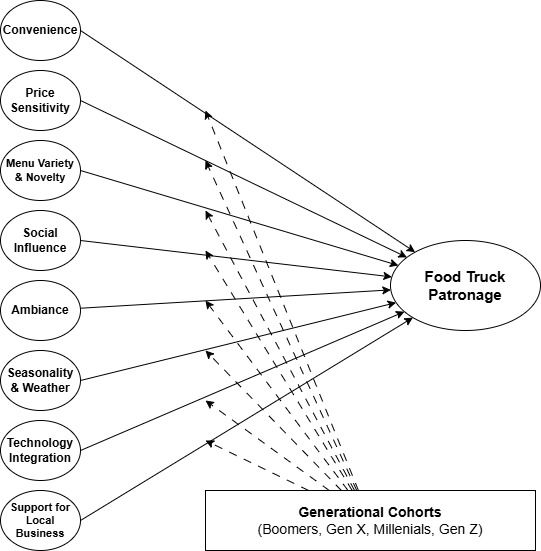
Building on the integration of generational theory, decision-making, and experiential consumption, we propose a framework (Figure 1) positioning food trucks as mobile servicescapes whose patronage is shaped by eight drivers. These drivers—convenience, price–value, novelty, social influence, ambiance, situational conditions, digital enablement, and localism—are interpreted through generational orientations that shape their relative salience. For entrepreneurs, the framework highlights that the same structural driver can signal entirely different meanings depending on cohort membership.
The eight drivers incorporated into the conceptual framework were derived through an integrative synthesis of prior research across foodservice management, small business strategy, consumer behavior, and technology-enabled service literature. Specifically, we reviewed studies examining food truck entrepreneurship, restaurant patronage, experiential consumption, digital servicescapes, and generational cohort differences to identify recurring consumer-facing factors shown to influence dining decisions. The resulting drivers—convenience, perceived price–value congruence, menu novelty, social influence, ambiance, situational conditions, digital enablement, and local business positioning—represent those constructs that consistently emerged across multiple literatures as salient determinants of foodservice patronage and that are meaningfully interpretable by consumers at the point of decision. Other potential factors (e.g., back-of-house operations, supply chain efficiency, ownership structure, or regulatory conditions) were deliberately excluded because they operate primarily at the firm or institutional level rather than at the consumer experience level emphasized in this study. Thus, the selected drivers reflect a parsimonious yet comprehensive set of consumer-relevant mechanisms through which generational cohorts are theorized to differentially evaluate and respond to food truck offerings.
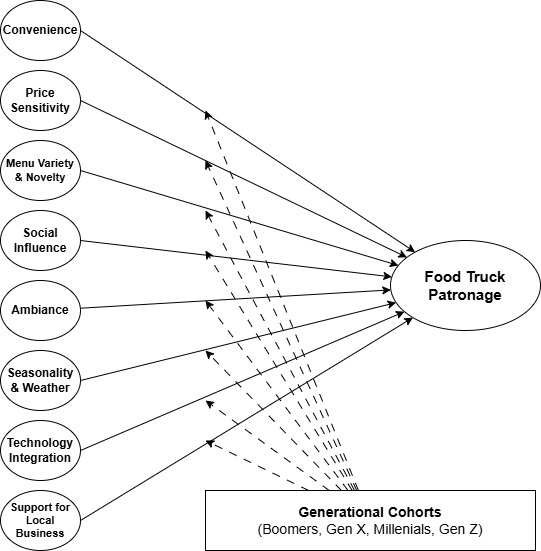
The figure highlights that generational cohort does not introduce new drivers of patronage, but rather conditions the relative salience and interpretation of drivers that are common across food-truck consumers.
Propositions
Building on the conceptual model in Figure 1, the framework can be expressed through a set of generationally filtered propositions. These propositions articulate how the eight patronage drivers operate differently across cohorts, creating distinct value propositions that small business entrepreneurs can strategically target.
Proposition 1 – Convenience as Temporal Value
Convenience is a foundational driver of food-related choice, yet its meaning and importance vary across generational cohorts. Baby Boomers and Generation X, shaped by career demands, commuting routines, and family responsibilities, often evaluate food trucks through a lens of time efficiency and reliability. For these cohorts, shorter wait times, predictable schedules, and accessible locations tend to signal value and reduce perceived risk. Millennials and Generation Z, by contrast, are often more willing to tolerate friction—such as longer queues or less predictable service—when the experience offers novelty, social visibility, or symbolic value. In this sense, convenience is not uniformly interpreted as speed alone, but rather as a culturally filtered assessment of whether the consumption experience is “worth the effort.”
P1: Generational cohort moderates the relationship between convenience and food-truck patronage, such that the relationship is stronger for Baby Boomers and Generation X than for Millennials and Generation Z.
From a strategic perspective, the framework suggests that convenience-oriented design choices may be evaluated differently across cohorts. For food-truck operators seeking to appeal to Baby Boomers and Generation X, efficiency cues such as predictable hours, streamlined ordering, and accessible parking may carry particular salience. In contrast, Millennials and Generation Z may be more tolerant of inconvenience when experiential or social value is present, allowing operators greater flexibility in service pacing when novelty, ambiance, or visibility are emphasized. These differences highlight how convenience functions not as a universal standard, but as a cohort-contingent strategic lever.
Proposition 2 – Price–Value Congruence
Perceptions of price and value are central to food-truck patronage, yet generational cohorts differ in how they interpret what constitutes a “fair” or worthwhile exchange. Baby Boomers and Generation X, whose formative experiences include economic volatility and prolonged exposure to budget constraints, often evaluate food purchases through lenses of fairness, portion adequacy, and price transparency. For these cohorts, value is frequently assessed relative to expectations of consistency and reliability. Millennials and Generation Z, by contrast, are often more willing to tolerate higher prices or smaller portions when the offering aligns with experiential benefits, novelty, ethical considerations, or symbolic meaning. In this sense, price–value judgments are not uniform assessments of cost, but culturally informed evaluations shaped by cohort-specific value logics.
P2: Generational cohort moderates the relationship between perceived price–value congruence and food-truck patronage, such that the relationship is stronger for Baby Boomers and Generation X than for Millennials and Generation Z.
Viewed through a strategic lens, the framework suggests that pricing cues and value framing may be interpreted differently across cohorts. For food-truck operators seeking to appeal to Baby Boomers and Generation X, transparent pricing, value bundles, and signals of portion adequacy may reinforce perceptions of fairness and reduce perceived risk. In contrast, Millennials and Generation Z may place relatively greater emphasis on how prices are contextualized—such as through sustainability narratives, limited-time offerings, or experiential positioning—allowing price premiums to be justified by symbolic or ethical value. These distinctions underscore how price functions not merely as a monetary constraint, but as a cohort-contingent signal within food-truck strategy.
Proposition 3 – Menu Novelty and Experimentation
Menu novelty plays a central role in experiential consumption, yet its appeal varies across generational cohorts. Millennials and Generation Z are often drawn to experimentation and variety, viewing novel or fusion offerings as opportunities for self-expression, discovery, and social signaling. For these cohorts, trying new flavors or unconventional menu items can function as a form of identity performance, particularly when novelty is visible or shareable. Baby Boomers and Generation X, while not opposed to innovation, tend to evaluate novelty more cautiously, preferring new offerings that are anchored in authenticity, familiarity, or perceived quality. In this way, novelty is not uniformly valued as change for its own sake, but is interpreted through cohort-specific expectations about credibility and meaning.
P3: Generational cohort moderates the relationship between menu novelty and food-truck patronage, such that the relationship is stronger for Millennials and Generation Z than for Baby Boomers and Generation X.
From a strategic perspective, the framework suggests that menu innovation may be interpreted differently across cohorts. Food-truck operators seeking to engage Millennials and Generation Z may benefit from offering rotating or experimental items that emphasize creativity and discovery, particularly when these offerings are visibly differentiated. In contrast, Baby Boomers and Generation X may be more receptive to innovation when it is framed within familiar culinary traditions or communicated as an enhancement to quality rather than a departure from it. These distinctions highlight how novelty functions as a cohort-contingent strategic signal rather than a universally appealing attribute.
Proposition 4 – Social Influence and Network Visibility
Social influence plays an important role in shaping food-truck patronage, but the sources and mechanisms of influence differ across generational cohorts. Millennials and Generation Z are deeply embedded in digitally mediated social networks, where discovery, validation, and signaling often occur through platforms such as Instagram, TikTok, and peer-generated content. For these cohorts, visibility within digital networks can amplify perceptions of popularity, novelty, and cultural relevance. Baby Boomers and Generation X, by contrast, tend to rely more heavily on interpersonal recommendations rooted in established social ties, such as friends, family, or local community networks. As a result, social influence operates through distinct channels across cohorts, shaping how food trucks are discovered, evaluated, and discussed.
P4: Generational cohort moderates the relationship between social influence and food-truck patronage, such that the relationship is stronger for Millennials and Generation Z than for Baby Boomers and Generation X.
Viewed through a strategic lens, the framework suggests that the effectiveness of social influence mechanisms depends on the dominant communication norms of targeted cohorts. Food-truck operators engaging Millennials and Generation Z may find that digitally visible cues—such as user-generated content, social sharing, or influencer engagement—carry particular interpretive weight. In contrast, for Baby Boomers and Generation X, trust may be more strongly shaped through word-of-mouth within established interpersonal networks or community settings. These differences underscore how social influence functions not as a single channel, but as a cohort-dependent pathway through which meaning and credibility are constructed.
Proposition 5 – Ambiance as Servicescape Value
Ambiance functions as a meaningful component of the food-truck experience, yet its interpretation varies across generational cohorts. For Millennials and Generation Z, ambiance often extends beyond physical comfort to include aesthetic cues, crowd energy, music, and visual distinctiveness that support lifestyle expression and social visibility. In these contexts, ambiance contributes to the overall narrative of the experience and can enhance symbolic value. Baby Boomers and Generation X, by contrast, are more likely to interpret ambiance through lenses of comfort, ease, and social accessibility, valuing elements such as seating availability, shade, lighting, and a manageable service environment. Thus, ambiance operates not as a uniform backdrop, but as a cohort-specific signal that shapes how the food-truck experience is perceived and evaluated.
P5: Generational cohort moderates the relationship between ambiance and food-truck patronage, such that the relationship is stronger for Millennials and Generation Z than for Baby Boomers and Generation X.
From a strategic perspective, the framework suggests that servicescape design choices may carry different meanings across cohorts. Food-truck operators seeking to engage Millennials and Generation Z may benefit from emphasizing visually distinctive or socially engaging atmosphere cues that enhance experiential and symbolic value. In contrast, Baby Boomers and Generation X may place greater emphasis on ambiance elements that facilitate comfort, ease of interaction, and predictability. These distinctions illustrate how ambiance serves as a cohort-contingent strategic lever rather than a universally interpreted feature of the food-truck environment.
Proposition 6 – Situational Conditions (Seasonality and Weather)
Situational conditions such as seasonality, weather, and event timing play a distinctive role in food-truck patronage because they directly shape the feasibility and comfort of the consumption experience. Generational cohorts differ in how they interpret and respond to these contextual constraints. Baby Boomers and Generation X often place greater emphasis on predictability, physical comfort, and risk avoidance, making them more sensitive to unfavorable weather conditions, extreme temperatures, or inconvenient timing. Millennials and Generation Z, by contrast, may be more willing to tolerate situational discomfort when the experience offers novelty, social engagement, or symbolic value, particularly in festival, pop-up, or event-based contexts. As a result, situational conditions do not function as uniform barriers to patronage but are filtered through cohort-specific thresholds for inconvenience and experiential payoff.
P6: Generational cohort moderates the relationship between situational conditions (e.g., seasonality and weather) and food-truck patronage, such that the relationship is stronger for Baby Boomers and Generation X than for Millennials and Generation Z.
From a strategic standpoint, the framework suggests that sensitivity to situational conditions varies systematically across cohorts. Food-truck operators seeking to appeal to Baby Boomers and Generation X may benefit from emphasizing predictable schedules, sheltered locations, and daytime service windows that reduce environmental friction. In contrast, Millennials and Generation Z may be more receptive to food-truck offerings embedded within events, festivals, or evening settings where situational challenges are offset by social and experiential rewards. These differences highlight how environmental conditions operate as a cohort-contingent strategic constraint rather than a universally limiting factor.
Proposition 7 – Digital Enablement
Digital enablement has become an increasingly salient feature of food-truck patronage, yet its importance is interpreted differently across generational cohorts. Millennials and Generation Z, having grown up with mobile technologies and platform-based discovery, often view digital touchpoints—such as social media presence, mobile ordering, QR menus, and cashless payment—as integral components of the consumption experience. For these cohorts, digital integration can signal legitimacy, accessibility, and cultural relevance. Baby Boomers and Generation X, by contrast, tend to perceive digital features as supplementary rather than essential, often prioritizing interpersonal interaction and ease of use over technological sophistication. As a result, digital enablement functions not as a uniform baseline expectation, but as a cohort-contingent cue that shapes how food trucks are evaluated and engaged.
P7: Generational cohort moderates the relationship between digital enablement and food-truck patronage, such that the relationship is stronger for Millennials and Generation Z than for Baby Boomers and Generation X.
From a strategic perspective, the framework suggests that investments in digital tools may carry different interpretive weight across cohorts. For food-truck operators engaging Millennials and Generation Z, digital visibility and functionality may enhance perceptions of convenience and relevance. In contrast, Baby Boomers and Generation X may respond more favorably when digital options are offered as optional complements rather than as primary points of interaction. These distinctions underscore how digital enablement operates as a cohort-dependent strategic signal rather than a universally required feature of food-truck operations.
Proposition 8 – Localism and Community Support
Localism is a broadly resonant theme in food-truck patronage, yet the meanings consumers attach to “supporting local” vary across generational cohorts. Millennials and Generation Z often interpret localism through lenses of sustainability, ethical consumption, and social impact, viewing food trucks as extensions of broader value-based lifestyles. For these cohorts, local patronage can signal alignment with environmental responsibility, diversity, and community values. Baby Boomers and Generation X, by contrast, tend to associate localism with continuity, trust, and long-standing community relationships, emphasizing loyalty to familiar vendors and neighborhood-based businesses. Thus, while local positioning appeals across cohorts, the underlying motivations and interpretive frames differ in ways that shape patronage behavior.
P8: Generational cohort moderates the relationship between local business positioning and food-truck patronage, such that the relationship is stronger for Millennials and Generation Z than for Baby Boomers and Generation X.
From a strategic perspective, the framework suggests that local positioning serves as a flexible but cohort-contingent signal. Food-truck operators may find that emphasizing sustainability practices, ethical sourcing, or social impact narratives aligns more closely with the value orientations of Millennials and Generation Z. In contrast, highlighting longevity, neighborhood presence, or community ties may carry greater interpretive weight for Baby Boomers and Generation X. These distinctions illustrate how localism can function as a unifying theme while still allowing for generationally nuanced strategic framing.
Entrepreneurial Takeaway
The propositions suggest that food-truck patronage drivers are not uniformly interpreted across generational cohorts. For entrepreneurs, this implies that strategic choices related to convenience, value communication, novelty, ambiance, and local positioning may be more effective when aligned with the dominant cohort logics present in a given market. More broadly, the framework reinforces entrepreneurship research emphasizing that market orientation and adaptive capability support small business performance under resource constraints (Parida et al., 2016; Wiklund & Shepherd, 2005).
Managerial Implications: Strategy-Relevant Considerations for Food-Truck Entrepreneurs
The managerial implications presented here are derived from the conceptual framework developed in this study and are intended to illustrate how generationally filtered patronage drivers may inform strategic thinking among food-truck entrepreneurs. Consistent with the conceptual nature of the paper, these implications are theory-informed rather than prescriptive and are offered to highlight patterns of interpretation and emphasis across generational cohorts. As such, they should be viewed as strategic considerations that warrant contextual adaptation and future empirical validation rather than as definitive managerial recommendations.
From a strategic perspective, the framework suggests that digital engagement functions as a generationally contingent signal rather than a universally required operational capability. For Millennials and Generation Z, digital visibility and functionality—such as social media presence, mobile ordering options, or cashless payment systems—may shape perceptions of relevance, legitimacy, and ease of engagement. For Baby Boomers and Generation X, digital features appear to play a more supplementary role, often evaluated in relation to interpersonal interaction and perceived simplicity. This distinction highlights how digital tools may serve different strategic purposes depending on the dominant generational context in which a food truck operates.
The framework further suggests that menu design and innovation represent an important site of generational differentiation. While novelty and experimentation may enhance experiential value and identity expression for younger cohorts, older cohorts often evaluate innovation through lenses of authenticity, familiarity, and quality continuity. Strategically, this implies that menus can function as signaling mechanisms that balance stability with selective innovation, allowing food-truck operators to convey both creativity and credibility without assuming that novelty is uniformly desirable across consumers.
Price–value considerations also emerge as cohort-dependent rather than absolute. For Baby Boomers and Generation X, perceptions of fairness, transparency, and consistency may play a particularly important role in shaping trust and repeat patronage. In contrast, Millennials and Generation Z may incorporate experiential, ethical, or symbolic dimensions into their assessments of value alongside monetary cost. From a strategic standpoint, this suggests that how price is framed and communicated may influence patronage as much as price levels themselves, especially in contexts where multiple cohorts are present.
Situational conditions such as weather, timing, and event context appear to operate as implicit segmentation mechanisms rather than neutral environmental constraints. The framework indicates that older cohorts may be more sensitive to physical comfort, predictability, and environmental friction, whereas younger cohorts may display greater tolerance for situational inconvenience when social or experiential rewards are salient. This insight highlights how location choice, scheduling, and event participation can shape the generational composition of a food truck’s customer base without explicit targeting.
Finally, the framework underscores the strategic flexibility of localism as a positioning narrative. While support for local businesses resonates across cohorts, the meanings attached to localism differ. Younger consumers may interpret local positioning through sustainability, ethics, and social impact lenses, whereas older consumers may associate it with loyalty, trust, and community continuity. This suggests that localism can function as a unifying strategic anchor while still allowing for generationally nuanced interpretation, reinforcing the value of adaptive messaging rather than one-dimensional positioning.
Conclusion and Future Research
Food trucks exemplify the challenges and opportunities of small business entrepreneurship. They operate at the intersection of resource constraints, intense competition, and shifting consumer expectations. This paper develops a conceptual framework that positions food trucks as mobile servicescapes, theorizing how eight drivers—convenience, price–value, novelty, social influence, ambiance, situational conditions, digital enablement, and localism—are filtered through generational orientations. By advancing propositions for each driver, the framework offers both scholarly contributions and strategy-relevant insights for practice.
The central insight is that the same driver does not carry the same weight across cohorts. Boomers and Generation X emphasize convenience, fairness, and comfort; Millennials and Generation Z prioritize novelty, digital integration, and social visibility. Localism emerges as a rare cross-cohort bridge, interpreted through sustainability by younger cohorts and community continuity by older ones. For small business strategy, these insights matter because they allow entrepreneurs to tailor menus, pricing, routes, and promotions with greater precision, conserving scarce resources while amplifying market impact (Markman & Baron, 2003; Wiklund & Shepherd, 2005).
Beyond immediate implications, the study sets a forward-looking research agenda. First, empirical validation is needed. Survey and experimental designs could measure how generational filters affect patronage, revisit intentions, and word-of-mouth. Second, life-stage versus cohort identity remains an open question: longitudinal studies could determine whether Millennials’ novelty-seeking and Gen Z’s digital fluency endure with age (Schewe & Meredith, 2004). Third, emerging drivers such as health consciousness, sustainability, and hybrid digital-physical consumption suggest fertile extensions of the model (Namkung & Jang, 2017; Theocharis & Tsekouropoulos, 2025). Fourth, cross-cultural comparisons could reveal how these generational patterns vary in collectivist versus individualist contexts (Roy & Goswami, 2020). Finally, digital ethnography—analyzing consumer narratives across Instagram, TikTok, and Yelp—offers opportunities to capture how identity and community are performed in food-truck culture (Kozinets et al., 2004).
Taken together, the framework reframes food trucks not just as vendors but as strategic arenas where generational identity, cultural meaning, and entrepreneurial practice intersect. For scholars, it extends consumer and small business strategy research into a novel, mobile context. For practitioners, it offers strategy-relevant insights for cohort-sensitive positioning and resource allocation in competitive markets. Food trucks may appear modest in scale, but they reveal enduring lessons about how small businesses can thrive when they align strategy with the cultural filters of their consumers.
Disclosure Statement
The author reports there are no competing interests to declare.
Funding
This research did not receive any specific grant from funding agencies in the public, commercial, or not-for-profit sectors.
Data Availability Statement
No new data were collected or analyzed in support of this conceptual study.
Generative AI Disclosure
During the preparation of this work, the author used OpenAI’s ChatGPT to assist with drafting, editing, and formatting. After using this tool, the author reviewed and revised the content and takes full responsibility for the final version of the manuscript.