1. Introduction
Entrepreneurship is widely recognized as a fundamental driver of economic growth, innovation, and employment generation, particularly in developing economies where large-scale industrial employment is often insufficient to meet rising demographic pressures (Ács et al., 2017; World Bank, 2020). In Pakistan, approximately 64% of the population is under the age of 30 (Pakistan Bureau of Statistics, 2023), making youth entrepreneurship a strategic imperative. Against this backdrop, the Higher Education Commission (HEC) has turned to entrepreneurship education as a tool for addressing both graduate unemployment and the underdevelopment of small businesses. As a strategic response, education, especially higher education, has emerged as a powerful tool to inculcate entrepreneurial mindsets and equip graduates with the necessary skills to start and sustain small businesses (Fayolle & Gailly, 2015; B. A. Soomro & Shah, 2022).
Pakistan’s Higher Education Commission (HEC) has positioned entrepreneurship education as a strategic policy intervention to address the dual challenge of graduate unemployment and small business underdevelopment. The 2023 Undergraduate Education Policy (UEP), issued by HEC, mandates a General Education course on entrepreneurship for all undergraduate students, regardless of discipline (HEC, 2023). This includes experiential components like capstone projects and business incubation opportunities, signaling a national-level policy shift toward institutionalizing entrepreneurship education. Additionally, the expansion of university-based Business Incubation Centers (BICs) aims to provide infrastructure and mentoring to support student ventures (Qureshi et al., 2021). The rationale for this intervention is grounded in three theoretical frameworks. Human Capital Theory (Becker, 1975) posits that investment in education increases productivity and economic outcomes. The Theory of Planned Behavior (TPB) (Ajzen, 1991) explains how educational interventions can shape attitudes, norms, and perceived behavioral control, key predictors of entrepreneurial intention. Finally, Policy Diffusion Theory (Berry & Berry, 1990) helps interpret how national policies are adopted unevenly across institutions, depending on their capacity and local context.
Despite these efforts, the effectiveness of entrepreneurship education in Pakistan remains under-examined. Previous studies note disparities in course delivery, faculty capacity, and student engagement (Khan et al., 2022; B. A. Soomro & Shah, 2022). For instance, while many universities offer entrepreneurship courses, only a fraction integrates them with incubation or field-based components, and mentorship access remains inconsistent (M. A. Soomro et al., 2019). Furthermore, Pakistani students face structural constraints such as limited startup funding, weak entrepreneurial ecosystems outside major cities, and inadequate mentorship networks (Bibi et al., 2025; Valerio et al., 2014). Moreover, while many universities have formally introduced entrepreneurship courses, few have rigorously evaluated their impact on students’ entrepreneurial intentions or startup activities. Soomro et al. (2019), in a study covering public and private universities in Pakistan, found a statistically significant but modest correlation between university support mechanisms and students’ entrepreneurial intentions. However, they also stressed the mediating role of contextual and institutional factors, such as access to mentorship, availability of incubation spaces, and the broader entrepreneurial ecosystem. The Undergraduate Education Policy 2023 presents a top-down, policy-driven framework that not only mandates entrepreneurship education but also standardizes course content, outlines experiential learning components (such as capstone projects and field exposure), and integrates entrepreneurship into the accreditation and quality assurance process. This comprehensive approach distinguishes it from previous ad hoc interventions and opens new avenues for empirical assessment.
The central problem this study seeks to address is the lack of systematic evidence on how this top-down policy for entrepreneurship education is associated with entrepreneurial intention and small business development among students in Pakistani HEIs. More specifically, there is an empirical gap in understanding how institutional support, such as the presence of BICs, mediates the policy’s effectiveness. This is particularly relevant in the context of uneven institutional capacity, socio-economic disparities, and regional differences in educational infrastructure within Pakistan. The purpose of this study is therefore twofold: first, to assess the degree to which HEC’s entrepreneurship policy has been implemented across universities in Pakistan; and second, to examine how exposure to this policy framework is associated with students’ entrepreneurial intentions and startup-related activities. This study further aims to identify the mediating role played by institutional factors such as the existence and activity of Business Incubation Centers (BICs), curriculum delivery, faculty expertise, and student access to entrepreneurial resources.
To this end, the study is guided by the following research questions:
-
What is the relationship between entrepreneurship course completion and entrepreneurial intention among final-year students?
-
How is entrepreneurship education exposure associated with students’ entrepreneurial intentions?
-
Does engagement with institutional support, such as Business Incubation Centers, mediate the relationship between education exposure and entrepreneurial intention?
Answering these questions is not only important for assessing the immediate outcomes of HEC’s strategic education reforms but also has broader implications for policymakers in other developing countries considering similar interventions. By examining both policy implementation and its association with student behavior, this study contributes to the literature on entrepreneurship education, higher education reform, and small business strategy in resource-constrained environments. Furthermore, this study complements existing scholarship that emphasizes the contextual nature of entrepreneurship education (Fayolle et al., 2006), especially in developing economies where entrepreneurial ecosystems are still evolving. Unlike in developed nations, where infrastructure and access to capital may be taken for granted, Pakistani students face systemic constraints that require tailored pedagogical and institutional strategies. This study seeks to critically assess whether HEC’s policy-driven approach to entrepreneurship education is associated with the intended strategic outcomes, including stronger entrepreneurial intention, greater startup-related engagement, and potential longer-term implications for the small business sector. The insights derived from this research are expected to inform future iterations of higher education policy in Pakistan and offer a replicable model for other developing economies.
1.1. Hypotheses Development
1.1.1. Entrepreneurship Education and Entrepreneurial Intention
Prior research consistently demonstrates that structured entrepreneurship education enhances entrepreneurial knowledge, opportunity recognition, and cognitive readiness for venture creation (Fayolle & Gailly, 2015; Martin et al., 2013). From a Human Capital Theory perspective (Becker, 1975), formal coursework represents an investment in skills and competencies that increase individuals’ perceived ability to initiate business activity. Empirical studies in both developed and developing contexts confirm that exposure to entrepreneurship courses is positively associated with entrepreneurial intention (Nabi et al., 2018; B. A. Soomro & Shah, 2022). In line with this theoretical and empirical evidence, the following hypothesis is proposed:
H1: Completion of the mandated entrepreneurship education course is positively associated with students’ entrepreneurial intentions.
1.1.2. Business Incubation Center Engagement and Entrepreneurial Intention
While classroom instruction builds foundational knowledge, institutional support structures such as Business Incubation Centers (BICs) provide mentorship, networking opportunities, and practical exposure necessary to transform ideas into actionable plans (Qureshi et al., 2021; Valerio et al., 2014). Incubation engagement enhances entrepreneurial self-efficacy and access to resources, which are critical determinants of entrepreneurial intention. Prior studies have shown that students with access to incubation ecosystems demonstrate stronger entrepreneurial commitment and a higher likelihood of venture development (Villa et al., 2022). Accordingly:
H2: Engagement with Business Incubation Centers (BICs) is positively associated with students’ entrepreneurial intentions.
1.1.3. Capstone Project Participation and Entrepreneurial Intention
Experiential learning, particularly through capstone projects, strengthens the practical application of entrepreneurial knowledge (Fayolle et al., 2006). Project-based learning enhances opportunity evaluation skills, problem-solving capacity, and entrepreneurial confidence (Sultana & Zaki, 2015). In developing contexts where ecosystem constraints are prevalent, experiential exposure is especially important for bridging theory and action (Villa et al., 2022). Therefore:
H3: Participation in entrepreneurship-related capstone projects is positively associated with entrepreneurial intentions.
1.1.4. Mediating Role of Business Incubation Centers
Policy Diffusion Theory suggests that top-down mandates produce varying outcomes depending on institutional absorptive capacity (Berry & Berry, 1990). Entrepreneurship courses may be associated with greater awareness and motivation, but institutional mechanisms such as BICs may help link educational exposure with applied entrepreneurial engagement. Incubators serve as a bridge between formal learning and venture-oriented action (Qureshi et al., 2021). Thus, BIC engagement may function as a mediating mechanism linking entrepreneurship education to intention:
H4: The relationship between entrepreneurship education and entrepreneurial intention is partially mediated by BIC engagement.
1.1.5. TPB Constructs and Entrepreneurial Intention
The Theory of Planned Behavior (Ajzen, 1991) posits that entrepreneurial intention is predicted by attitude toward entrepreneurship, subjective norms, and perceived behavioral control. Extensive empirical evidence supports the predictive validity of these constructs in entrepreneurship research (Liñán & Chen, 2009; Nabi et al., 2018). In the Pakistani context, TPB constructs have similarly demonstrated significant associations with entrepreneurial intention (M. A. Soomro et al., 2019). Based on this framework:
H5a: Attitude toward entrepreneurship is positively associated with entrepreneurial intention.
H5b: Subjective norms are positively associated with entrepreneurial intention.
H5c: Perceived behavioral control is positively associated with entrepreneurial intention.
2. Literature Review
Entrepreneurship education has witnessed a global surge in both policy and practice as governments and institutions seek to cultivate entrepreneurial competencies to stimulate economic growth, innovation, and employment (Reimers, 2024). Fayolle and Gailly (2015) argue that entrepreneurship education, when effectively designed, can positively influence entrepreneurial attitudes and intentions. Universities worldwide have responded by integrating entrepreneurship courses into business, engineering, and liberal arts curricula, reflecting their transdisciplinary nature (Kazakeviciute et al., 2016). Studies from developed economies highlight the strong correlation between structured entrepreneurship education and entrepreneurial behavior. Nabi et al. (2018), in a longitudinal UK-based study, demonstrated that first-year entrepreneurship education had a sustained impact on students’ entrepreneurial intentions even years after course completion. Similarly, Martin et al. (2013) conducted a meta-analysis showing that entrepreneurship education significantly influences cognitive and behavioral outcomes such as opportunity recognition and venture creation.
2.1. Effectiveness in Developing Economies
In developing contexts, entrepreneurship education is increasingly viewed not just as academic enrichment but as a strategic necessity to address youth unemployment and economic stagnation (Rashid, 2019). However, its effectiveness is often moderated by ecosystem-level constraints, limited access to capital, mentorship, and institutional support (Harima & Harima, 2025). In Sub-Saharan Africa and South Asia, studies have shown mixed results. While entrepreneurship programs increase self-efficacy and awareness, they often fall short in enabling actual startup activity due to resource limitations (Valerio et al., 2014). Villa et al. (2022) emphasize that in many low-income settings, experiential learning and mentorship are more impactful than theoretical coursework.
2.2. Strategic Role of Entrepreneurship Education
Strategically, entrepreneurship education serves multiple functions: it prepares individuals for self-employment, encourages innovation, and contributes to the creation of resilient small business ecosystems (Harima & Harima, 2025). Its role extends beyond job creation to shaping entrepreneurial ecosystems by developing human capital and fostering a culture of innovation. Entrepreneurial university institutions that systematically support entrepreneurial thinking and activities are central to this strategy. Rahmawati (2025) argues that entrepreneurial education contributes to regional growth by promoting technology transfer, startup creation, and community development. This positions education as a catalyst for both economic and social transformation.
2.3. Pakistan-Specific Literature
In Pakistan, the Higher Education Commission (HEC) has adopted an increasingly proactive stance toward embedding entrepreneurship into the national academic framework. Entrepreneurship education has evolved from being elective in business schools to a mandatory component in all undergraduate degree programs under the 2023 Undergraduate Education Policy (HEC, 2023).
2.3.1. Curriculum Alignment with Entrepreneurship
HEC’s curriculum reforms mandate a standard entrepreneurship course for all undergraduate students, regardless of discipline. According to Soomro and Shah (2022), this policy aims to “democratize” entrepreneurial training, allowing non-business students to acquire entrepreneurial competencies. Hayat et al. (2022) note that this shift reflects the best global practices where entrepreneurial thinking is encouraged across all fields. Yet there is significant variability in how universities interpret and implement guidelines. While some institutions offer project-based learning and case studies, others rely on rote-learning formats, which undermine the course’s experiential essence (Sultana & Zaki, 2015).
2.3.2. Challenges in Implementation
Challenges persist in ensuring consistency and quality across higher education institutions (HEIs). Faculty expertise is a primary bottleneck. Khan et al. (2022) identify limited faculty training, lack of exposure to entrepreneurial practice, and curriculum rigidity as key barriers. Inadequate infrastructure, overburdened teaching staff, and lack of industry collaboration further constrain program effectiveness (M. A. Soomro et al., 2019; Tanveer et al., 2021). Additionally, the evaluation of entrepreneurship courses is often limited to academic metrics (grades, attendance) rather than entrepreneurial outcomes such as venture ideation, networking, or participation in incubators (B. A. Soomro & Shah, 2022).
2.3.3. Role of Business Incubation Centers (BICs)
To address these limitations, HEC has promoted the establishment of Business Incubation Centers (BICs) within universities. These centers offer physical space, mentorship, funding access, and networking opportunities for students and alumni. According to Qureshi et al. (2021), universities with active BICs have significantly higher student engagement in startup initiatives. However, BIC impact varies based on regional disparities and university governance. Institutions in urban centers such as Lahore and Islamabad tend to have better-resourced BICs than those in peripheral regions (Bibi et al., 2025). Moreover, the integration between academic curricula and incubation services is often weak, limiting the incubation pipeline.
2.4. Theoretical Foundations
2.4.1. Human Capital Theory
This theory, advanced by Becker (1975), posits that investments in education and training enhance individuals’ productivity and economic potential. In the context of entrepreneurship, education builds critical skills such as opportunity recognition, problem-solving, and risk assessment. Entrepreneurship education, therefore, functions as a strategic investment in the development of the human capital necessary for a dynamic small business sector (Marvel et al., 2016).
2.4.2. Theory of Planned Behavior (TPB)
TPB, developed by Ajzen (1991), is widely used to predict entrepreneurial intention. It holds that intention is shaped by attitudes toward behavior, subjective norms, and perceived behavioral control. Nabi et al. (2018) successfully applied TPB to evaluate the effectiveness of entrepreneurship education programs. In Pakistan, studies by Soomro et al. (2019) confirm that TPB constructs are valid predictors of students’ entrepreneurial intentions, making this theory particularly relevant for assessing educational outcomes.
2.4.3. Policy Diffusion Theory
Policy Diffusion Theory explains how policy innovations spread and are adopted across institutions (Berry & Berry, 1990). HEC’s mandate for nationwide entrepreneurship education is a classic case of top-down diffusion. However, the success of such policies depends on institutional readiness, resource availability, and local adaptation. The variance in adoption and outcomes across HEIs in Pakistan can be effectively studied through this lens (B. A. Soomro & Shah, 2022).
2.5. Integrated Theoretical Framework
While Human Capital Theory, the Theory of Planned Behavior (TPB), and Policy Diffusion Theory are conceptually distinct, this study integrates them into a multi-level explanatory framework aligned with the Higher Education Commission’s (HEC) 2023 Undergraduate Education Policy. Policy Diffusion Theory offers a macro-level lens, explaining how a centrally mandated national reform, such as a compulsory entrepreneurship curriculum, spreads across higher education institutions with varying levels of institutional capacity (Berry & Berry, 1990). This theory situates the HEC policy as the structural driver of change within universities.
Human Capital Theory operates at the institutional and individual development level. The mandated entrepreneurship course and associated experiential components represent investments in students’ entrepreneurial knowledge, competencies, and opportunity-recognition skills (Becker, 1975; Marvel et al., 2016). Through coursework and capstone experiences, students accumulate entrepreneurial human capital.
The Theory of Planned Behavior (Ajzen, 1991) provides the psychological mechanism through which this accumulated human capital translates into entrepreneurial intention. Specifically, education and institutional exposure influence students’ attitudes toward entrepreneurship, perceived behavioral control, and subjective norms, which in turn shape intention.
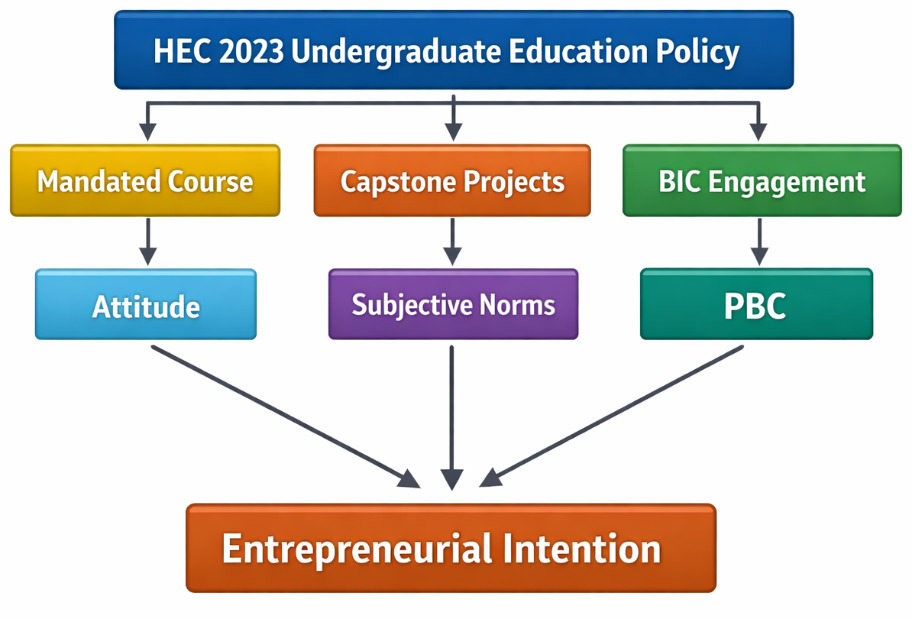
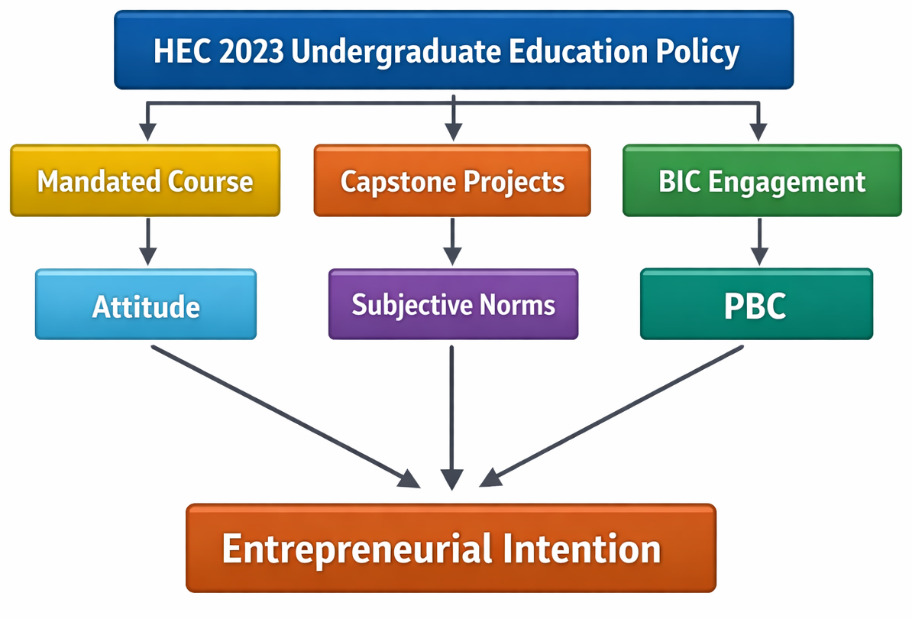
Accordingly, the integrated framework conceptualizes entrepreneurship education as a policy-driven intervention (macro level), implemented through institutional mechanisms such as coursework and Business Incubation Centers (meso level), which build entrepreneurial human capital and influence TPB-based cognitive determinants (micro level), ultimately shaping entrepreneurial intention. Figure 1 illustrates this multi-level integration and highlights the policy-relevant pathways linking national reform to student-level outcomes.
Figure 1 illustrates the integrated theoretical framework that informs the study’s conceptual model. At the macro level, the HEC, 2023 Undergraduate Education Policy functions as a policy diffusion mechanism mandating entrepreneurship education across higher education institutions. At the meso (institutional) level, universities implement this mandate through entrepreneurship coursework, capstone/experiential projects, and Business Incubation Centers (BICs), with course participation also facilitating engagement with incubation mechanisms. At the micro (psychological) level, these institutional mechanisms influence Theory of Planned Behavior (TPB) constructs, attitude toward entrepreneurship, subjective norms, and perceived behavioral control, which collectively shape students’ entrepreneurial intentions.
2.6. HEC Policy Context
The Higher Education Commission (HEC) of Pakistan introduced the 2023 Undergraduate Education Policy as part of a broader effort to align university curricula with economic development goals, particularly through entrepreneurship. A key reform is the mandate for all undergraduate students to complete a General Education course in “Entrepreneurship and Innovation,” regardless of discipline. This aims to foster entrepreneurial thinking across the academic spectrum, from engineering to the humanities (HEC, 2023). Beyond the classroom, the policy emphasizes experiential learning through fieldwork, capstone projects, and industry-linked assignments. Final-year students are required to complete entrepreneurship-oriented capstone projects, such as business plans, social enterprise models, or feasibility studies, often in collaboration with external mentors. These efforts aim to connect theory with real-world application and improve employability and startup readiness (Hayat et al., 2022). To support these reforms, HEC has expanded Business Incubation Centers (BICs) within universities. These centers provide infrastructure, mentorship, and funding access to help students translate ideas into ventures. However, the availability and quality of BICs vary, with stronger infrastructure concentrated in urban institutions (Qureshi et al., 2021). Integration between academic programs and incubation services remains an area needing further development. Curriculum quality is maintained through National Curriculum Review Committees (NCRCs), which include academic experts and industry stakeholders. These committees ensure that entrepreneurship content remains relevant, up-to-date, and aligned with Pakistan’s labor market needs. Accreditation bodies like NACBE now assess entrepreneurship outcomes as part of program evaluations (B. A. Soomro & Shah, 2022). Generally, HEC’s policy signals a systemic shift toward positioning entrepreneurship as a national strategy for innovation and small business development. Yet disparities in implementation, especially around faculty readiness and institutional capacity, indicate that further support is needed to translate policy into measurable entrepreneurial impact.
3. Methodology
3.1. Research Paradigm
This study is grounded in a post-positivist research paradigm, which holds that social phenomena can be objectively measured through empirical investigation. This paradigm supports the study’s use of structured data collection, validated theoretical frameworks, and inferential statistics (Creswell & Creswell, 2017). The Theory of Planned Behavior (Ajzen, 1991) serves as the conceptual foundation, guiding the measurement of entrepreneurial intention as a function of cognitive and institutional predictors.
To operationalize the integrated theoretical framework, a conceptual model was developed specifying the hypothesized relationships among policy-driven educational exposure, institutional mechanisms, TPB constructs, and entrepreneurial intention. While the theoretical framework explains the multi-level logic linking Policy Diffusion Theory, Human Capital Theory, and the Theory of Planned Behavior, the conceptual model translates these theoretical propositions into empirically testable paths examined through regression and Structural Equation Modeling (SEM). Thus, the conceptual model represents the operationalization of the broader theoretical framework.
3.2. Research Design
The study adopts a quantitative, cross-sectional survey design, allowing for data collection at a single point in time. This design is appropriate for identifying relationships among multiple variables and testing theory-driven hypotheses using multivariate techniques, including Structural Equation Modeling (Hair et al., 2019).
3.3. Population and Sampling
The target population consisted of final-year undergraduate students from public and private universities across Pakistan. All participants were enrolled in programs subject to the Higher Education Commission’s (HEC) 2023 Undergraduate Education Policy. The study employed a stratified, purposive multi-institutional sampling strategy to ensure representation across institutional type (public vs. private) and major geographic regions, including Punjab, Sindh, Khyber Pakhtunkhwa, Balochistan, and Islamabad.
Data was collected from students enrolled in 18 universities, including 10 public and 8 private institutions. Universities were selected purposively to capture variation across institutional types and regions. Within participating universities, final-year undergraduate students were recruited through departmental coordination, classroom access, and administrative facilitation where permission was granted. This approach improved institutional and regional coverage, although it did not constitute a fully probabilistic national sample.
The sample size of 600 exceeds the minimum typically recommended for Structural Equation Modeling, which is often estimated at least 10 cases per parameter (Hair et al., 2019). This sample size provided adequate statistical power to detect medium-sized effects. However, because the sampling strategy was purposive rather than fully random, the findings should be generalized cautiously within the Pakistani higher education context.
3.4. Instrumentation
A structured, self-administered questionnaire was used and consisted of three sections. The first section collected demographic and institutional information, including age, gender, discipline, province, and university type. The second section assessed exposure to entrepreneurship education and institutional support, including entrepreneurship course completion, participation in capstone/startup projects, and engagement with Business Incubation Centers (BICs). The third section measured attitude toward entrepreneurship, subjective norms, perceived behavioral control, and entrepreneurial intention using items grounded in the Theory of Planned Behavior.
The TPB-related and entrepreneurial intention items were adapted from validated instruments, primarily the Entrepreneurial Intention Questionnaire developed by Liñán and Chen (2009), with contextual adaptation informed by Nabi et al. (2018). All scale items were measured on a five-point Likert scale ranging from 1 = Strongly Disagree to 5 = Strongly Agree. Appendix A reports the source, number of items, representative wording, and response format for each construct used in the study.
3.5. Variables
This study examines entrepreneurship course completion and capstone participation as primary independent variables. Business Incubation Center (BIC) engagement is examined in two ways. First, in regression analysis, BIC engagement is treated as an institutional exposure variable to assess its independent association with entrepreneurial intention. Second, in the Structural Equation Modeling (SEM) analysis, BIC engagement is modeled as a mediating institutional mechanism linking entrepreneurship education to entrepreneurial intention. This dual treatment reflects the distinction between assessing independent associations and testing mediated structural pathways.
Dependent Variable: Entrepreneurial intention (TPB-based composite).
Control Variables: Gender, province, university type, and academic discipline
3.6. Data Analysis
Data were analyzed using SPSS for descriptive statistics, reliability testing (Cronbach’s alpha), and regression analysis. AMOS was used for Structural Equation Modeling (SEM) to test the hypothesized relationships, including mediation pathways. Model fit was evaluated using common indices: Comparative Fit Index (CFI), Root Mean Square Error of Approximation (RMSEA), Tucker–Lewis Index (TLI), and Standardized Root Mean Square Residual (SRMR).
Bootstrapping (5,000 samples) was employed to assess the significance of indirect effects in the mediation model. Confidence intervals were calculated to determine whether the mediated effects were statistically significant. The mediation tested was partial, given the presence of both direct and indirect paths from education to intention.
3.7. Missing Data and Ethical Considerations
Less than 5% of data was missing across key variables. Given the low rate and MCAR (Missing Completely at Random) assumption verified via Little’s test (p > .05), missing values were addressed using multiple imputations. Missing data primarily affected non-demographic items, including 2.8% responses on BIC engagement and 3.6% on capstone participation. These values were imputed using multiple imputations with five iterations to minimize bias. Final analyses were conducted on the imputed dataset using pooled estimates. Ethical approval was obtained from the Institutional Review Boards (IRBs) of participating universities. Informed consent was secured from all participants. Data was anonymized and stored securely, in accordance with HEC and international research ethics standards.
Because the study relied on self-reported data collected in a single survey wave, common method variance cannot be ruled out. To reduce this risk, responses were collected anonymously, questionnaire sections were organized by topic, and item wording was standardized to reduce evaluation apprehension and patterned responding. These procedural remedies help mitigate, but do not eliminate, the possibility of common method bias.
4. Results
This section presents the results of the descriptive, inferential, and structural analyses conducted to test the study’s hypotheses. Descriptive statistics summarize respondents’ demographic profiles and exposure to entrepreneurship-related programs. Reliability analysis confirms strong internal consistency across TPB constructs. Multiple regression and Structural Equation Modeling (SEM) were used to evaluate direct and indirect relationships among key variables. The analysis provides empirical support for the proposed conceptual model, highlighting both institutional and psychological predictors of entrepreneurial intention. All hypotheses were statistically examined using SPSS and AMOS.
Table 1 presents the demographic profile of respondents, with a balanced gender distribution among respondents, with 50% identifying as female and 46.7% as male. The majority of participants were aged between 22 and 24 years (41.7%), and over half attended public universities (51.7%). Students were primarily from Punjab (33.3%), with notable representation from Sindh and Khyber Pakhtunkhwa. In terms of academic discipline, Business & Management (33.3%) and Engineering (23.3%) were the most common. Notably, 76.7% reported completing the HEC-mandated entrepreneurship course, indicating widespread policy implementation.
Although the sample includes respondents from multiple provinces, Punjab is more heavily represented than Balochistan, and this imbalance should be considered when interpreting the regional generalizability of the findings.
Table 2 shows that most students reported that their universities offered entrepreneurship-related fieldwork or capstone projects (63.3%), yet actual participation was lower at 41.7%. About one-third received mentorship from BICs (33.3%), while half did not have access. Encouragingly, over half of students had either started (36.7%) or were planning (16.7%) a business, indicating growing entrepreneurial engagement.
The results in Table 3 show high internal consistency across all TPB constructs (α = .81–.88). Students expressed positive attitudes toward entrepreneurship (M = 4.12, SD = 0.68) and strong entrepreneurial intentions (M = 4.05, SD = 0.65). Perceived behavioral control was also relatively high (M = 3.97), suggesting confidence in entrepreneurial skills, while subjective norms scored slightly lower (M = 3.85), indicating moderate social support.
Table 4 results depict that the regression model explained a substantial share of variance in entrepreneurial intention (R² = .50, p < .001). Among institutional factors, completing the entrepreneurship course (β = .31, p = .001) and BIC engagement (β = .28, p = .004) emerged as significant predictors, while capstone participation (β = .21, p = .011) had a modest effect. In interpretive terms, the support for H2 highlights the importance of institutional absorptive capacity in the association between top-down entrepreneurship reforms and entrepreneurial intention. Similarly, the support for H3 suggests that experiential components embedded within national policy frameworks are positively associated with stronger applied entrepreneurial confidence, thereby reinforcing the practical dimension of entrepreneurship education. From the TPB constructs, perceived behavioral control (β = .35) and attitude (β = .34) were the strongest predictors, followed by subjective norms (β = .26). Generally, both policy-driven exposure and psychological factors significantly influenced students’ entrepreneurial intentions.
Model Fit Summary:
-
χ²/df = 2.11 (good fit)
-
CFI = 0.95
-
TLI = 0.94
-
RMSEA = 0.045
-
SRMR = 0.041
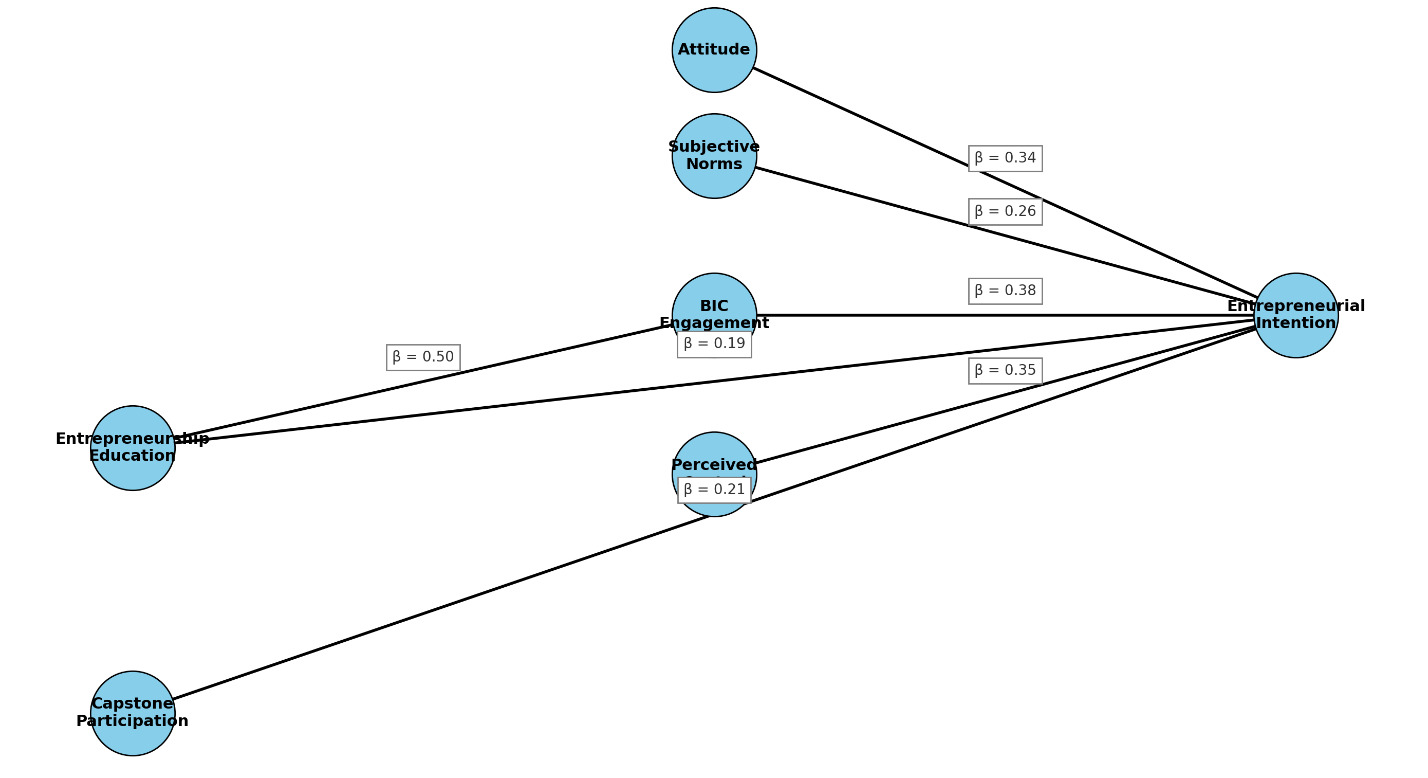
The Structural Equation Modeling (SEM) results in Table 5 indicate a well-fitting model, as evidenced by strong fit indices (CFI = 0.95, RMSEA = 0.045, SRMR = 0.041). Entrepreneurship education had a significant direct effect on entrepreneurial intention (β = 0.19, p = .035), and a stronger indirect effect through BIC engagement (β = 0.19, p = .007), with the bootstrapped 95% confidence interval [.08, .29] confirming mediation significance. BIC engagement itself had a substantial effect on entrepreneurial intention (β = 0.38, p < .001). Among TPB constructs, perceived behavioral control (β = 0.35) and attitude toward entrepreneurship (β = 0.34) were the strongest predictors, while subjective norms also contributed significantly (β = 0.26). These findings affirm that both institutional exposure and psychological readiness shape students’ entrepreneurial intentions.
The smaller direct coefficient for entrepreneurship education in the SEM model, relative to the regression model, reflects the inclusion of BIC engagement as a mediator; that is, part of the association observed in the regression model is accounted for indirectly through BIC engagement in the structural model.
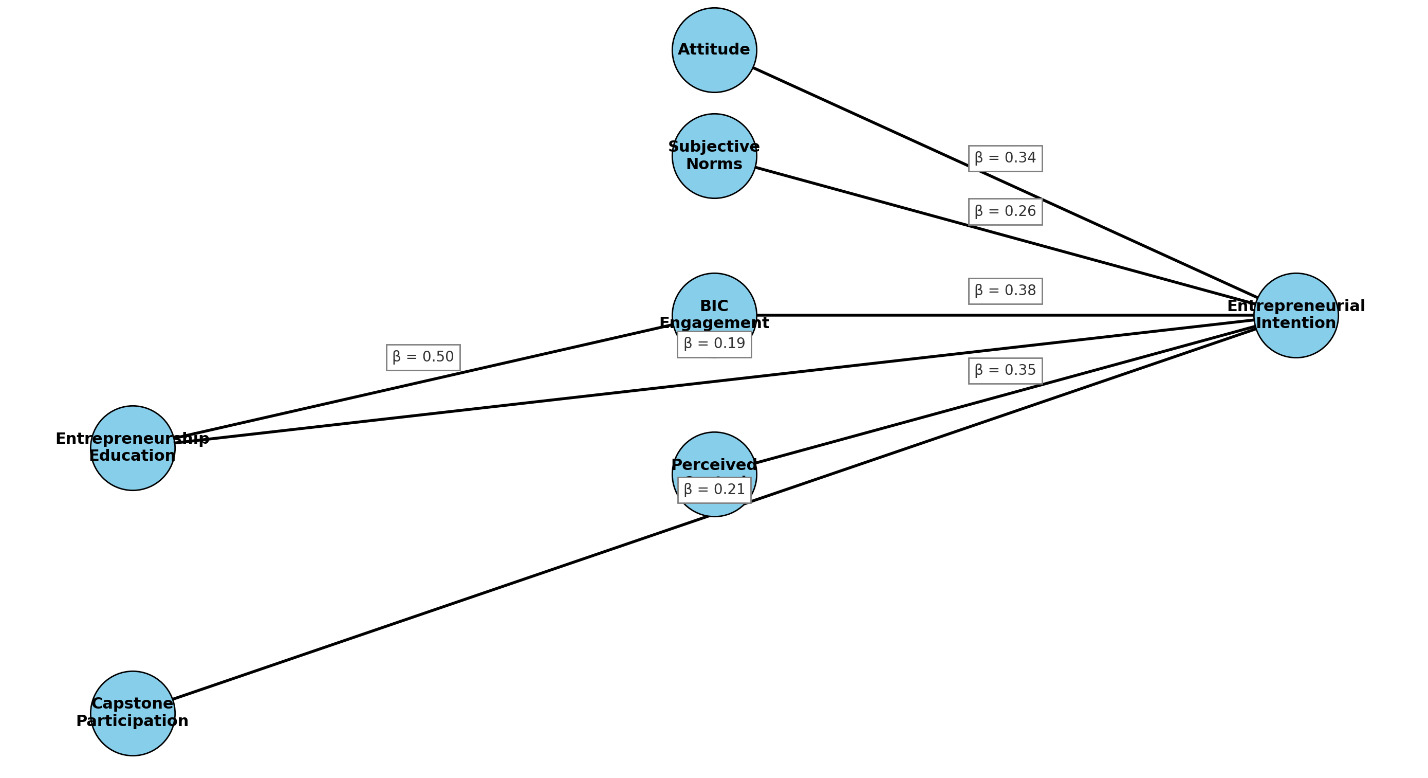
In the structural model, attitude toward entrepreneurship, subjective norms, and perceived behavioral control were specified as direct predictors of entrepreneurial intention, consistent with the Theory of Planned Behavior (Ajzen, 1991). These constructs were modeled simultaneously with institutional variables to assess their relative and complementary influence, see Figure 2.
5. Discussion
5.1. Policy Implementation and Student Exposure
This study offers one of the first empirical evaluations of the Higher Education Commission’s (HEC) 2023 Undergraduate Education Policy on entrepreneurship. The findings suggest that implementation has achieved considerable reach, with 76.7% of students completing the mandated entrepreneurship course. This reflects substantial policy diffusion across Pakistani higher education, echoing earlier assessments of top-down reform adoption (Berry & Berry, 1990). However, deeper analysis reveals significant variation in engagement quality. Only 41.7% of respondents reported participating in capstone projects, and just one-third had any exposure to Business Incubation Centers (BICs). This points to a policy–practice gap (B. A. Soomro & Shah, 2022), where access to formal structures exists, but utilization remains uneven. It suggests that while institutional compliance may be high, actual integration of experiential learning into student pathways is still limited. This multi-level finding underscores that entrepreneurship policy effectiveness depends not only on regulatory mandates but also on institutional absorptive capacity and student-level psychological readiness.
5.2. Entrepreneurship Education and Entrepreneurial Intention
The association between entrepreneurship education and entrepreneurial intention supports Human Capital Theory (Becker, 1975), which proposes that investments in education can enhance individual capabilities. Students who completed the entrepreneurship course reported significantly higher entrepreneurial intentions (β = .31, p < .001), consistent with findings from Fayolle & Gailly (2015) and Martin et al. (2013), who documented the role of entrepreneurship education in skill-building and mindset development. The support for H1 indicates that policy-mandated entrepreneurship education is positively associated with entrepreneurial intention beyond voluntary program participation. This finding addresses the ongoing debate in the literature regarding whether compulsory entrepreneurship courses can meaningfully influence student motivation in developing contexts. Crucially, this association extended across disciplines, not just among business students, reinforcing the rationale behind HEC’s interdisciplinary mandate. However, given the cross-sectional nature of the data, these findings should be interpreted as indicative of a positive relationship rather than definitive proof of causality. Other unmeasured factors, such as pre-existing entrepreneurial interest, may also influence both course participation and intention.
5.3. Mediating Role of Business Incubation Centers
One of the study’s most significant contributions is the identification of Business Incubation Centers (BICs) as a mediating mechanism. The SEM analysis revealed that entrepreneurship education was positively associated with BIC engagement (β = .50), which, in turn, was linked to higher entrepreneurial intention (β = .38). The indirect effect (β = .19, p = .007) underscores the importance of institutional infrastructure in linking classroom learning with stronger entrepreneurial intention and applied engagement. The confirmation of H2 underscores that institutional infrastructure exerts a direct influence on entrepreneurial intention, independent of its mediating function, highlighting the strategic importance of strengthening incubation capacity within universities. This modeling approach distinguishes between the independent institutional contribution of BIC engagement and its mediating role in linking formal coursework with applied entrepreneurial motivation. The support for H4 extends prior research by showing that institutional infrastructure functions not merely as a parallel predictor but also as a structural mechanism through which entrepreneurship education is associated with entrepreneurial motivation. This finding contributes to a more nuanced understanding of how policy-driven reforms are associated with differentiated outcomes across institutional settings. These findings align with research in other developing contexts (Qureshi et al., 2021; Valerio et al., 2014), which suggests that incubators provide critical access to mentorship, peer learning, and real-world application, components not easily replicable in classroom settings. The results also align with Policy Diffusion Theory, emphasizing that universities with strong internal absorptive capacity are more likely to translate external policy mandates into meaningful student outcomes.
5.4. Psychological Determinants of Entrepreneurial Intention
The study affirms the robustness of the Theory of Planned Behavior (TPB) (Ajzen, 1991) in a non-Western, developing context. All three constructs, attitude, subjective norms, and perceived behavioral control, were significantly associated with entrepreneurial intention. Perceived behavioral control (β = .35) and attitude (β = .34) were the most influential, suggesting that both self-efficacy and value attribution play critical roles in driving intention. Subjective norms, though weaker (β = .26), were still significant, indicating that peer and family support remain influential, especially in collectivist societies like Pakistan (M. A. Soomro et al., 2019). The confirmation of H5a, H5b, and H5c reinforces the cross-cultural robustness of the Theory of Planned Behavior in entrepreneurship research and demonstrates that psychological readiness remains central even within policy-driven educational environments. These findings echo earlier studies (Liñán & Chen, 2009) and show how psychological and structural factors interact in shaping entrepreneurial orientation.
5.5. Implications for Policy and Practice
For educators and administrators, the findings suggest that policy compliance alone is insufficient. While course completion rates are high, capstone engagement remains suboptimal, indicating a need to embed experiential learning more deeply into program design. Curricular reforms should prioritize field-based learning and cross-disciplinary collaboration, especially in final-year projects. The central role of BICs further underscores the need for greater investment in incubation infrastructure, particularly in underserved provinces like Balochistan and remote areas of Khyber Pakhtunkhwa. Without such investment, policy reforms risk reinforcing regional disparities in access to entrepreneurial opportunity. For policymakers, the results call for a shift from input-based metrics (course coverage) to outcome-based evaluations that assess depth of engagement, startup activity, and post-graduation entrepreneurial behavior. Supporting inclusive access, especially for women, rural students, and non-business majors, must become a policy priority.
5.6. Contributions to Global Literature
The findings contribute to global literature on entrepreneurship education by providing evidence from a resource-constrained, developing economy. While studies in advanced contexts have demonstrated strong, often linear effects of entrepreneurship education (Nabi et al., 2018), the current study reveals a conditional effect, dependent on the presence of institutional supports. This supports calls by Fayolle et al. (2006) and Walter & Block (2016) for context-sensitive frameworks in entrepreneurship education research. It also suggests that the association between entrepreneurship education and entrepreneurial intention may be shaped not only by psychological variables but also by structural access and institutional capacity, especially in countries with emerging ecosystems. However, as Bae et al. (2014) caution, a well-documented gap often exists between entrepreneurial intention and actual startup behavior, suggesting that intention alone may not fully predict entrepreneurial outcomes. Longitudinal research is needed to assess how these intentions translate into tangible ventures over time.
5.7. Limitations and Future Research
This study has certain limitations. The cross-sectional design does not permit causal inference or temporal sequencing among entrepreneurship education, institutional engagement, and entrepreneurial intention. All measures were collected through self-report in a single survey wave, which raises the possibility of common method variance. Although the sample included multiple universities across Pakistan, the sampling strategy was stratified and purposive rather than fully probabilistic, and regional representation was uneven, with Punjab more heavily represented than Balochistan. This may affect the generalizability of the findings, particularly given regional variation in institutional infrastructure and Business Incubation Center quality. The dependent variable was entrepreneurial intention rather than actual startup behavior, and prior research suggests that an intention–behavior gap may exist. This study did not conduct discipline-specific subgroup analyses. Future research should use longitudinal and comparative designs, incorporate behavioral outcomes, and examine whether the observed associations vary across academic disciplines and regional institutional environments.
6. Conclusion
This study offers one of the first empirical evaluations of a nationally mandated entrepreneurship education reform in a developing economy. The results suggest that while national policy initiatives, such as the Higher Education Commission’s (HEC) entrepreneurship education mandate, have achieved broad implementation, their effectiveness in fostering entrepreneurial intention appears to depend on institutional and psychological enablers. Specifically, the findings indicate that exposure to entrepreneurship education is positively associated with entrepreneurial intention, especially when supported by practical mechanisms such as Business Incubation Centers (BICs) and capstone projects. These platforms appear to strengthen the association between theoretical learning and applied entrepreneurial motivation. At the same time, psychological factors, including perceived behavioral control and attitude, emerged as significant correlates of intention, reinforcing the importance of nurturing entrepreneurial self-efficacy. Importantly, the study highlights that policy diffusion alone does not guarantee deep engagement. Variability in institutional capacity, uneven access to experiential learning, and limited regional infrastructure continue to pose challenges. Without addressing these structural limitations, well-intentioned policies may deliver symbolic rather than substantive outcomes. At the same time, the study’s outcome variable is entrepreneurial intention rather than actual venture creation or sustained entrepreneurial activity. This distinction is important because entrepreneurial intention does not automatically translate into entrepreneurial behavior. The findings should therefore be interpreted as evidence regarding precursors of entrepreneurship rather than realized entrepreneurial outcomes.
From a broader perspective, the Pakistani case offers cautious optimism for policymakers across the Global South. While top-down reforms can create enabling environments, their long-term impact hinges on bottom-up capacity, including institutional readiness, equitable access, and meaningful student engagement. Future research should explore how these dynamics evolve over time and across contexts, particularly using longitudinal or comparative methods.
Funding Statement
This research did not receive any specific grant from funding agencies in the public, commercial, or not-for-profit sectors.
Ethical Approval
This study was approved by the Institutional Review Board (IRB) of the respective universities. Informed consent was obtained from all participants prior to data collection.