Introduction
Agriculture plays a vital role in economic growth, contributing 4% to the global gross domestic product (GDP), and in some of the least developed countries, it can make up more than 25% of GDP (The World Bank, 2024). Enhancing agricultural value can reinforce a country’s economic stability (Kaur et al., 2018). Currently, agriculture is experiencing its fourth revolution, driven by information technology that can exponentially boost productivity (Walter et al., 2017). Digital technology is transforming agriculture by increasing efficiency and promoting environmental sustainability (Kernecker et al., 2020). From this perspective, the role of farmers extends beyond being mere producers of raw materials. They also have the potential to become entrepreneurs. Agriculture holds vast potential, offering sustainable and suitable employment opportunities for new-generation farmers and agripreneurs.
On the other hand, the growth of the technology-driven agricultural sector is threatened by disruptions caused by the COVID-19 crisis, extreme weather fluctuations, increasing poverty, and conflict (The World Bank, 2024). Most research shows that agricultural skills, personality traits, and perceptions of government support significantly influence the operation of agribusinesses (Annosi et al., 2020). Still, several factors affect the development of agripreneurs in developing countries, such as support from the government, trade barriers and monopolies by large operators, poor infrastructure, incomplete market institutions, and limited credit for agricultural investments, especially the lack of business skills (Adeyanju et al., 2023). Likewise, developing countries like Thailand face challenges such as the middle-income trap, income inequality, disparities, and unbalanced development. Agriculture, which employs 40% of the country’s population, contributes only 10% of GDP (Thailand Policy Lab, 2024). The problem of unequal income distribution from production stems from the inability to transition from being a producer to becoming an entrepreneur. As a result, they remain merely intermediate product producers for entrepreneurs who manufacture the final goods. For instance, in the case study of white rice, it was found that in 2023, only 1.1% of the price of white rice as a final consumer product was returned to Thai farmers as profit. Therefore, the inability of Thai agriculture to generate added value that appropriately returns income to farmers results in the average annual income of agricultural workers in 2022 being approximately 4,019.20 USD per person, while non-agricultural workers have an average annual income of approximately 18,193.23 USD per person (TTB Analytics, 2024). This inevitably leads to a trend where the younger generation forgoes agriculture in favor of employment in non-agricultural sectors, driven by higher financial returns. Thai farmers face ongoing inequality, so they need to learn to become entrepreneurs, gain new skills, and adopt new technologies to keep up with the world.
In the context of Agriculture 4.0, digitalization driven by the Internet of Things (IoT) and big data enables precision farming that reduces input misuse, stabilizes yields, and lowers production costs—key failures in smallholder rice systems (Karunathilake et al., 2023). IoT-based sensors, smart irrigation, and real-time crop and soil monitoring generate continuous data that support site-specific decisions, reducing resource waste and vulnerability to climate and pest shocks that erode Thai rice farmers’ margins (Kumar et al., 2024). Along the rice value chain, big data analytics applied to IoT-derived logistics and quality data improve supply chain coordination, optimize transport and storage, and cut post-harvest losses, thereby weakening the historically high-cost, low-transparency structures that disadvantage smallholders (Abbasi et al., 2022). Digital platforms further enable farmers to bypass intermediaries by accessing real-time price information and selling directly to consumers or retailers, thereby increasing market accessibility and substantially raising farmgate income while improving price transparency and payment security (Niyawanont, 2022). These data-driven platforms help address the “trust deficit” in agricultural trade by enabling traceability, certification, and more equal information flows, supporting a shift from low-margin bulk rice to higher-value, quality-differentiated, and sustainably branded products (Araújo et al., 2021).
Nevertheless, in Thailand, large capital companies and multinational corporations dominate high-potential digital technologies, and there are issues with the development imbalance trap, including low competitive capability (Ministry of Industry Thailand, 2021). This provides a strong and explicit bridge from national income disparities, rice value chain problems, and uneven digital adoption, motivates examining how agripreneurial capabilities, sustainability, and the mediating role of digitalization. Due to attracting younger generations to the agricultural sector is essential for fostering the long-term sustainability of global food and agricultural systems.
Literature Review
Agripreneurship is the transformation of agricultural activities into entrepreneurial activities that manage agribusinesses dynamically (Mukaila, 2022). Academics applied the concept of agripreneurship to business owners engaged in independent professions, focusing on creating agricultural wealth through community agriculture that markets directly and sustainably (Kaur et al., 2018). While also undertaking to apply new methods, processes, and techniques in agriculture to achieve better yields and economic income (Mukembo, 2017). From the review literature, mainstream entrepreneurship often overlooks the agricultural sector and sustainable development in agriculture. Furthermore, the lack of empirical evidence poses challenges in developing the dimensions of agripreneurship and in studying the impact on sustainable agribusiness performance in an era where digitalization has played a significant role. Digitalization is transforming the agricultural sector using digital technologies, including IoT, big data, and platforms, which are creating new service channels and opportunities. These technologies are being integrated into the agricultural value chain to enhance efficiency and effectiveness. Digitalization is a process that involves entrepreneurship (Kraus et al., 2023). Similar to digitalization in agripreneurship, the implementation of digital technology in all aspects of agricultural activities and agribusiness has important principles for using digital technology in agriculture to achieve sustainable policy (MacPherson et al., 2022). As well as digitalization in the process of promoting sustainable agricultural activities in various aspects (Hidalgo et al., 2023). A substantial body of academic research has found that sustainable entrepreneurship plays a crucial role in promoting sustainability across economic, social, and environmental aspects (Vuorio et al., 2018). The concept of sustainable development is not only used to provide knowledge or define sustainable development goals but also serves as a performance measurement tool for businesses that engage in sustainability practices, playing a crucial role in demonstrating commitments to agricultural sustainability (Sargani et al., 2020). Amid the advancement in digital technology, significantly transforming business models and changing consumer behavior, it is essential to explore the dimensions of agripreneurship to be able to survive sustainably in the current challenging environment.
Hypotheses Development
Agripreneurship and Digitalization
The role of individual entrepreneurial orientation in a digital strategy context involves creating innovation and digitalization (Ritala et al., 2021) and achieving firm outcomes. Likewise, agripreneurship is the behavior that entrepreneurs demonstrate through various activities in agribusiness operations, which influences digitalization by utilizing digital technology (Hidalgo et al., 2023). Digitalization has been seen in the dynamics of technology, input, suppliers, farmers, traders, processing, retailers, and consumers. The impact of digitalization is deeply interwined with agribusinesses and agripreneurs (Annosi et al., 2020). However, there are few empirical research studies, and they are conducted in different industries (Warner & Wäger, 2019). This research focuses on agripreneurship, which demonstrates the ability to grow agribusinesses and support competitive potential. Therefore, this is the basis for hypothesis H1:
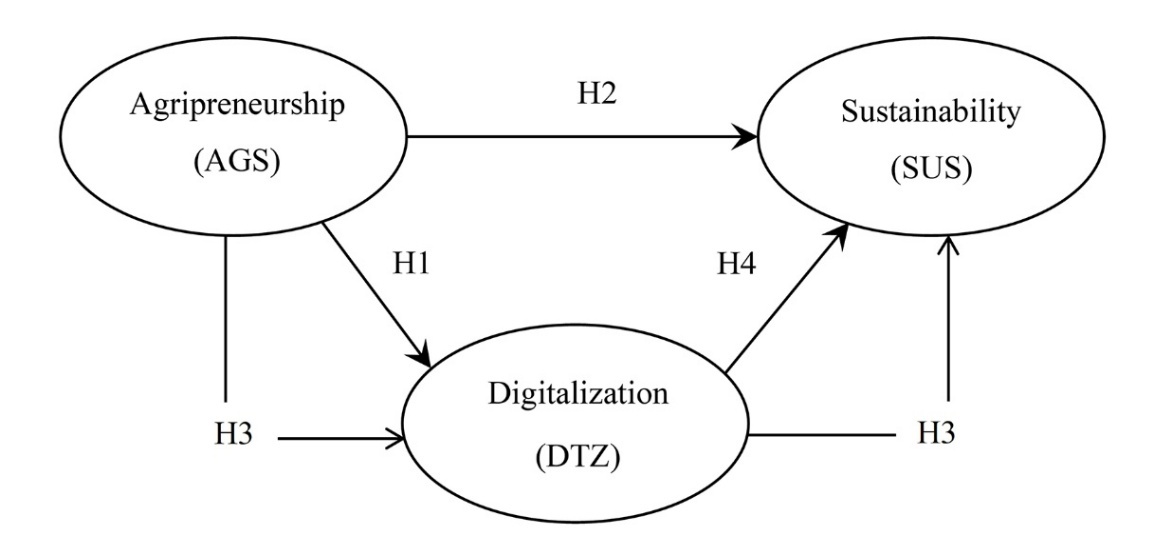
H1. Agripreneurship has a positive direct effect on digitalization
Agripreneurship and Sustainability
Over the past decade, there has been a growing focus on developing agripreneurial sustainability. The findings of Kaur et al. (2018), agripreneurship is an agribusiness where the community/farmers directly sell their products and improve productivity through sustainable value addition. Aligning with Bischoff and Volkmann (2018) supported the concept of entrepreneurship that brought sustainability to the core strategies and business models of companies, by showing that entrepreneurs understand the connection between environmental, economic, and social sustainability. In addition, Rosário et al. (2022) found that being an entrepreneur is a process of integrating sustainability into the operational strategies of organizations to create collective sustainability. However, empirical results have received little attention, and the lack of empirical evidence poses a challenge in developing the dimensions of agripreneurship that affect sustainability. Hence, this leads to the hypothesis H2, which is:
H2. Agripreneurship has a positive direct effect on sustainability
Agripreneurship, Digitalization, and Sustainability
Agripreneurship creates value and establishes businesses in the agricultural sector for the benefit of economic development (Kaur et al., 2018). Agripreneurs utilized digital technologies to provide opportunities for transforming agriculture for sustainability (Walter et al., 2017), increasingly integrated with investment in agricultural development, which can improve efficiency and sustainability (Ferreira et al., 2020). Hence, digitalization is a tool for enhancing economic efficiency and a solution to sustainability issues (MacPherson et al., 2022). Numerous research findings acknowledge that digital agriculture will lead to changes in efficiency, productivity, and sustainability throughout the supply chain. On the other hand, the support system for promoting entrepreneurship activities in developing countries, where the application of modern technology has limitations, affects the sustainable development of agripreneurship (Kraus et al., 2023). This gives rise to hypothesis H3, which is:
H3. Digitalization has a mediating role between agripreneurship and sustainability
Digitalization and Sustainability
Digitalization is a critical strategic mechanism as an integrated process—progressing from IoT-enabled data collection to big data analytics, and culminating in platform business models, this stage connects the entire supply chain from upstream to downstream. Furthermore, platforms enhance social sustainability by providing smallholder farmers with direct market access, ensuring fairer pricing and better livelihood security (Niyawanont, 2022). In the context of sustainability, this technology allows for “precision agriculture,” where water, fertilizers, and pesticides are applied only where and when needed. By minimizing waste and reducing chemical runoff, IoT directly contributes to the environmental dimension of sustainability (Hidalgo et al., 2023). According to several studies, digital transformation has a direct positive influence on firm outcomes. There is currently no global or regional strategy for agricultural digitalization. However, policies often consider digitalization as a driving force or means to achieve sustainability goals (MacPherson et al., 2022). Therefore, this is the origin of hypothesis H4.
H4. Digitalization has a positive direct effect on sustainability
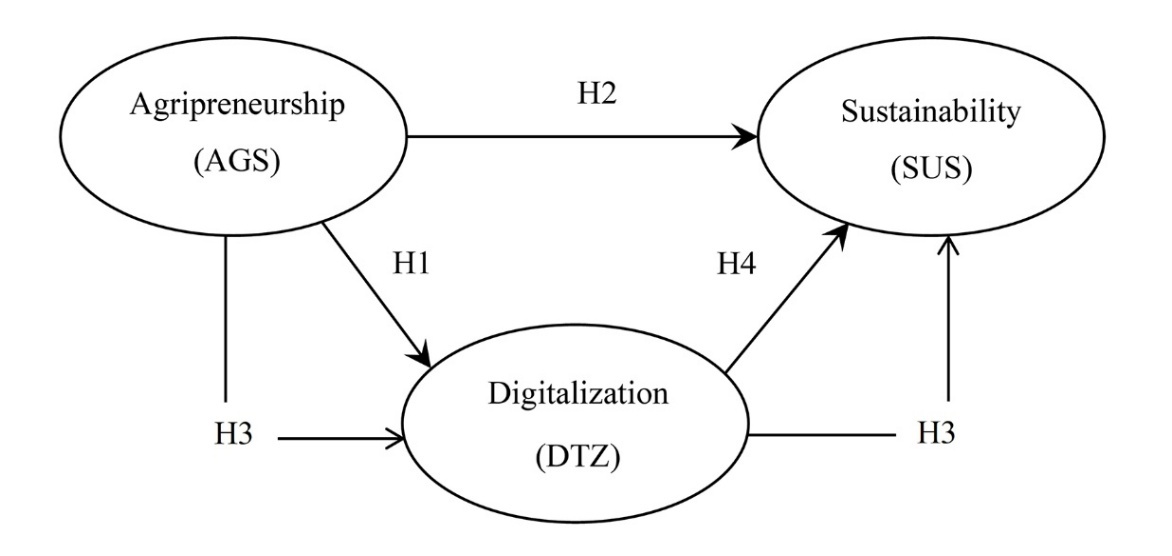
The research framework is shown in Figure 1.
Methodology
Sample and Data Collection
The population is agripreneurs in Thailand. There were 452 registered in the public database on the Ministry of Agriculture and Cooperatives, Thailand (2023) website. Data was collected by electronic questionnaires sent via email to the entire population over five months with a convenience sampling method. A total of 204 samples were collected. The response rate was 45.13%
Instrument and Measurement
The questionnaire is the instrument used to collect primary data. The measurements capture the latent variables of SEM that require respondents’ opinions using a 7-point Likert scale ranging from 1 (Strongly Disagree) to 7 (Strongly Agree). The details are shown in the appendix.
Exogenous Variable: Agripreneurship, measured through 24 items were adapted from Adeyanju et al. (2023); Mukembo (2017).
Mediator Variable: Digitalization, the items were adapted from Kraus et al. (2023).
Endogenous Variable: Sustainability, evaluated through environmental, social, and economic indicators, the items were adapted from Rosário et al. (2022); Zhen and Routray (2003).
Then, the items were reviewed and assured content validity by 3 experts. The result found that the Index of Item Objective Congruence (IOC) = 0.87, which was greater than 0.5 (Rovinelli & Hambleton, 1977). Reliability testing by a pilot study with 30 respondents. The Cronbach’s alpha coefficients were greater than 0.800 (agripreneurship = 0.867, digitalization = 0.926, and sustainability = 0.931). This indicates that the measurement model has a very good level of reliability (George & Mallery, 2016).
Data Verification
Multivariate outliers examination is the consideration of abnormally high or low values using the Mahalanobis distance (D2) statistic (Mahalanobis, 1936). There are 4 data with the D2 = 85.800, 86.246, 90.570, and 121.974, and all of the p-values = 0.000 are lower than 0.001, which were considered as multivariate outliers. Then, the said data was eliminated. Hence, a total of 200 data can be analyzed. The sample size of 200 has good reliability for structural equation modelling (SEM) (Hair et al., 2018). The normal distribution has been verified by skewness-kurtosis values (Tabachnick & Fidell, 2019). The result found the range of -3.00 to +3.00, which shows a normal distribution (Kline, 2023).
Structural equation modelling
This research employed SEM with the AMOS technique to examine the measurement model, structural model, and hypotheses testing. First, exploratory factor analysis (EFA) was used to investigate the observable/items of agripreneurship and develop constructs for the appropriate measurement of agripreneurship. This aimed to develop dimensions of agripreneurship. Second, confirmatory factor analysis (CFA) was used to confirm the measurement model of agripreneurship, digitalization, and sustainability. Finally, path analysis was used to examine the causal relationship for testing hypotheses. Model fit testing with criteria < 5.00 (Loo & Thorpe, 2000), RMSEA < 0.08, GFI > 0.90, CFI > 0.90, NFI > 0.90 (Hu & Bentler, 1999), IFI > 0.90, TLI > 0.90 (Hair et al., 2018). The convergent validity analysis: a statistical significance of 0.05 with a t-value > 1.96. The composite reliability or construct reliability (CR) > 0.7 (Carmines & Zeller, 1980), the average variance extracted (AVE) > 0.5 (Fornell & Larcker, 1981), the factor loading > 0.6 (Hair et al., 2018), and the discriminant validity analysis when comparing of each variable with the correlation between the other variables, must be higher than the correlation between the variables (Fornell & Larcker, 1981). Finally, mediation analysis using 95% Confidence Interval with 5,000 bootstrap samples estimate (Collier, 2020).
Results
According to 200 sampled agripreneurs in Thailand, that gathered from this research. They were 67.2% crop agripreneurship, 17.5% livestock agripreneurship, and 15.3% aquaculture agripreneurship. Most of the agripreneurs were in the start-up stage = 35.5%, the maturity stage = 30.0%, the growth stage = 23.0%, and the renewal or decline stage = 11.5%. Most of them have a duration of the business establishment until the present of less than 10 years = 35.0%, 11-20 years = 35.5%, more than 30 years = 17.6%, and 21-30 years = 12.0%. Most of them have 1-9 employees = 59%, 10-49 employees = 22.0, 50-250 employees = 18.0%, and more than 250 employees = 1.0%.
Agripreneurship Construct
Agripreneurship dimensions development utilized EFA to investigate the appropriate components of agripreneurship, employing common factor analysis with the principal axis factoring method, which resulted in a low root mean square residual (RMSR). Then, oblique rotation with the Promax method was appropriate for correlating factors and is likely and suitable for factor analysis for SEM (Hair et al., 2018). The results showed that Kaiser-Meyer-Olkin (KMO) = 0.866. This means that the model was able to describe 86.60% of the agripreneurship variables composition, which was at a good level. According to Barlett’s test of sphericity, it was statistically significant at 0.001. This indicates that the items within the components are interrelated. Therefore, it can be concluded that the data is appropriate for the construct of agripreneurship. Furthermore, the result found that the commonalities were higher than 0.4 (Costello & Osborne, 2005), while the eigenvalue > 1, representing 63.76%. There were 26 items, with a factor loading > 0.6, that can be extracted into a total of 6 components. Then, CFA was used to investigate the construct of agripreneurship.
The CFA results of the agripreneurship construct showed index values: = 1.166, RMSEA = 0.029, GFI = 0.901, CFI = 0.987, NFI = 0.919, IFI = 0.988, and TLI = 0.985. The index values passed the statistical criteria, indicating that the AGS component was consistent with empirical data; meanwhile, the t-value > 1.96. The findings suggest that the agripreneurship construct shows convergent validity. Likewise, CR, AVE, and factor loading had good construct reliability, as shown in Table 1.
The items were grouped into 6 components. (The agripreneurship items AGP1-AGP27 are in the appendix). These define each as 6 new dimensions of agripreneurship as follows:
Agripreneurial innovation (AGI) refers to the creative initiative in seeking ways to develop agricultural products that add value and generate income. As well as the new agribusiness processes that can assess the risks of agricultural investments, agribusiness must be resilient to uncertainties and committed to developing new methods to achieve sustainable success in agricultural operations.
Agripreneurial opportunities (AGO) refers to the exploration and assessment of opportunities to plan the transformation of agriculture into agribusiness, and they believe that it will succeed. This is the ability to access information about agribusiness throughout the value chain. For example, production factors range from farmers, processors, suppliers, the retail, and technology.
Agripreneurial Operations (AGP) refers to the ability to plan, control, and make rational decisions that align with the goals of future agribusiness and to operate agribusiness successfully.
Agripreneurial venturing (AGV) refers to the skill of persuading investors to support/invest in their agribusiness, as well as being interested in investing and/or becoming business partners in agriculture with allies/trade partners, and the ability to convince customers to purchase their agricultural products.
Agripreneurial adaptability (AGD) refers to the ability to manage/learn from failed business projects with determination and the courage to face new challenges, and to make independent decisions to lead the agribusiness to success. The ability to adapt is an advantage in the highly competitive global economy.
Agripreneurial marketing (AGM) refers to the ability to determine the types of agricultural products that customers want, to create a brand and set appropriate prices, and to market agricultural products using new methods.
Measurement Model
Before CFA of the measurement models and SEM, manifest variables, which refer to items of each component of each construct, were reduced into composite variables. For reducing the number of variables and parameter values in the research cases where the sample size is small (Prajogo & Sohal, 2003). By combining the values of each item of each component and calculating the meaning (Williams & O’Boyle, 2008).
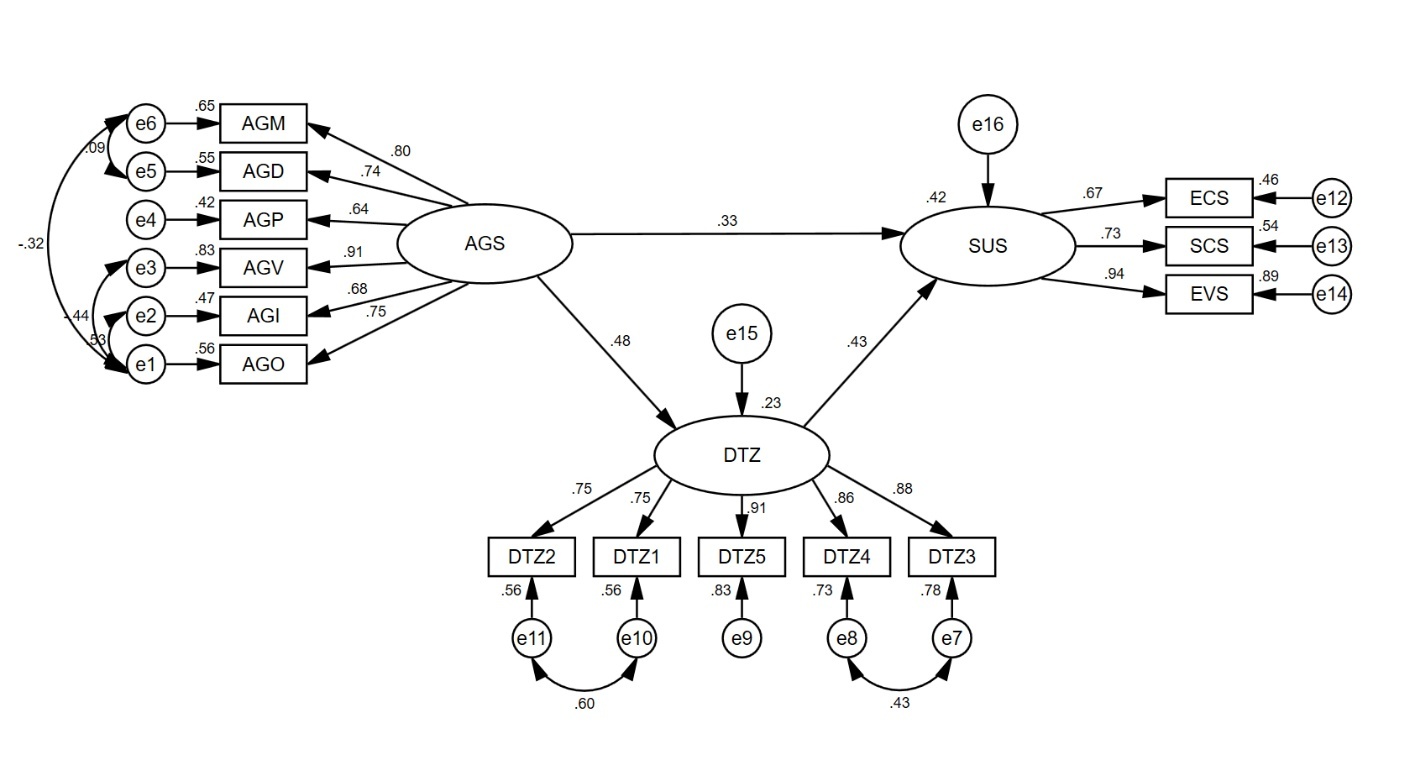
The CFA results of the measurement models showed index values: = 1.896, RMSEA = 0.067, GFI = 0.921, CFI = 0.972, NFI = 0.943, IFI = 0.972, and TLI = 0.961. The index values passed the statistical criteria, indicating that the measurement model was consistent with empirical data. Meanwhile, t-value > 1.96, it is concluded that the measurement model shows convergent validity. Likewise, CR, AVE, and factor loading had good construct reliability, as shown in Table 2. And the details of each composite variable/item are in the appendix.
Table 3. The discriminant validity presents that of agripreneurship = 0.760, digitalization = 0.831, and sustainability = 0.792 when comparing of each variable, along with the correlation between those variables and other variables in which is higher than the correlation between the variables (0.482, 0.533, and 0.585). This finding suggests that the measurement model could clearly distinguish each variable and had good discriminant validity (Fornell & Larcker, 1981).
Structural model and hypotheses testing
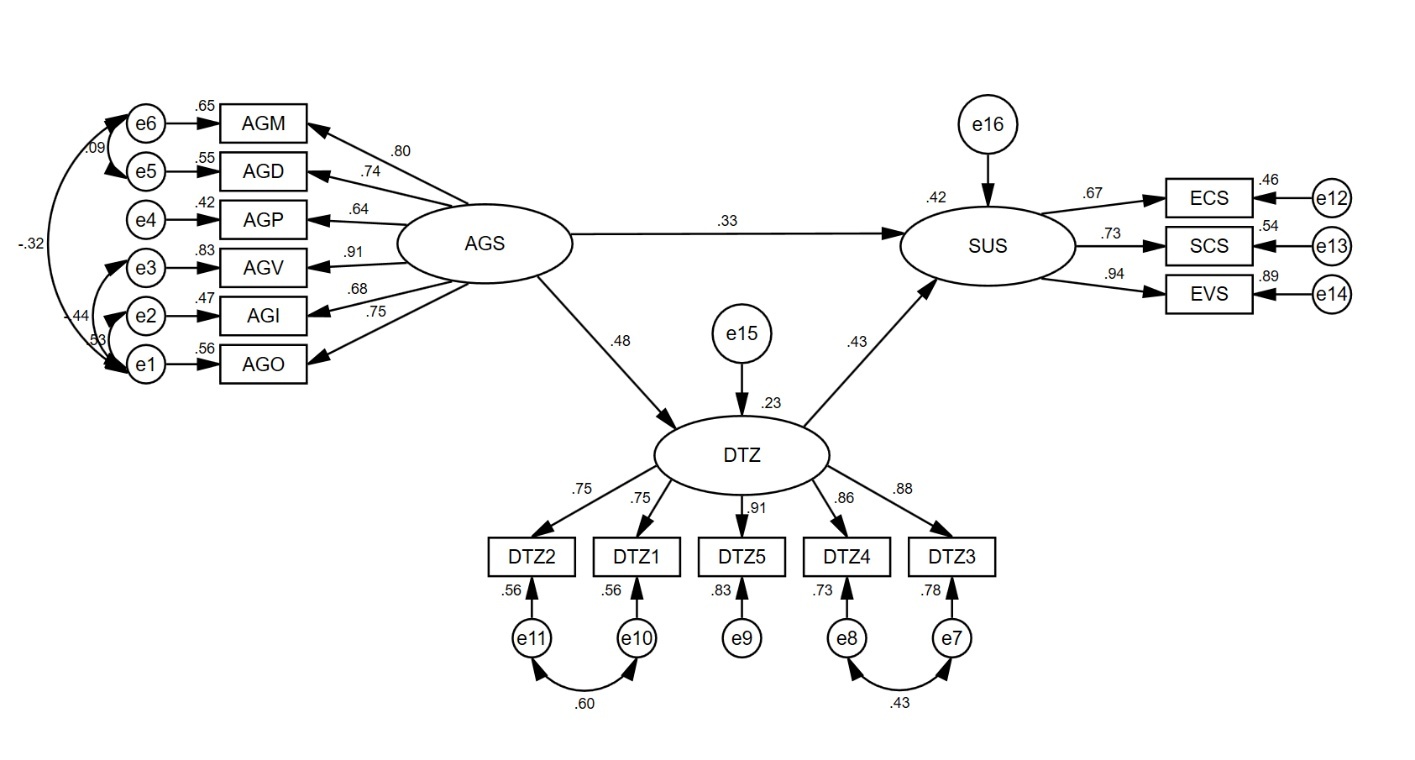
Figure 2, which presents the index values: = 1.896, RMSEA = 0.067, GFI = 0.921, CFI = 0.972, NFI = 0.943, IFI = 0.972, and TLI = 0.961. The index values were consistent with the statistical criteria. This indicated that this structural model is valid.
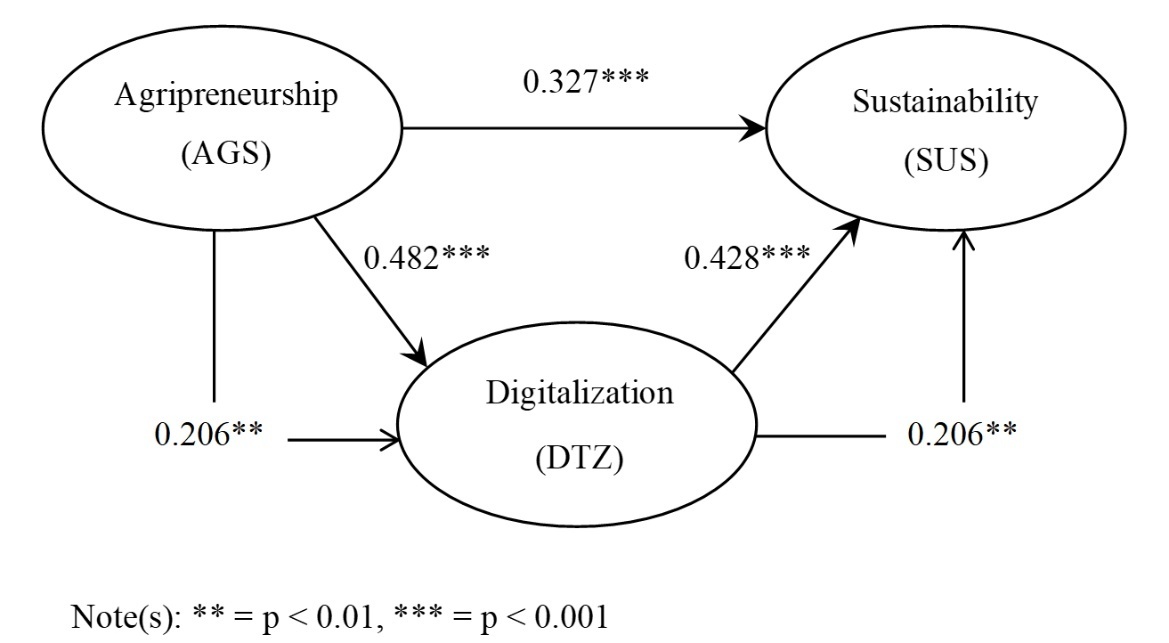
The results of path analysis are shown in Figure 2 and Table 4, which show that agripreneurship had a positive direct effect on digitalization (DE = 0.482), the standard coefficient = 0.482 (t-value = 5.766, p < 0.001); hence, H1 was accepted. The coefficient of determination (R2) = 0.232, meaning that 23.20% of the digitalization variance could be explained and predicted by agripreneurship.
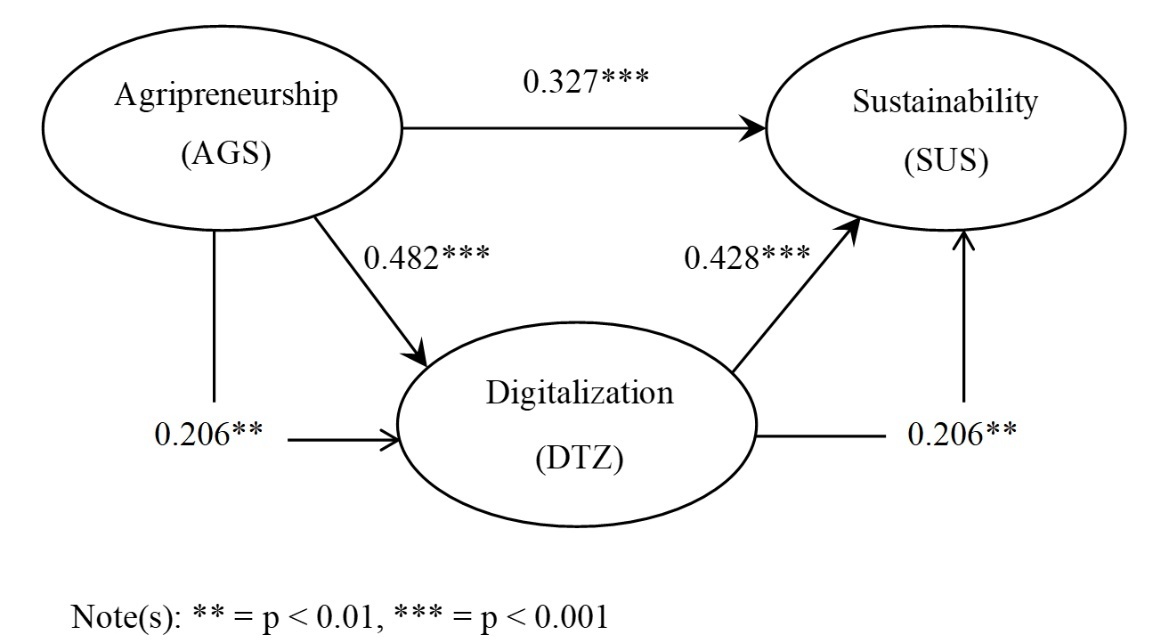
Agripreneurship had a positive direct effect on sustainability (DE = 0.327), the standard coefficient = 0.327 (t-value = 3.913, p < 0.001); thus, H2 was accepted. Furthermore, agripreneurship had a positive indirect effect on sustainability through digitalization (IE) = 0.206 (t-value = 3.847, p < 0.01); hence, digitalization partially mediated the relationship between agripreneurship and sustainability (Mediation analysis summary is presented in Table 5). Therefore, H3 was accepted. Digitalization had a positive direct effect on sustainability (DE = 0.428), the standard coefficient = 0.428 (t-value = 5.164, p < 0.001); thus, H4 was accepted. The coefficient of determination (R2) = 0.424, meaning that 42.40% of the sustainability variance could be explained and predicted by agripreneurship and digitalization.
The summary of hypotheses testing results is represented in Figure 3 and Table 6.
Discussion and Implications
The results revealed a significant positive direct effect of agripreneurship on digitalization = 0.482, t-value = 5.766, p < 0.001). The finding is consistent with existing literature that entrepreneurship is an important factor that enables organizations to undergo digital transformation more quickly. Entrepreneurs are the ones who use digitalization strategies (Kraus et al., 2023; Warner & Wäger, 2019). According to the research results, if entrepreneurs have an increased ability to be agripreneurs, it will positively impact digitalization as well. The extensive adoption of digital technology is contingent upon the entrepreneurial behavior of employees. Especially in large companies where organizational management no longer relies solely on a single leader, but benefits from employees with increasingly entrepreneurial behaviors (Ritala et al., 2021).
Likewise, agripreneurship has a positive direct effect on sustainability = 0.327, t-value = 3.913, p < 0.001). The finding supports the study of Zhen and Routray (2003); Rosário et al. (2022), and this is consistent with Vuorio et al. (2018) found that sustainability in entrepreneurship can extend to other types of entrepreneurs, which requires consideration of the forms of economic sustainability, society, and the environment in the context related to that type of entrepreneurship. Entrepreneurs can develop sustainability by creating social collaboration that meets the needs of individuals and communities, including economic, social, and environmental aspects. Therefore, when agripreneurs intend to develop and enhance the creation of economic, social, and environmental values.
Furthermore, digitalization partially mediated the relationship between agripreneurship and sustainability (IE = 0.206, t-value = 3.847, p < 0.01). This is consistent with Walter et al. (2017); Ferreira et al. (2020); Kraus et al. (2023). This finding suggests that digitalization plays an enhancing role for organizations with characteristics of agripreneurship to achieve the principles of sustainability. Agripreneurs can use digital technology to effectively and transparently monitor biodiversity and the utilization of ecosystem services. Supports good and diverse agricultural decision-making for productivity goals and improves the effective use of resources. Therefore, digitalization plays a role in using digital technology as a tool to connect agripreneurship to achieve sustainable goals for sustainable agricultural practices in the future.
Finally, Digitalization has a positive direct effect on sustainability = 0.428, t-value = 5.164, p < 0.001). This is consistent with Annosi et al. (2020); Mukaila (2022), who found that digital technology has the potential to address several sustainability issues in the value chain of farmers. The use of digital technology to improve agricultural operations enhances productivity and reduces production costs. Farmers and agripreneurs can trade directly via platforms, such as digital marketing or online social networks. These can improve visibility and engagement in the supply chain by directly accessing production factors and marketing channels. In addition, data transmitted through digital channels can be used to learn about sustainable practices and operations to adapt to various changes. These are allowed for risk management planning and creating new opportunities (Hidalgo et al., 2023) for sustainable agripreneurship.
The empirical results confirm that six dimensions of agripreneurship: (1) agripreneurial innovation, (2) agripreneurial opportunities, (3) agripreneurial operations, (4) agripreneurial venturing, (5) agripreneurial adaptability, and (6) agripreneurial marketing) are evidenced by its high factor loading (0.685, 0.746, 0.645, 0.910, 0.744, and 0.804). These serve as a critical pillar of the agripreneurship construct. Meanwhile, digitalization mediates the relationship between agripreneurship and sustainability (IE = 0.206, t-value = 3.847, p < 0.01). The six dimensions move agriculture from subsistence to high-value industry, which is the primary mechanism for escaping the middle-income trap. For example, by integrating agripreneurial venturing and innovation, digitalization acts as a catalyst that shifts traditional farming toward high-value agribusiness, providing a structural exit from the middle-income trap through enhanced total factor productivity (Schwab et al., 2023). This mediated transition ensures more equitable income distribution by democratizing market access and reducing the systemic inefficiencies that stifle rural economic mobility. The mediation of digitalization allows dimensions like agripreneurial adaptability and marketing to function as direct exit strategies from economic stagnation by diversifying rural income streams and by-passing predatory intermediaries (Nayyar et al., 2024). Consequently, digital integration transforms these six dimensions from individual survival tactics into a collective framework to narrow the wealth gap and foster long-term macroeconomic sustainability.
Theoretical Implications
The findings present 6 new dimensions of agripreneurship: (1) agripreneurial innovation, (2) agripreneurial opportunities, (3) agripreneurial operations, (4) agripreneurial venturing, (5) agripreneurial adaptability, and (6) agripreneurial marketing, which is consistent with empirical data. These dimensions show that agripreneurship means the ability to engage in agricultural business with innovation, from the production process, product development, and new ways of conducting agribusiness. Being able to turn agricultural opportunities into a successful agribusiness, possessing agripreneurial skills and interest in investing in agribusiness, can make independent decisions to adapt to a highly competitive business environment. Plus, the ability to market agricultural products using new methods, which align with the creation of innovative economic organizations for growth under the constraints of risks and uncertainties, in a current context where digital technology has become important in the agricultural sector (Klerkx et al., 2019).
Practical Implications
The mediating role of digitalization underscores that the six dimensions of agricultural entrepreneurship serve as strategies for escaping the economic constraints of the middle-income trap and unequal development. Particularly, agripreneurial operations and innovation require digital tools to manifest their potential for sustainable development fully. Therefore, agripreneurs and smallholders should move beyond basic digital literacy toward the adoption of integrated value-chain tools. Since (1) agripreneurial operation and (2) agripreneurial innovation showed high factor loading (0.645, 0.685), evidence supports the development of innovation capabilities that enable agripreneurs to introduce new technologies, productions, products, and business models. Practically: (a) Provide innovation-focused training and incubation that helps agripreneurs design, test, and commercialize new agricultural products and services, especially in high-tech domains such as smart farming and Agriculture 4.0. (b) Support agri-startups and digital agribusiness models that combine entrepreneurial talent with advanced technologies. (c) Facilitate access to innovation resources, R&D partnerships, and innovation clusters that strengthen agripreneurs’ capacity to experiment with and scale novel solutions (Adenan et al., 2025). (3) agripreneurial venturing showed a strongly high factor loading (0.910). Structuring joint agribusiness ventures and public–private partnerships that blend public risk-sharing with private equity stakes to expand access to capital and modern technologies. Mobilizing private agricultural investment through clear incentives and stable rules, making high-risk agrifood ventures more investable for private partners (Havemann et al., 2020). With these equity and joint-venture mechanisms with the empirically strong agripreneurial venturing dimension, governments and intermediaries can more effectively channel private capital to local agripreneurs.
The empirical results confirm that agripreneurial opportunities, marketing, and adaptability serve as a critical pillar of the agripreneurship dimensions. Since (4) agripreneurial opportunities showed a high loading factor (0.746), suggesting that the ability to systematically scan, evaluate, and exploit market gaps is a primary determinant of agribusiness performance and economic sustainability. Agripreneurs should receive structured training on opportunity identification and assessment in agribusiness management. As well as strengthen farmers’ social and market networks and information use (extension services, ICT tools, and market intelligence) to detect and evaluate emerging niches (Sher et al., 2019). This involves leveraging digital analytics to monitor market trends, shifting consumer demands, technological advancements, and policy-created opportunities. (5) Agripreneurial marketing is evidenced by its very high factor loading (0.804). Building agripreneurs’ marketing skills in market research, pricing, packaging, branding, promotion, and use of online and social-media channels, which are repeatedly identified as core determinants of successful product launch and higher farm incomes. Expanding access to timely market information (prices, demand trends, buyer requirements) through digital platforms, which enhances farmers’ negotiation power and allows them to choose more profitable channels (Thakur et al., 2023). (6) Agripreneurial adaptability showed high factor loading (0.744). Policy makers and support agencies should design interventions that deliberately strengthen agripreneurs’ ability to reconfigure their products, processes, and market channels in response to market changes and technological disruptions. This includes (a) entrepreneurship training focused on adaptive business planning and risk management (Reidsma et al., 2023) and (b) support for the adoption and effective use of digital technologies (e.g., IoT, big data, digital platforms) as key enablers of rapid adjustment in production, marketing, and sustainability practices (de Boon et al., 2024). Including building “adaptive capacity”, the ability to reallocate resources and capital toward social and economic opportunities that emerge during market volatility.
These recommend that agricultural enterprises implement “digital audits” to ensure that technology is actively contributing to the six agripreneurship dimensions, particularly in marketing and venturing. This ensures that digitalization remains a functional tool for achieving the United Nations’ Sustainable Development Goals (SDGs) within the agricultural sector (United Nations, 2023).
Policy Implications
Thai agriculture faces inequality, low wages, and high informality that are closely linked to unequal access to digital technologies and agripreneurial opportunities. The mediating role of digitalization in this research recommends targeted, structural reforms that leverage agripreneurial capabilities. Policies should be inclusive digital agriculture ecosystems that explicitly support smallholders’ transition to agripreneurs. Evidence shows that smallholders’ digital adoption depends on digital infrastructure, affordability, and skills, not just technology availability (Choruma et al., 2024; Smidt & Jokonya, 2022). In Thailand, where artificial intelligence and agriculture technology are often driven by large capital, these risks reproduce existing inequalities rather than transforming them (Niyawanont, 2022). Thus, policy must integrate access to finance, technology, skills, and supportive institutions
Given aging farmers, small plots, and debt, policy should differentiate between: (a) direct digital users (younger, better-educated farmers) and (b) those accessing digitalization via cooperatives, outsourcing, or service platforms (Hoang & Tran, 2023). Evidence from China and other developing countries shows that cooperatives, service-scale operations, and digital platforms can embed smallholders in digital agriculture even when they lack individual capacity or land scale (Xie et al., 2021)
For Thailand, this implies prioritizing: (1) Digital farmer development frameworks and extension reforms that embed digital technology such as IoT, big data, and digital platforms within agripreneurial training and peer communities (Mapiye et al., 2021). (2) Public–private partnerships conditioned on inclusive access, transparent data use, and support for smallholders rather than only large agribusiness (Kitole et al., 2024). (3) Youth-focused agripreneurship programs combining digital skills, incubation, and start-up capital to counter rural aging and informality (Singh & Misra, 2021). These recommendations connect the six agripreneurship dimensions of this research to specific state interventions that can unlock the indirect, digitalization-mediated pathway from agripreneurship to sustainability.
Limitations and future research
The scope of this research was specifically delimited to digitally active agripreneurs to ensure that the mediator variable (digitalization) possessed sufficient variance for robust covariance-based analysis. However, the reliance on electronic data collection is a methodological limitation regarding broader generalizability. Because SEM requires measurable variance to establish causal paths, the inclusion of digitally excluded groups—who would yield zero-level data for the mediation construct—would violate the statistical assumptions required for path modeling (Hair et al., 2018). Consequently, while this research successfully maps the structural relationships within the digitalization, it may not reflect the subjective barriers faced by those on the ‘analog’ side of the digital divide. Future research should adopt a mixed-methods explanatory design (Creswell & Creswell, 2017). This would allow for the use of qualitative instruments, such as in-depth interviews or ethnographic observation, to explore the ‘lived experiences’ and motivations of farmers currently excluded from digital networks—factors that purely quantitative SEM is not designed to capture.
Furthermore, the empirical evidence presented is derived exclusively from agripreneurs within the Thai context. While the identified dimensions, such as agripreneurial innovation and adaptability, align with the current digital transformation in Southeast Asia. The transferability of these results to other geographic or economic regions may be constrained. Likewise, the entrepreneurial ecosystem is heavily influenced by localized institutional frameworks and cultural norms. The role of digitalization as a mediator may manifest differently in regions with disparate technological infrastructures. In contexts where digital literacy or internet penetration is lower than that of the sampled Thai population, the indirect impact of agripreneurship on sustainability might be less pronounced (Pindado & Sánchez, 2017). Future studies could test and compare this model across multiple countries and production systems to examine how institutional, socio-cultural, and economic differences shape agripreneurship, digitalization, and sustainability linkages.
Conclusion
This research aims to develop the dimensions of agripreneurship and investigate the causal relationships among agripreneurship, digitalization, and sustainability, while examining the mediating role of digitalization in the relationship between agripreneurship and sustainability. The findings showed 6 new dimensions of agripreneurship: (1) agripreneurial innovation, (2) agripreneurial opportunities, (3) agripreneurial operations, (4) agripreneurial venturing, (5) agripreneurial adaptability, and (6) agripreneurial marketing. In which the construct of agripreneurship is appropriate and consistent with empirical data. These dimensions help enhance the potential of agripreneurs. Especially, to empower farmers to become agripreneurs. In addition, the mediating role of digitalization is a tool that the six dimensions of agripreneurship serve as strategies for escaping the economic constraints of the middle-income trap and unequal development, as well as achieving economic, social, and environmental sustainability in agribusiness. Furthermore, agripreneurs are leaders in adopting digitalization strategies to improve the efficient and sustainable use of resources throughout the value chain. The optimization of the allocation of production factors in line with market demands and the commitment to produce. Meeting regional needs will strengthen the role of digitalization in enhancing overall agricultural products. This research shows empirical evidence that is beneficial for the government in promoting the integration of digitalization and agripreneurship, including farmers, agripreneurs, and agribusiness. For the sustainability of the food chain and prosperity through the activities of young farmers who may dynamically become agripreneurs, providing sustainable economic growth.