INTRODUCTION
Management theories began emerging in the early twentieth century, encompassing scientific management, human relations, and classical, bureaucratic, and neoclassical approaches, while theories of organizational behavior and development have gained prominence only over the past twenty-five years. Several of these approaches have explored connections between management and art, either by applying artistic principles or by drawing on artistic practices to guide the behavior of organizational leaders and managers.
Collective creativity is a behavior increasingly sought within organizations to enhance competitiveness; however, activating a group’s creative potential requires a favorable environment. In the realm of art, when working on a piece, an artist can, to some extent, detach from the surrounding context and focus exclusively on the work itself.
Such “isolation” is rarely possible in organizational settings, where work is inherently collaborative. Fostering an appropriate organizational environment is essential for generating creative ideas.
By focusing on the relationship between art and management, the main objective of this paper is to examine whether organizations dedicated to the commercialization of works of fine art embody beauty internally, that is, within their managerial practices and everyday operations.
To ground the literature review and demonstrate the current research gap, this study draws upon Peirce’s triadic theory of signs, an established framework for analyzing collective action-construction processes (Lorino, 2014). Grounded in semiotic logic, the literature review is organized into three distinct dimensions:
-
Fundamentals (Firstness – What we have): Represents organizational possibilities, including facilities, technology, organizational charts, operational tactics, strategies, and underlying principles.
-
Processes (Secondness – What we do): Captures operational reality through daily practices, decision-making procedures, planning, and behavioral evaluations.
-
Valuations (Thirdness – How we do it): Reflects the regularities accepted as organizational law, encompassing culture, pragmatic effects, and overarching institutional goals.
Although organizational aesthetics literature addresses dimensions parallel to conventional management studies, it introduces a distinct focus on emotional and perceptual experiences. Consequently, a systematic review was conducted within each dimension to establish the remaining gap in the literature.
This study is structured in three sections. The first provides a brief overview of the evolution of management theories and their intersections with art, with particular emphasis on the theoretical framework of organizational aesthetics. The second section outlines the methodology, which is grounded in the semiotics of American philosopher Charles Sanders Peirce. The third section presents the results of exploratory interviews conducted at the Art Basel fairs in Paris and Miami. The study concludes with a discussion that integrates these findings and draws the overarching conclusions.
LITERATURE REVIEW
Art, Beauty, and Aesthetics
In Western philosophy, the history of aesthetic ideas can be traced back to Plato, Aristotle, and other ancient-world thinkers. The concept of art in antiquity, the Middle Ages, and the Renaissance was understood as the skill required to build an object, such as a statue or a ship, as well as to command an army or address an audience. All these skills were referred to as arts, and the primary criterion for deciding what was or was not a work of art was generally beauty.
[Art] encompassed not merely the fine arts but the handicrafts as well; painting was an art to the same degree as was tailoring. Not only was skillful production termed art, but so above all was the skill of producing itself, the mastery of the rules, the expert knowledge (Tatarkiewicz, 1980, p. 13).
In the eighteenth century, these ideas were revisited, and a body of writings emerged that is now regarded as foundational to aesthetics, namely, Baumgarten’s Aesthetica (1750), Diderot’s Les Salons (1759), and Winckelmann’s Geschichte der Kunst des Altertums (1764), among others.
Baumgarten’s aesthetics refer to a theory of sensibility that reflects on art and beauty. In their aesthetic reflections, other modern thinkers focused on taste, beauty, and the pleasure produced by its contemplation. Notable among their works are Shaftesbury’s Characteristics (1711), Hutcheson’s An Inquiry into the Origin of Our Ideas of Beauty and Virtue in Two Treatises (1726), Addison’s The Works (1873), Kant’s Kritik der Urteilskraft (1790), as well as the writings of empiricist philosophers, such as Hume (1739-40) and Burke (1757).
The concept of beauty was supplanted in the second half of the nineteenth century by that of aesthetic experience, which “came to dominate aesthetics even more fully than during the Enlightenment” (Tatarkiewicz, 1980, p. 325). Over the past century, a wide range of theories has developed around this concept.
Given that this study’s methodological framework is based on the semiotics of American philosopher Charles Sanders Peirce, a brief discussion of his aesthetic ideas is appropriate. He lived during the nineteenth century, a time when American art remained distant from Europe’s emerging impressionist movement and was characterized by what has been described as “lack of imagination” (Barrena, 2015). Peirce did not develop a theory of aesthetics; rather, he focused his theoretical work on understanding nature and human aspirations. Throughout his life, he was interested in the classification of the sciences. In his later works, he articulated the three Normative Sciences, namely, Aesthetics, Ethics, and Logic, in accordance with his categories of firstness, secondness, and thirdness.
Aesthetics thus emerges as the foundation of the other two normative sciences, providing the basic principles that underpin them. Ethics, in particular, depends on aesthetics (CP 8.255, 1897), since we cannot understand how we are prepared to act deliberately until we know what we admire . . . The study of right and wrong must therefore turn to aesthetics to determine its ultimate end, the summum bonum (Barrena, 2015, pp. 137–38).
Just as Peirce connects Aesthetics with Ethics, he also does so with Logic, the doctrine of what we ought to think. Thus, the three Normative Sciences are oriented toward an ultimate end, the summum bonum:
This dependence does not mean that everything should be mixed together (CP 8.255), but that the three normative sciences must be guided by the ultimate ideal and tell us how our thoughts, feelings, and actions should be so that they approximate and conform to that ideal (Barrena, 2015, p. 142).
This study adopts the theory of beauty in its most inclusive sense, as found in the original Greek understanding and in Peirce’s nineteenth-century conception, which includes moral beauty. From this perspective, Ethics and Aesthetics are intrinsically connected, giving rise to the following question:
Can the concepts of art, beauty, and aesthetics be integrated into the domain of business management?
The Concept of Organizational Aesthetics and Creativity
Within the field of management in the 1970s, the structuralist paradigm and excessive rationalism in organizations were strongly criticized. Early studies introducing aesthetics into organizational analysis focused more frequently on the physical aspects of work functionality than behavioral matters (Steele, 1973). The aesthetic dimension of work and organizational life emerged in the 1980s, and interest in the issue grew at the beginning of the new millennium, as did academic literature.
Strati (1999) identifies the earliest works on corporate image and organizational aesthetics as emerging from the Second Standing Conference on Organizational Symbolism (SCOS), an academic event held in Antibes, France, in 1985 and organized by Vincent Degòt. Numerous works were presented at the conference and subsequently published in the journal Dragon. Notable contributions include Costa’s (1986) exploration of organizational identity as graphically reflected in a company’s name, Bolognini’s (1986) analysis of the meanings conveyed by the images circulating within an organization, and Schneider and Powley’s (1985) study of images expressed through events external to the organization.
This conference sparked renewed interest in organizational aesthetics, following Strati, as reflected in the 1987 issue of Dragon, edited by Pierre-Jean Benghozi and focused on art and organization. Three contributions are particularly noteworthy. Degòt (1987) compares managerial practices with artistic production, arguing that a purely business-oriented perspective is insufficient for such evaluation and that aesthetics is needed to broaden the analytical focus. Ramírez (1987) suggests that organizations may be regarded as beautiful or elegant, as judged by both internal and external audiences. Rusted (1987) analyzes how aesthetic decisions concerning ceremonies contribute to the social construction of organizational communication. More recently, Souza Lopes et al. (2017) have presented a chronology of key events relevant to the study of aesthetics in organizations.
Over the past five years, numerous publications have addressed aesthetics and examined its connection to organizational purposes and strategies. Notable contributions include works by De Groot (2020), Beyes and Holt (2020), Monteiro et al. (2022), Cattani et al. (Eds., 2020), Lütticken (2023), Bacevice and Wilhoit Larson (2024), and Kerschbaum (2025).
In the current globalized and competitive context that has developed over recent decades, organizational decision-making is expected not only to be efficient but also creative (Shalley & Gilson, 2004). Given that creativity emerges from interaction among individuals (Csikszentmihalyi, 1996), it is closely related to the environment in which people work.
Accordingly, aesthetic dimensions within organizations both facilitate and support creativity, thereby fostering higher levels of employee engagement. According to Alvira,
Today, the recognition of the central role of the human element in the firm has primarily led to the development of business ethics, but ethics is only one aspect of the humanistic domain . . . Thus, before bringing about ethical improvement in someone, the good must be made to shine before their eyes. And this is not an ethical problem, but an aesthetic one (1997, p. 2).
Aesthetic aspects may manifest in multiple ways. Alvira (1997, p. 6) identifies seven facets through which aesthetics are expressed: (1) people’s behavior; (2) the rhythm, or tempo, of work; (3) the workplace, understood as physical space; (4) the organization’s structure; (5) the product; (6) corporate image; and (7) advertising.
If organizational climate is understood as motivating commitment to work and fostering creativity, aesthetic formation becomes a key element within corporate philosophy. This, in turn, raises a further question:
Can beauty be found within organizations?
Art, Art Galleries, and Organizational Beauty
Assuming that entrepreneurial creation resembles artistic creation, inasmuch as the entrepreneur imagines new products or services and creates the conditions necessary for their production (Sánchez Asiaín, 1991), a parallel can be drawn between recent developments in the history of art and the evolution of management theories.
The previous section concludes that organizational climate affects performance and that management theories have begun to recognize the aesthetic dimension of individual behavior within organizations. This cognitive activity is accompanied by an evaluative process that may be experienced as either satisfactory or unsatisfactory; in the latter case, it produces displeasure, which undermines a positive organizational climate.
However,
In the realm of artworks, unpleasant aesthetic experiences are often perceived as events that should not exist (hence the tendency to attribute an inherently positive value to the notion of “work of art,” implying that a “bad” work is not truly a work at all) . . . Moreover, it is assumed that a work of art is created to produce a satisfying aesthetic experience. In addition, within a market economy, one usually has to spend money to gain access to it (Schaeffer, 2005, pp. 35–36).
Cultural journalist and art critic Laura Revuelta’s review of developments in art over the last quarter-century offers key insights for understanding the changes that have occurred.
The work produced over the past 25 years follows discourses that address not only unabashed revisionisms of the past, but also issues of gender, feminism . . . climate change, and all those concepts that are moving the world toward more sustainable and equitable futures (2025, p. 12).
A very similar process occurred in the evolution of management theories, which shifted their focus from a purely economic rationalism focused on profit maximization to making room for other humanistic perspectives that, in addition to reason, incorporate emotions within the organizational context. With the emergence of the complexity paradigm at the end of the twentieth century, theories began to address gender issues and accommodate concerns with business ethics, which had previously been considered outside the scope of organizational studies.
The market and its powerful agents appear to attract the greatest attention in management studies, and apparently, also in the art market: Gallerists, auction houses, collectors, and others. “(The market and its agents . . . ) constitute a kind of god that slips into every corner. It dethrones and enthrones kings in this firmament. It seeks to profit from all innovations and all discourses” (Revuelta, 2025, p. 13).
It is worth noting that the art market is by no means negligible; what is striking, however, is the relative scarcity of research on this topic, especially when studies abound in other sectors, such as industry, commerce, or service.
A study conducted between February and May 2025 by Deloitte Private and Art Tactic surveyed a sample of 473 key actors in the art market, including:
-
231 art professionals
-
119 art collectors
-
65 private banks
-
37 family offices
-
21 art-backed lenders
The study presents a forecast of the art market based on individuals with ultra-high net worth (UHNW), defined as those with assets exceeding 5 million USD. Assuming that 5 percent of UHNW wealth is allocated to the transfer (buying and selling) of artworks, the study concludes that $992 billion will change hands over the next ten years, an average of approximately $100 billion per year.
“Art would not be what it is if it were not accompanied by its market value. The artist and their work are defined by what they are worth,” asserts Revuelta (2025, p. 55). The forecasts seem to promise a favorable future.
Dobson (2010), a key author in studies of organizational aesthetics, asked: Why should the lamp be considered a work of art, but not the company that produced it? Inspired by this question, the present study asks: Why should art galleries that trade in beautiful objects not be beautiful themselves?
Three arguments justify this study. The first is its originality, as no prior research has examined art gallery management, not in terms of how galleries ought to be managed, but rather how they are managed in practice.
The second argument concerns the specificity of art gallery management. Unlike other commercial sectors, the prices of artworks are not dictated by competition or international markets, as in commodities. In the art world, the value of objects is often conflated with their price, a phenomenon uncommon in other industries—for example, a Klimt painting that sold for $236 million. Another distinction is that running or managing a business generally does not require expertise in its products or services; knowledge of administrative and financial management tools, along with operational experience, usually suffices. In contrast, it would be nearly impossible for someone completely unfamiliar with the art world to successfully run a gallery.
The final argument justifying this research is the global economic significance of art galleries. This is reflected in the twelfth report by UBS in collaboration with Arts Economics, based on surveys of 3,100 high-net-worth individuals, one of the largest surveys of high-net-worth art collectors worldwide.
Conducted in the first half of 2025, the report concludes that despite economic uncertainty and market fragmentation, the wealth of high-net-worth individuals (HNWI) continued to grow strongly, and collectors maintained investments across various categories of art and collectibles.
The report revealed that galleries and dealers remained the most commonly used channels for purchasing art among high-net-worth individuals. Eighty-three percent of respondents purchased art from a gallery, whether in person, online, via social media, or at an art fair.
The conclusions of the previous two sections raise the possibility of introducing the concepts of art, beauty, and aesthetics into business management, as well as of identifying beauty within organizations.
The following sections present a tool for assessing individuals’ perceptions of beauty in their workplace, understanding organizational beauty as the coherence among strategies (Aesthetics), assessments (Ethics), and purposes (Logic).
To this end, the theoretical foundations based on Charles Sanders Peirce’s semiotics are outlined, providing a matrix to organize the dimensions and variables of beauty in organizations, with particular focus on art galleries.
METHODOLOGY
Charles Sanders Peirce (1839–1914), scientist, logician, and philosopher, was one of the most influential thinkers in the United States. He is considered the founder of the philosophical movement known as pragmatism and is also regarded as the “father” of contemporary semiotics, understood as a philosophical theory of meaning and representation.
For Peirce, semiotics, or the theory of signs, is comparable to the logic of classical philosophy as formulated by Aristotle. Its object is the study of semiosis, defined as inference from signs. Peirce’s originality lies in his triadic conception of the sign, understood as a three-term relation corresponding to ontological categories.
Semiotic approaches focus on the articulation of meanings rather than on meaning itself, aiming to explicate the processes through which meaning is produced. Consequently, they are theories of signification that emphasize the form of content. This study employs a semiotics-based methodological tool known as the Method for the Analysis of Research in Management (Sastre, 2016).
The method’s primary contribution lies in its ability to structure analytical thinking for the examination of complex phenomena. It comprises three sequential stages: (1) constructing the general conceptual matrix; (2) constructing the specific conceptual matrix corresponding to the phenomenon, understood as a sign; and (3) designing the questionnaire used in empirical investigation.
The general conceptual matrix presented below draws on Sastre’s (2021) analysis of organizational beauty and on the classification of ten types of signs, or types of organizational beauty. The development of the specific conceptual matrix, focused on art galleries, along with the design of the diagnostic questionnaire, constitutes the study’s original contribution and is presented in the results section.
Construction of the General Conceptual Matrix
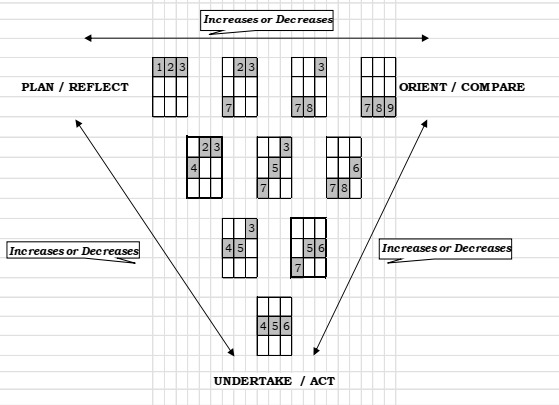
Following the triadic logical categories of the sign, Guerri et al. (2016) developed an operational model for qualitative research known as the semiotic nonagon. The model consists of three columns (trichotomies) and three rows (correlates). The three columns correspond to: (1) possibilities or prior knowledge, understood as past conceptions of the phenomenon; (2) actions or modes of manifestation of the phenomenon in the present; and (3) social assessments of the phenomenon as the expected future. The three rows correspond to: (1) theoretical practice, (2) practical actions, and (3) political practice. Table I presents the general conceptual matrix.
THEORETICAL PRACTICE
This section covers the imaginary, that is, what is logically prior (the past). It encompasses the various possible conceptualizations of beauty in organizations, as reflected in different ideologies, knowledge, and principles.
Formal elements are expressed through theoretical practice, such as tactics and training programs designed to develop the personal competencies, capacities, and skills required in beautiful organizations.
Theoretical conceptualizations carry aesthetic value within the context in which they are applied. This encompasses the ways of perceiving, understanding the significance of, and assessing the strategies that make organizations beautiful.
PRACTICAL ACTIONS
This section focuses on the real: the economic and social embodiment of the phenomenon under study, expressed in the form of plans and reports used to make decisions that contribute to organizational beauty.
Economic practice refers to the concrete actions and decisions within organizations that promote beauty.
Every action is accompanied by an evaluation. These are ethical considerations, assessments of the beauty of actions, which are expressed through narratives of satisfaction or complaints.
POLITICAL PRACTICE
This section addresses the symbolic, encompassing the culture and specific regulations that foster beauty in organizations.
Political practice produces pragmatic effects through concrete actions that shape organizational beauty.
Every practice involves a Logic, expressed through ends or purposes that establish beauty as the organization’s guiding principle.
The 10 Types of Organizational Beauty
To systematically and coherently bring together the different aspects of the sign of “organizational beauty,” Sastre (2021) suggests drawing on Peirce’s perspective. In his writings, Peirce proposes organizing analytical categories according to a classification he termed the “ten types of signs” (CP 2.254–2.264).
This classification is based on the different emphases placed on possibilities, actions, and assessments, which arise from the application of rules. Accordingly, the ten types of signs follow combinatory rules that respond to the relations of necessity established by Peirce’s categories and that, among the twenty-seven mathematically possible combinations, are semiotically viable. Guerri et al. (2016), citing Magariños de Morentín, describe the procedure for constructing the ten classes of signs as follows:
-
Each row (correlate) is hierarchically ordered in relation to the others, such that each lower row contains the higher ones. Thus, elements from a lower row may articulate with those of a higher row, but not vice versa.
-
Only one element from each row may be selected per column (trichotomy), without repeating or omitting any column, as the sign is ultimately being reconstructed.
-
The order in which elements are selected from the respective columns must always follow the sequence of form, existence, and value, that is, firstness, secondness, and thirdness, in the integration of each sign (26).
Figure 1 presents Peirce’s ten types of signs applied to organizational beauty.
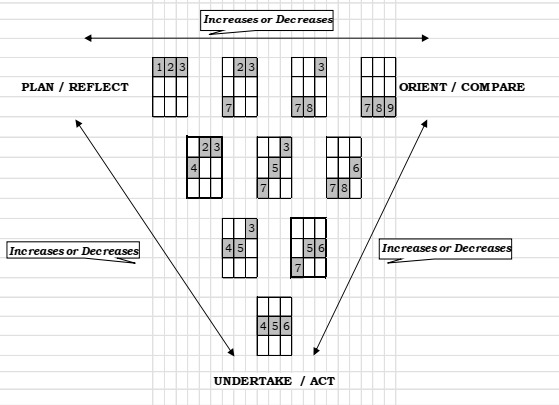
This notion of ten types of organizational beauty is proposed as a logical matrix to organize the specific variables or attributes of art galleries.
Building on the general conceptual matrix and the notion of organizational beauty presented in this section, the following results section introduces the specific conceptual matrix and the questionnaire derived from it. This questionnaire is used to diagnose how people working within these organizations perceive beauty in their workplace.
The subsequent section also presents the results of an exploratory study conducted in 13 art galleries.
The target sample was drawn from galleries exhibiting at Art Basel Paris and Art Basel Miami, which collectively represent at least 80% of the global art market. Selection was limited to galleries where owners or directors agreed to participate in semi-structured interviews. In terms of demographic profile, the sample comprises 77% women and 23% men. Regarding age distribution, 24% of participants were under 35 years old, 38% were between 35 and 50 years old, and 38% were over 50. All respondents reported formal training in art, with 46% having attained a postgraduate degree.
The study is considered exploratory because no previous research with similar aims has been found (Fassio et al., 2002).
The methodological design is non-experimental, as variables are neither controlled nor manipulated, and the goal is not to measure cause-and-effect relationships between them, but rather discover whether the components of the phenomenon (or sign) are related to each other. Accordingly, the discussion section advances toward an explanatory study by establishing relationships between the identified variables and reflecting on these connections.
RESULTS
Construction of the Specific Conceptual Matrix
Unlike museums, which are more educational and public, art galleries are usually private and market-oriented, with spaces dedicated to exhibiting, promoting, and selling artworks such as paintings, sculptures, or contemporary installations. The role of the manager, or gallerist, is multifaceted: serving as a mediator who represents emerging or established artists, negotiating sales, and organizing events, among other tasks requiring both knowledge and passion for art, as well as business, cultural, and administrative expertise.
The strategies developed to achieve objectives may vary depending on the organization’s purposes and the type of gallery. In any case, creativity must be present in the strategic vision to build bridges between artists, collectors, and the general public. Thus, theoretical practice can be framed in the specific matrix with the following variables.
THEORETICAL PRACTICE
Principles or prior knowledge required for art gallery management:
-
Management
-
Curation and art
-
Business
Most relevant Tactics for art gallery management:
-
Digital training for managers and staff, including specialized software for inventory control, CRM, sales, and mailing, among others
-
Market research for artwork pricing
-
Identification and recruitment of emerging artists
Most relevant strategies for achieving business objectives
-
Promotion of innovation and creativity
-
Expansion of client base and increased profitability
-
Promotion of artists
-
Maintaining a presence at international fairs
Day-to-day art gallery management combines curatorial, commercial, and administrative domains. The activities specific to this type of business include selecting artists and artworks, designing exhibitions, cataloging artworks, and managing inventory and logistics.
Plans, actions, and the resulting assessments (that is, practical actions) can be incorporated into the specific matrix through the following variables.
PRACTICAL ACTIONS
Plans and reports that inform decisions supporting effective art gallery management.
-
Business
-
Marketing and communication
-
Artwork cataloging and logistics
-
Talent scouting and artist development
Necessary and most important actions in art gallery management.
-
Sales negotiation
-
Investment in marketing and communication
-
Promotion of the gallery’s name and brand
-
Investment in exhibitions and art fairs
-
Programming and management of the exhibition season
Key contextual assessments.
-
Assessments by peers and competitors
-
Assessments by social institutions and museums
-
Assessments by artists
-
Assessments by investors and collectors
As in any organization, legislation and culture, both at the organizational level and within its broader context, are variables that shape management style. Art galleries, however, may represent a paradigmatic case of organizational beauty, as aesthetics lie at the core of their identity, making them spaces in which sensory beauty drives organizational action.
Regarding the purposes or ends that guide action in art galleries specifically, three broad orientations may be distinguished: those oriented toward art itself, those oriented toward the market, and those oriented toward cultural dissemination. Accordingly, political practice can be represented in the specific matrix through the following variables.
Management-influencing culture and context, expressed through propositions that respondents may agree with to varying degrees.
-
A country’s own culture influences the promotion and dissemination of art.
-
The owner’s or gallerist’s cultural background and artistic knowledge are essential to art gallery management.
-
Art gallery management requires genuine passion for art.
-
The art business is most strongly supported by the laws of countries that promote it.
Most desirable effects resulting from day-to-day activities.
-
International recognition
-
Social media presence
-
Personal prestige
-
Artist recognition
Purposes or ends guide the organization. These variables are the most significant within the matrix, as they establish coherence among all the others.
In Peirce’s framework, this corresponds to the dimension of Logic, which is articulated with Ethics (assessments) and Aesthetics (strategies), all three constituting the Normative Sciences. Organizational beauty emerges from the coherence among these three dimensions, regardless of the specific types of beauty an organization may exhibit.
The core purposes of art galleries are summarized and detailed below. Each gallery may prioritize some of these purposes over others, depending on its business model:
-
Promotion and dissemination of art. Exhibiting and providing visibility for both emerging and established artists to promote their work and contribute to cultural development.
-
Support of artists. Offering a space for artists to showcase their work, providing guidance, representation, and networking opportunities.
-
Innovation and trends. Introducing new art forms, such as digital art or installations, while adapting to market trends and emerging technologies.
-
Profitability and business growth. Acting as intermediaries between artists and buyers, maximizing profitability, and contributing to the economic valuation of art.
-
Brand building in the art industry. Organizing exhibitions, talks, or events that foster art appreciation, educate the public on trends, styles, and art history, and reinforce the gallery’s brand and identity.
-
Commercialization of art. Selling artworks to collectors, institutions, or the general public, and generating revenue for both the gallery and the artists.
-
Personal fulfillment. Supporting professional and personal development beyond the business’s financial objectives.
-
Cultural preservation and dissemination. Conserving and promoting artistic heritage, particularly in galleries working with historically or culturally significant art.
-
Education and the creation of experiences. Developing unique environments that combine aesthetics, creativity, and emotion, attracting visitors and strengthening the artistic community.
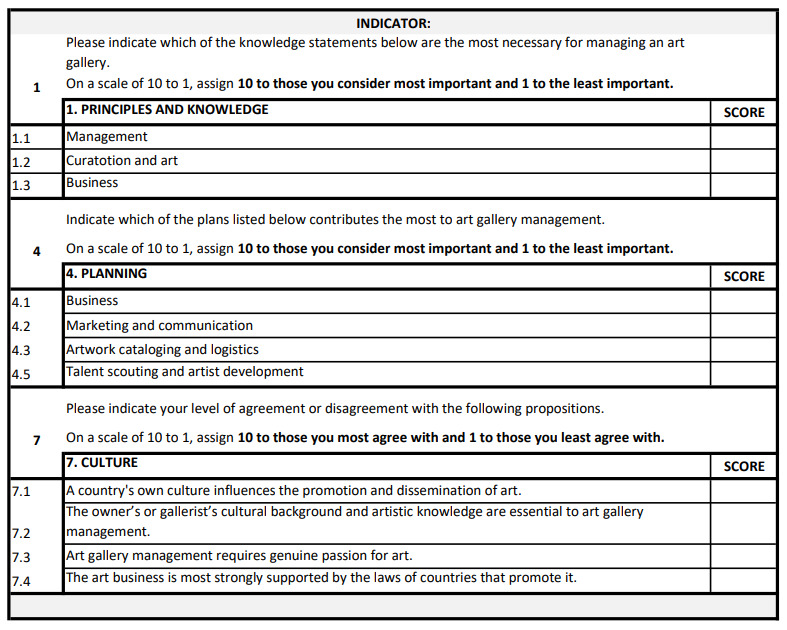
Once the conceptual matrix is completed, a questionnaire is developed, comprising three parts, each with three sections, for a total of nine groups of questions. Respondents are asked to rate the questions or propositions in each area on a scale of 1 to 10, with 1 representing the lowest and 10 the highest value.
A 1–10-point scale was selected over a traditional 1-5-point Likert scale to provide greater granular resolution and capture subtle variations across responses. On 1–5-point scales, data often exhibit central tendency bias, clustering tightly around values 3 and 4; expanding the range increases variance relative to the mean, thereby yielding richer analytical detail.
A table can be constructed from the scores from each respondent or group of respondents to summarize the possibilities, actions, and assessments that were identified as most important or highest ranked. The results are then averaged to generate a numerical matrix, which can be subjected to statistical verification methods. Figure 2 presents an example of a portion of the questionnaire.
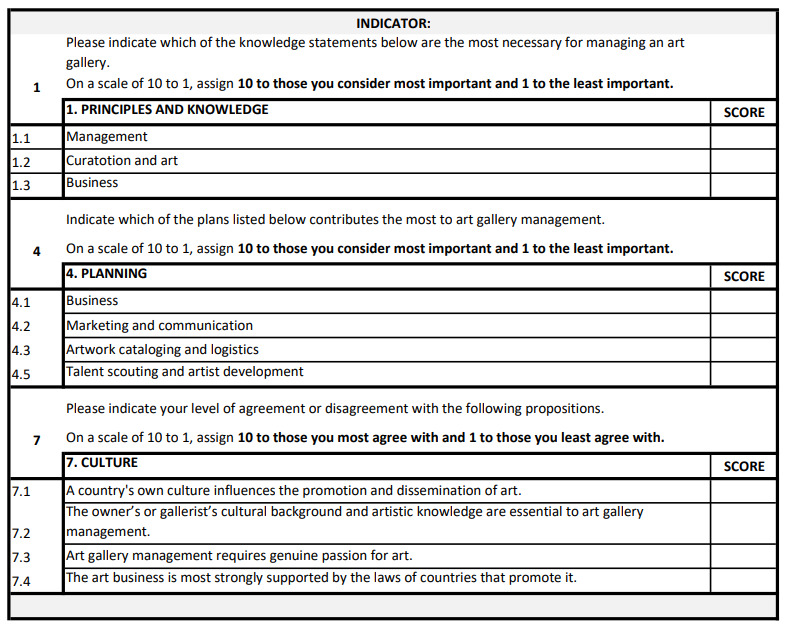
Building on the ten types of signs (organizational beauty) presented in the previous section and on the attributes or variables specific to art galleries, a typology of beauty can be articulated. The names assigned to each type are arbitrary and are intended solely to reflect their principal attributes.
TYPE: SPECIALIZED (emphasis on cells 1–2–3)
These galleries focus on a specific niche, such as Indigenous art, photography, sculpture, or design. They are oriented toward collectors with particular interests.
Attributes (or variables that predominate among the questionnaire options)
-
Principles or prior knowledge: Curation and art
-
Tactics: Identification and recruitment of emerging artists
-
Strategies: Promoting artists
TYPE: POP-UP (emphasis on cells 4–2–3)
These galleries seek to participate in specific events through temporary spaces that operate for a limited period, such as fairs or collaborative projects.
Attributes (or variables that predominate among the questionnaire options)
-
Planning: Marketing and communication
-
Tactics: Digital training for managers and staff
-
Strategies: Maintaining a presence at international fairs
TYPE: AUCTION-BASED (emphasis on cells 4–5–3)
These galleries target high-profile collectors and integrate the exhibition of artworks with auction events.
Attributes (or variables that predominate among the questionnaire options)
-
Planning: Artwork cataloging and logistics
-
Actions: Programming and management of the exhibition season
-
Strategies: Maintaining a presence at international fairs
TYPE: COMMERCIAL (emphasis on cells 4–5–6)
These galleries focus primarily on the sale of artworks. They represent artists and promote their work to collectors, institutions, or the general public. They typically operate in physical spaces located in prestigious areas and may specialize in specific genres, such as contemporary, modern, or abstract art.
Attributes (or variables that predominate among the questionnaire options)
-
Planning: Marketing and communication
-
Actions: Sales negotiation
-
Assessments: By investors and collectors
TYPE: CONTEMPORARY ART (emphasis on cells 7–5–6)
These galleries exhibit works by living artists or recent productions, with a focus on current trends. They promote innovation and artistic experimentation.
Attributes (or variables that predominate among the questionnaire options)
-
Culture: A country’s own culture influences the promotion and dissemination of art
-
Actions: Investment in marketing and communication
-
Assessments: By investors and collectors
TYPE: ARTISTIC (emphasis on cells 7–5–6)
These galleries prioritize the promotion of art and culture over sales. They are typically funded through grants, donations, or institutional support.
Attributes (or variables that predominate among the questionnaire options)
-
Culture: The art business is most strongly supported by the laws of the countries that promote it
-
Effects: International recognition
-
Assessments: By artists
TYPE: COOPERATIVE (emphasis on cells 7–5–3)
These galleries are generally managed by a collective of artists who share costs and responsibilities. They are often more accessible to emerging artists.
Attributes (or variables that predominate among the questionnaire options)
-
Culture: The owner’s or gallerist’s cultural background and artistic knowledge are essential to art gallery management
-
Actions: Programming and management of the exhibition season
-
Strategies: Promoting artists
TYPE: VIRTUAL (emphasis on cells 7–8–9)
These galleries operate exclusively online, exhibiting and selling art through digital platforms. They are globally accessible and reduce operational costs, though they face challenges regarding authenticity.
Attributes (or variables that predominate among the questionnaire options)
-
Culture: A country’s own culture influences the promotion and dissemination of art
-
Effects: Social media presence
-
Purposes: Promotion and dissemination of art. Exhibiting and providing visibility for both emerging and established artists to promote their work and contribute to cultural development
TYPE: ALTERNATIVE AND EXPERIMENTAL ART (emphasis on cells 7–8–3)
These spaces promote nonconventional art outside commercial circuits. They focus on performance, installation, or interdisciplinary practices.
Attributes (or variables that predominate among the questionnaire options)
-
Culture: A country’s own culture influences the promotion and dissemination of art
-
Effects: Artist recognition
-
Strategies: Promoting innovation and creativity
TYPE: INSTITUTIONAL OR MUSEUM BASED (emphasis on cells 7–2–3)
These galleries are affiliated with museums or cultural institutions and prioritize curated and educational exhibitions, whether temporary or permanent.
Attributes (or variables that predominate among the questionnaire options)
-
Culture: A country’s own culture influences the promotion and dissemination of art
-
Tactics: Identification and recruitment of emerging artists
-
Strategies: Promoting innovation and creativity
What is most significant in each type of organizational beauty is the coherence among the dimensions, or cells, of the matrix. The variables or attributes included are illustrative rather than exhaustive. What matters is that the highest assessments prevail in the dimensions that constitute a given type of sign. Additionally, each type of beauty may be more or less aligned with the purposes of a given organization.
Exploratory Investigation
The questionnaire and the ten-type classification of organizational beauty were tested in two exploratory studies at the Art Basel fairs in Paris and Miami.
These exhibitions were selected because they typically bring together galleries representing at least 80 percent of the global art market and attract a large number of visitors. As Revuelta mentions,
At high-end fairs of this kind—and Art Basel more than any other, extending its networks and franchises from east to west, from Basel to Hong Kong—the works for sale are not displayed with price tags hanging from them as if they were bargains or special deals. Nor is the familiar red “sold” dot usually affixed, as it suggests certain vulgarity and lack of professionalism. Everything operates according to codes of discretion and apparent decorum between the millionaire clients and millionaire gallerists (2025, p. 70).
The findings derived from personalized interviews with gallerists and representatives from six galleries exhibiting at Art Basel Paris and seven at Art Basel Miami are presented in Tables II, III and IV.
Table II presents summary statistics for the overall sample. Given the limited sample size, these results should be interpreted with caution regarding their statistical precision; nevertheless, they offer valuable indicative trends.
For instance, examining the predominant dimensions within each column (or trichotomy) reveals that dimension 1 prevails in the first column—that is, principles rank higher than plans and culture. In the second column, dimension 5, actions, predominates over their effects and the tactics devised to execute them. In the third column, dimension 3, strategies, prevail over assessments and ends or purposes.
Expressed as a sign configuration, this corresponds to a 1–5–3 profile. While this constitutes a mathematically valid combination, it lacks the semiotic coherence that characterizes any of Peirce’s ten classes of signs.
This phenomenon can be attributed to cultural differences between the galleries interviewed in Paris and in Miami.
Some gallerists in Paris stated that they would not attend the Miami fair because the market is different, it reflects a different culture, and requires bringing artworks aligned with that context. Indeed, in practice, the Miami fair featured a substantially higher proportion of contemporary art and pop art than the fairs in Basel and Paris.
Consequently, the two sub-samples were analyzed independently by averaging the responses for each fair. The resulting analysis is presented in Tables III and IV.
The average type of beauty corresponds to one of the ten types of signs identified by Peirce, namely type 7–5–3, which aligns with a cooperative gallery model. However, although all the galleries studied are commercial in nature, when evaluating the alternatives presented in the questionnaire, they tended to downplay or assign lower importance to commercial and business-related aspects.
The average result corresponds to one of Peirce’s ten sign types, namely type 4–5–6, which aligns with a commercial gallery style. It is worth noting that, when asked about the final outcomes of the fair, all respondents expressed satisfaction, reporting that they had sold nearly all the works they brought to the fair. This finding is consistent with the commercial orientation of all the galleries interviewed in Miami.
For the analysis of the highest and lowest-rated variables within each dimension of the matrix, mean values were used, without segmenting the sample.
Regarding principles or prior knowledge considered necessary for art gallery management, “management” and “curation and art” received the highest ratings. Notably, business and entrepreneurial knowledge was rated lowest, suggesting that it is not perceived as a significant contributing factor to the achievement of organizational objectives.
Among planning variables, “talent scouting” ranked highest, followed by “marketing and communication.”
Within the culture dimension, the most highly valued variable among the gallery owners interviewed in Paris was that “the owner’s or gallerist’s cultural background and artistic knowledge are essential to art gallery management.” The predominant choice among Miami respondents, in contrast, was “a country’s own culture.”
The tactic most highly valued by both samples was “market research for artwork pricing,” although none of the interviewees specified how this was actually carried out.
Regarding actions, in the first sample, the highest-rated variable, with a score of 10, was “programming and management of the exhibition season.” In the second sample, this variable ranked second, with priority given instead to “investment in exhibitions and art fairs.” Investments in marketing and communication were also rated relatively low. Apparently, these actions are not perceived as being directly related to what takes place at fairs such as Art Basel, despite the substantial investment required to participate in them. Sales appear to be the primary objective at fairs, rather than communication or promotion.
Consistent with these responses is the low rating of action-related effects such as “social media presence,” which received the lowest score of all the variables included in the questionnaire. The most highly valued effect of actions was “artist recognition.”
Among strategies, the option with the highest average rating across both samples, with a score of 9.92 out of 10, was “expanding the client base.” This score is fully consistent with the organizational type of the galleries interviewed, all of which were commercial rather than cooperative in nature.
Regarding contextual assessments, “social institutions and museums” received an average score of 10 in the first sample and 9.92 in the second. This result exceeds assessments by investors and collectors, as well as artists, who appear in the purposes dimension primarily through the “support of artists” variable.
In the purposes category, a significant divergence emerged between the first and second samples. Interviewees in the first sample unanimously identified “education and the creation of experiences” as the most important purpose of an art gallery, with a score of 10, above both the support of artists and the commercialization of art. In the second sample, this variable was among the lowest rated, with an average score of 6.71.
It is worth noting that the Art Basel fairs offer very limited educational content regarding the artworks on display. Only a limited number of guided tours are available, and the cost is relatively high. These tours last no more than one hour and generally focus on the same selection of works, typically drawn from galleries representing less than 10 percent of the total exhibition. In this context, Revuelta draws attention to this type of exhibition:
Now, does anyone within the establishment care about this abyss between art and the society it addresses, with which it supposedly expects to engage in dialogue, educate, guide, and stimulate? No. Criticism simply bounces off a superbly reinforced layer of cement (2025, p. 165)
DISCUSSION
The literature review section highlights the growing relevance of studying aesthetics within the organizational field. However, this exploratory investigation found no convergence with that which theoretical practice proposed, not even with the works of the field’s pioneering authors. Organizational identity (Costa, 1986) is not visually reflected in art galleries. Identifying any indicator or identity would require examining the artworks commercialized, and even then, these would not necessarily correlate directly with organizational Ethos. The same applies to corporate imagery and naming practices (Bolognini, 1986): little concern seems to exist for the graphic communication of the gallery’s brand, which in most cases simply bears the name of the gallerist or founder.
Degòt (1987), like many authors who followed, emphasized the importance of aesthetics in business. In practice, however, none of the interviewees had heard of aesthetics in management. When informed that the study sought to examine beauty in the management of organizations that trade in beauty, the general response was “How interesting!” Nevertheless, they were unfamiliar with the concept’s meaning, and none asked what “beauty in management” meant. They were told during the interviews that beauty resides in the coherence among organizational dimensions, particularly aesthetics (strategies), ethics (assessments), and logic (ends or purposes).
Nor was aesthetic concern evident in ceremonial practices (Rusted, 1987) involved in client reception at a fair as prestigious as Art Basel. The primary focus was on the display of artworks, specifically their placement within the booth, lighting, and all aspects related to the “products” offered for sale. None of the surveyed galleries provided comfortable spaces for receiving visitors; instead, they were limited to a small table and a pair of chairs. The gallery staff remained standing in the booth most of the time.
Taylor (2002) referred to the difficulty of articulating aesthetic experience in management. Fortunately, organizational aesthetics has since become sufficiently widespread to be taken seriously in everyday practice. In the case of art galleries, the concept of aesthetic experience is not only well known but actively applied in the search for and selection of artworks for sale. However, it is not at all associated with management, as though these were two entirely separate worlds.
Art and creativity are left in the hands of artists, while gallery managers remain uninvolved. This is reflected in the fact that the pursuit of innovation and new managerial trends as an organizational purpose received the lowest rating among proposed alternatives, with an average score of 6.46 out of 10.
In sum, this study’s theoretical contribution lies in highlighting the lack of management-focused research on this segment of the art gallery sector.
THEORETICAL CONTRIBUTION AND IMPLICATIONS
The theoretical contributions of this study operate at the intersection of organizational aesthetics, semiotics, and art management literature. By grounding organizational analysis in Charles Sanders Peirce’s triadic semiotics and his three Normative Sciences (Aesthetics, Ethics, and Logic), this paper provides a novel structural approach to defining and diagnosing “organizational beauty.”
First, while previous literature on organizational aesthetics has largely focused on sensory perceptions, architectural spaces, or emotional experiences (Beyes & Holt, 2020; Strati, 1999), this study formalizes organizational beauty as structural and relational coherence. Specifically, we operationalize beauty as the dynamic alignment between an organization’s strategic vision (Aesthetics/Firstness), contextual and ethical evaluations (Ethics/Secondness), and overarching organizational purposes (Logic/Thirdness). In doing so, we expand the conceptual boundaries of management theory by demonstrating that aesthetics is not merely an auxiliary or decorative aspect of organizing, but a foundational normative science that underpins ethical decision-making and logical purpose (Barrena, 2015).
Second, this study contributes to semiotic management theory by developing an art gallery-specific conceptual matrix derived from Peirce’s ten types of signs. By mapping the theoretical, practical, and political correlates across Peircean trichotomies, we offer a granular typology to analyze how specialized cultural organizations structure their values and operations.
Finally, our empirical findings reveal a striking disconnect between theoretical semiotic coherence and real-world organizational practice. The aggregate profile derived from the total sample fails to correspond to any of Peirce’s ten semiotically viable sign types. Mathematically, while numerous combinations of organizational attributes can exist, only those exhibiting internal harmony between form, existence, and value achieve true semiotic coherence. By identifying that coherence only emerges when segmenting the sample by fair type (Paris vs. Miami), this study demonstrates that organizational beauty is heavily contingent on institutional contexts, cultural dynamics, and market positioning rather than universal managerial formulas.
From a managerial perspective, this study provides actionable insights for gallerists, art business directors, and managers operating within highly volatile creative industries.
First, the 9-dimensional matrix and diagnostic questionnaire developed in this research serve as a practical, low-cost diagnostic tool for gallery owners. Managers can use this framework to audit their internal operations, identifying misalignment between their stated artistic mission (Logic/Purposes), their day-to-day operation (Ethics/Assessments), and their market positioning (Aesthetics/Strategies). For instance, a gallery aiming for long-term cultural dissemination (Logic) that over-prioritizes short-term sales negotiation tactics at the expense of artist scouting (Ethics) can visually trace and rectify this operational dissonance. Achieving this internal alignment fosters a harmonious work environment necessary to cultivate collective creativity.
Second, our empirical findings highlight the critical role of market financial pressures and organizational segmentation. Gallery owners operating in distinct geographic or commercial environments—such as the historically and culturally rooted European market (Art Basel Paris) versus the highly commercial, transaction-driven American market (Art Basel Miami)—cannot rely on standardized management templates. Management strategies must be tailored to the specific cultural and economic pressures of their immediate ecosystem.
Third, the study exposes a widespread industry vulnerability: the gap in formal management training among gallery directors. While 100% of respondents in our sample possessed formal training in art and curation, few had formal training in business administration or organizational design. To navigate the projected $100 billion annual art market, gallery leaders must complement their curatorial passion with structured strategic planning, digital CRM tools, and operational frameworks that balance artistic integrity with commercial viability.
LIMITATIONS AND FUTURE RESEARCH DIRECTIONS
While this exploratory study provides pioneer insights into the internal management of art galleries, several methodological limitations must be acknowledged, opening valuable avenues for future research.
The primary limitation rests in the sample size Although the sample was drawn exclusively from gallery owners and directors participating in Art Basel Paris and Art Basel Miami—representing the top tier of the global art market—the small sample size limits the statistical precision and generalizability of the quantitative ratings. Consequently, the statistical averages reported should be interpreted as indicative trends rather than definitive parametric benchmarks. Future studies should expand the sample size across regional art fairs, mid-tier galleries, and emerging art hubs to validate these typologies and test for statistical robustness.
Second, the study relied on a non-experimental, cross-sectional design utilizing semi-structured interviews and self-reported survey ratings. While appropriate for exploratory semiotic research, self-reported data carries inherent risks of social desirability bias. Future research could adopt longitudinal designs or mixed-methods approaches—combining ethnography, financial performance metrics, and employee satisfaction surveys—to evaluate how alignment with Peirce’s ten sign typologies impacts long-term economic sustainability and creative performance.
Third, while this research focused specifically on commercial fine art galleries, the conceptual framework of organizational beauty is broadly adaptable. Future scholarly inquiries could apply and adapt the 9-dimensional Peircean matrix to other creative and cultural industries, such as design firms, performing arts centers, architecture studios, or high-end luxury brands, to explore whether the theory-practice gap observed here is endemic to the art market or characteristic of creative industries at large.
Finally, working hypotheses for future research may be inferred from this study through abduction. Abduction, as described by Peirce (1893/1931), proposes a hypothetical explanation of facts; induction tests the hypothesis generated by abduction; and deduction predicts outcomes. Although abduction is the weakest form of reasoning, it is also the most creative. Examples of hypotheses that may be proposed include:
-
Hypothesis 1. Organizational beauty typologies are correlated with an organization’s purpose.
-
Hypothesis 2. Organizational beauty typologies vary according to the perceiver’s academic background.
-
Hypothesis 3. Organizational beauty typologies vary according to an organization’s age.
The abductive method of hypotheses generation and Peirce’s open, triadic thinking may offer new possibilities for research and for the study of organizational management practices, including leadership, work motivation, and other issues examined in the field of management studies.
CONCLUSIONS
As noted at the outset of this study, research on aesthetics in art gallery management is both relevant and original. The distinctive features of the art business raise numerous questions. From the buyer’s perspective, what is the primary motivation for acquiring and collecting artworks—investment, aesthetic enjoyment, social display, commitment to artists, philanthropy, or other factors?
From the seller’s perspective, what demands greater attention: the taxes and laws of the countries in which transactions take place, the prices that can be set for artworks, or the actions of competitors?
Art gallery management, with all its particularities, requires clearly defined purposes to ensure coherence across all the dimensions involved in its operation and, in turn, identify a typology of beauty that best aligns with those purposes.
At least three conclusions and contributions can be obtained from this exploratory study.
- On the Method’s Contribution
The MAIA method was applied to the study of different phenomena, revealing several advantages over other qualitative research methods.
It integrates theory and practice to examine complex organizational phenomena. Questionnaire design requires familiarity with both the theory and the practical enactment of the selected sign and should be carried out collaboratively with those involved in the research, as this provides a pragmatic means of generating knowledge.
The method also enables both cross-sectional analysis, comparing results from different organizations (by size or geographic location, for example), and vertical analysis, comparing results across different levels within the same organization. Multiple hypotheses can be creatively generated using abductive logic by regrouping responses across areas or logical cells.
These hypotheses may then be tested using quantitative methods. Because respondents’ ratings are translated into a numerical matrix, this matrix can be used to construct models representing the hypotheses and to test them using structural equation modeling. Such models are useful for examining linear causal relationships and for confirming or rejecting causal hypotheses.
- On the Importance of Organizational Aesthetics
For Peirce, aesthetics, one of the three normative sciences, extends beyond the notion of the “beautiful” to encompass that which is admirable and motivates action. Ethics, the second normative science, evaluates action against an ideal, while logic, the third, provides the ordering criterion that makes comparison possible.
This study applies Peirce’s concept of aesthetics to organizational analysis, extending the scope of organizational aesthetics beyond purely cognitive approaches. Perceptions, feelings, and thoughts jointly shape the knowledge produced and are therefore strategically necessary components of the research instrument.
This investigation contributes to the literature on organizational aesthetics and opens a new line of inquiry in the context of art galleries.
- On the Importance of Finding Coherence in Organizations as a Source of Beauty
In art galleries, beauty in management fosters stronger connections between artists, collectors, investors, and society. According to some authors, the relationship between art galleries and society is weak or even absent, as if the art world were reserved for a small circle of insiders.
Beauty in management helps create an environment conducive to creativity and innovation, both of which are essential in management, given the contemporary context’s ambiguity and complexity.
As noted at the outset of this study, many management theories link art and management; accordingly, art gallery managers must also perform their role creatively, particularly in leading teams.
- On practical implications for managers
From a managerial standpoint, the nine-dimensional matrix and diagnostic questionnaire offer a practical, low-cost instrument for auditing internal alignment. Gallery leaders can identify and correct dissonances among their stated purposes, day-to-day actions, and strategic positioning, thereby fostering the internal harmony necessary to sustain collective creativity.
The study further emphasizes that standardized management templates are inadequate; strategies must be tailored to the specific cultural and commercial ecosystems in which galleries operate.
In sum, Peirce’s triadic conception of the categories of phenomena may serve as a useful tool for organizational research, particularly when the articulation of theory and practical life is valued and when multidisciplinary inquiry is emphasized.
When the dimensions aesthetics, ethics, and logic achieve coherence, art galleries do not merely trade in aesthetic objects; they embody beauty as a living organizational quality capable of nurturing creativity and sustaining cultural and commercial vitality, which fosters broader societal engagement.