Introduction
Debt-based funding represents a vital yet often underemphasized source of new venture financing. Despite the focus on equity investment in the popular press and academic literature (Cumming & Johan, 2017), equity financing accounts for only a small proportion of the primary sources of start-up funding (Gartner et al., 2012). Indeed, debt is a common source of capitalization for early-stage start-ups as bank loans are secondary only to personal contributions by founders (Gartner et al., 2012). Additionally, bank loans are not only a common source of financing, but research also suggests they improve venture performance (Cole & Sokolyk, 2018).
Small business lending is big business. In 2020, over $700 billion in small business loans was provided to companies in the United States, and smaller lending institutions, many located in rural areas, accounted for about 20% of outstanding small business loans (U.S. Small Business Administration, 2022). These small banks, often referred to as “community banks” (Lux & Greene, 2015) play a significant role in supporting local economies as a primary source of capitalization for new and existing small businesses.
However, obtaining a small business loan can be challenging for first-time business owners who lack familiarity with the process. Past research on small business lending practices suggests that commercial loan officers use a combination of “hard” and “soft” information when making loan decisions (Berger & Black, 2011). Scholarly literature on the utilization of soft information in the lending process, referred to as “relationship lending,” has expanded in recent years (Berger & Udell, 2002; Udell, 2008). Unsurprisingly, community banks tend to engage in relationship lending to a greater extent, relying more heavily on soft factors in the decision-making process (Cole et al., 2004; Scott, 2004; Uchida et al., 2012). However, while current literature recognizes the existence of relationship lending practices, there remains a lack of deep insight into the nature, motivations, and reasons for the soft practices in small business lending.
This study sought to fill this gap in the literature by examining the process of lending to first-time founders at community banks using qualitative inquiry. As the current literature is flush with studies of private equity and bootstrap financing, a significant gap has developed in the space of small business lending, even though debt still ranks as the number one source of third-party capital for small businesses. The goal of this investigation was to inform the entrepreneurial ecosystem of the nuanced relationship lending process and to better align scholarship and entrepreneurship education with practice.
To this end, the following research question was addressed in this study: In what ways do soft factors influence the lending decisions made by small business loan officers at community-based financial institutions? This question builds on prior literature by exploring how soft factors complement more traditional hard factors such as credit score, collateral capacity, and cash flow. The literature that led to this question is reviewed, followed by research methodology, results of the study, and a discussion of the implications.
Literature Review
Debt Financing for New Ventures
Access to the necessary capital to launch and grow new ventures is of critical importance to entrepreneurs (Leach & Melicher, 2020; Rogers, 2014; Smith & Smith, 2004). Significant evidence suggests that entrepreneurial finance impacts all elements of new venture creation (Macht, 2016; Mwasalwiba, 2010; Neck & Greene, 2011). Beyond start-ups, the literature has also noted the positive effects of capital availability on the continued growth and innovation of small businesses (Ayyagari et al., 2012).
Research also suggests that certain entrepreneurial finance arrangements improve overall venture performance. For example, according to Cole and Sokolyk (2018), new firms that obtained bank credit outperformed and survived longer than businesses relying on personal credit. Galli-Debicella (2020) specifically found that the 4-year survival rate of start-ups improved when tied to a U.S. Small Business Administration (SBA) loan. Much of this literature points to the influence and accountability of the third-party relationship between banks and founders as a positive influence.
Despite the focus on private equity financing in popular culture and the media (Clement et al., 2015; Cumming & Johan, 2017), debt is the largest source of third-party capital for small businesses (Berger & Udell, 1998; Cole & Wolken, 1995; Gartner et al., 2012) and ranks second only to the founder’s capital investments (Gartner et al., 2012). While the term “debt” can be applied in many different contexts, including trade credit, lines of credit, revolving debt, and traditional loans, it generally represents the borrowing of capital from a third party coupled with a promise to pay, collateral, and/or interest payments (Leach & Melicher, 2020; Rogers, 2014). Germane to this study, bank loans are the most common source of debt capitalization for early-stage start-ups (Berger & Udell, 1998).
With over $700 billion in small business loans provided to companies in the United States in 2020 (U.S. Small Business Administration, 2022), it is clear this form of capital provides critical support for local entrepreneurial ecosystems. While a relatively larger proportion of small business loans are issued by large banks, small lending institutions, defined as those with assets <$1 billion, accounted for roughly 20% of total outstanding small business loans (U.S. Small Business Administration, 2022). These “small community banks” (Lux & Greene, 2015) have experienced increased competition from both larger and nonbank entities over the past decade (Jagtiani & Lemieux, 2016) but remain a significant source of capital, especially for businesses located outside of urban centers.
Navigating the loan application process, however, can be difficult for first-time business owners unfamiliar with the process. This is in part due to the perception in the entrepreneurial community that banks are not their friends, and that these institutions have a set of highly conservative, antagonistic, hard-and-fast rules by which they assess small business loan applications (Boutillier, 2019; Durkin et al., 2013). This perception that it is all about the transaction and that there is a cold, shrewd “go or no-go” formula with little room for context or character has had a deep negative effect on the relationship between small business founders and lenders.
Some of this negativity may be the result of what Neck and Greene (2011) referred to as an “inputs and outputs” (p. 61) perception of entrepreneurship. Founders feel that providing the proper transactional inputs in the form of a business plan, will yield the proper output, a small business loan. Prior research, however, has shown that softer relationship factors play a significant role in lending (Moro et al., 2014) beyond purely transactional reasons. For example, there is evidence that intangibles like social capital impact the financial outcomes of new ventures, as well as their ability to effectively seek capital (Baron & Markman, 2003; Clement & Silvernagel, 2019; Macht, 2016).
Soft and Hard Information in Small Business Lending
Research on small business lending practices suggests that commercial loan officers use a combination of so-called hard and soft information when making loan decisions (Berger & Black, 2011). Hard information consists of more traditional “transactional” data, such as financial statements, credit reports, and detailed business plans. The softer side, often referred to as relationship lending (Berger & Udell, 2002), relies more on the character of applicants and the establishment of a long-term bond between institution and client.
The empirical literature on small business lending consistently highlights the importance of these relational factors, and studies reveal significant advantages for firms that secure loans through relational channels. For example, close relationships enable banks to gather in-depth qualitative information about borrowers that goes beyond traditional financial metrics (Petersen & Rajan, 1994). This information leads to more informed decisions and potentially higher approval rates for qualified businesses.
On the borrower’s side, evidence suggests that they may secure lower interest rates and more flexible terms via relationship lending compared to those engaged in transactional lending (Berger & Udell, 1995). Researchers have also found that relationship lending fosters trust and commitments, leading to increased loan continuity and support for struggling borrowers during difficult economic times (Berger & Udell, 2002; Cole & Sokolyk, 2018), and that a positive impact on firm performance was a by-product of the ongoing communication and support provided by relationship bankers (Gartner et al., 2012).
Entrepreneurs, however, are not the only beneficiaries of relationship lending. Lenders themselves reap the rewards of close bonds with borrowers that lead to customer loyalty, referrals, and more. For that reason, community banks tend to engage in relationship lending to a greater extent and thus rely more heavily on those soft factors in the decision-making process (Cole et al., 2004; Scott, 2004; Uchida et al., 2012). These smaller banks seem to sidestep at least some of the antagonist clichés heaped on lending institutions based on the past adversarial relationships with entrepreneurs noted earlier.
However, the literature also acknowledges limitations and negative side effects associated with relationship lending. For example, Cole et al. (2004) highlights potential bias in lending decisions by small banks, favoring borrowers with personal connections over those solely qualified by financial metrics. Additionally, studies like Uchida et al. (2012) and Udell (2008) emphasize the crucial role of individual loan officers in nurturing effective relationships, suggesting potential variability in lending practices across banks and even within the same institution. From a relationship perspective, which lender an entrepreneur works with can matter a great deal. This is yet another factor to consider as founders begin the often-challenging process of seeking small business financing.
Theoretical Foundations
Entrepreneurial Communication and Legitimacy. The lending process between community banks and nascent entrepreneurs can be partially understood through the lens of entrepreneurial communication and legitimacy. Research findings demonstrate that entrepreneurs must not only possess viable business concepts but also effectively communicate their worthiness and credibility to secure financing (Martens et al., 2007; Pollack et al., 2012). Effective communication helps to establish entrepreneurial legitimacy, the acceptance and credibility that new ventures gain from key stakeholders, which has been shown to play an important role in resource acquisition (Zimmerman & Zeitz, 2002). In the context of nascent entrepreneurs and small business lending, cognitive legitimacy is especially important, as loan officers must understand and categorize the entrepreneur’s business concept within familiar frameworks (Pollack et al., 2012). Entrepreneurs establish this through storytelling, demonstrating preparedness, conveying their competence and character, and other aspects that contribute to the “soft” factors considered in the loan process.
Asymmetric Information Theory. The challenge entrepreneurs need to overcome via effective communication involves asymmetric information. Asymmetric information theory, introduced by Akerlof (1970) and expanded upon by Stiglitz and Weiss (1981), highlights the issue of adverse selection that can occur in transactions where one party possesses more information than the other. In the context of small business lending, information asymmetry creates uncertainty for banks as they attempt to assess risk with limited information, much of which is provided by the entrepreneur. It is likely that first-time founders, who lack established track records and financial data, are especially prone to this issue. Asymmetric information theory suggests that this information gap and the uncertainty it creates leads to inefficient market outcomes, such as deserving businesses being denied loans (Berger & Udell, 2002).
Utilizing these theoretical frameworks, this study sought to uncover how small business lenders uncover information and what key factors influence their decision to proceed with a loan to first-time founders. This information can assist nascent entrepreneurs to navigate the asymmetrical information landscape of community bank lending and learn what and how to communicate (both hard and soft data) to establish legitimacy. This nuanced understanding can inform interventions and practices that aim to bridge the information gap highlighted earlier, promote ethical and equitable lending, and foster mutually beneficial outcomes for both community banks and the burgeoning ventures they support.
Methodology
To explore the subjective nature of the small business lending process to new ventures, a qualitative study was conducted on the decision-making process by small business loan officers when presented with a new business idea from a nascent entrepreneur. This study utilized a qualitative descriptive approach, as discussed by Sandelowski (2000, 2010), to investigate the type of information required (both hard and soft data) and assessment factors (both transactional and relational) that influence loan decisions in this scenario. The researchers posited that multiple complex factors may influence the decision to offer a loan to a nascent entrepreneur and that those factors are often not readily available to or known by the founder.
Sample Selection
The sample in this study consisted of small business loan officers at community banks in the Midwest with asset portfolios of <$1 billion. Banks of this size are typically located in smaller communities outside of urban areas and often referred to as “community” banks (Lux & Greene, 2015) as opposed to regional or national banks. These criteria were utilized because community banks are more likely to engage in relationship lending. Purposive sampling, a commonly accepted approach in qualitative research (Patton, 2015), was used to leverage the professional network of the researchers to identify and recruit qualified participants into the study. To be included in the study, small business loan officers needed to meet the following criteria: a) They needed to be employed by a community bank with assets of <$1 billion at the time of the interview and b) They needed to have experience with and authority in the decision-making process for approving small business loans to nascent founders. In total, seven participants were interviewed, with each participant representing a different community bank. While this is a small sample size, six to twelve participants has been cited as sufficient for identifying themes in exploratory qualitative research, particularly in cases where subjects are relatively homogenous (Guest et al., 2006).
Data Collection and Treatment
Semi-structured interviews are a common data collection method utilized in qualitative descriptive research (Kim et al., 2017). Drawing from guidance on conducting qualitative interviews by Kvale and Brinkmann (2009) and Rubin and Rubin (2012), a semi-structured interview guide was developed, drawing from past literature (see Appendix A). Because of the open-ended and conversational nature of the interviews, the list of questions served as a guide, leveraging prompts that were used to probe deeper insights depending on how each participant answered the questions. All interviews took place between June and August of 2023 and were conducted either in-person at the loan officers’ places of employment or virtually via Microsoft Teams. Each interview lasted approximately 45–90 minutes and was conducted individually by the coauthors. Transcripts were subsequently checked against the digital recording to verify accuracy and deidentified.
Data Analysis
The primary qualitative analysis techniques selected for this study were content (Krippendorff, 2018) and thematic analysis approaches (Braun & Clarke, 2012) to generate insights and themes from the data, which are common techniques in qualitative descriptive research (Doyle et al., 2020; Kim et al., 2017). Data were coded using first-cycle and second-cycle coding techniques outlined by Saldaña (2013). First-cycle coding included structural, descriptive, and process coding to gain an initial understanding of the nature of the data. Second-cycle coding utilized elaborative coding (Auerbach & Silverstein, 2003), as this study sought to understand the previously researched soft side of small business lending within community banks.
While qualitative research with multiple researchers can introduce challenges related to reliability during the coding process, this study drew from guidelines provided by Richards and Hemphill (2018) and Hall et al. (2005) on effective collaborative qualitative analysis. Collaboration in the data collection and analysis process also allows for triangulation, a technique commonly used in qualitative research to ensure rigor and validity (Flick, 2004). This study utilized investigator triangulation, as all three researchers conducted interviews and analyzed data, both individually and collaboratively, thus bringing multiple perspectives to the process, another advantage of multi-researcher qualitative inquiry (Cornish et al., 2013). Multiple intensive group discussions were conducted to develop the preliminary codebook and during first-cycle and second-cycle coding, resulting in group consensus to create the final codebook and interpretation.
Results
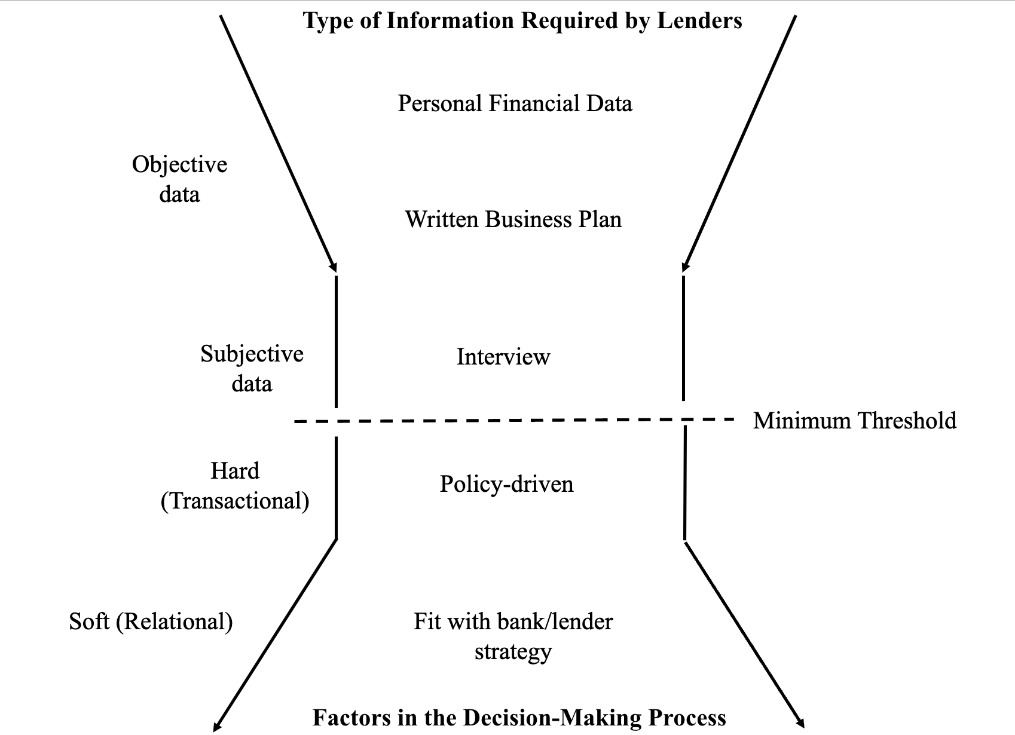
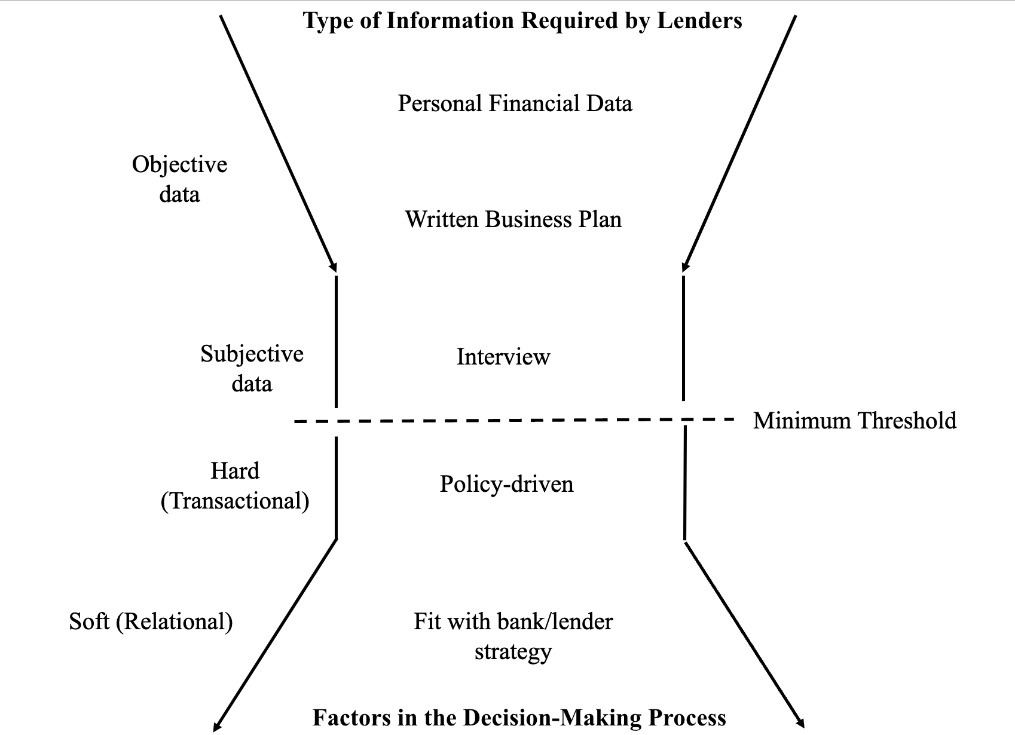
The small business loan officers interviewed revealed distinct aspects of the loan decision-making process to nascent founders. Two overarching categories emerged from the analysis: a) type of information lenders require to make a loan decision and b) factors that influence the decision-making process. In accordance with prior literature, participants revealed that they rely on hard (objective) and soft (subjective) data to fully evaluate the loan request. There appeared to be a minimum threshold of information required by the lender to evaluate whether the loan request would proceed in the decision-making process. This included a minimum of a) personal financial information, b) a written business plan, and c) a verbal discussion or interview with the applicant (see Figure 1).
Once the minimum threshold of information had been met, these loan officers then took into consideration additional factors that influence the loan decision. Once again, hard (transaction) and soft (relational) factors emerged as critical influencing factors in the decision-making process. High-level themes within these categories included policy-driven factors and whether the founder and business idea “fit” within the banks’ or loan officers’ strategies. It is important to note that this process is not strictly linear and occurs over time through various communication channels. Each theme and subtheme are described in more detail next.
Type of Information Required by Loan Officers
Hard (Objective) Data
Similar to past research, this study found that loan officers require a minimum level of hard or objective data about the founder and their business idea to engage in the loan decision-making process. Unsurprisingly, participants stated that credit score was a critical piece of information required to make a loan, in addition to tax returns and a personal financial statement that included information related to a) collateral that could be offered by the founder, b) availability of cash, c) ability to leverage assets to make a downpayment for the requested loan amount (on average 20%), d) current income, e) amount of outstanding debt, and f) liquidity ratio (see Table 1).
In some cases, participants reported the use of software programs in the decision-making process: “You can just tell it [the software] I want a credit score of this, I want a debt-to-income number of this, and I want an advance rate of this. That’s really the three metrics that you use when you’re loaning money anyway” (2023, 6, I).
Soft (Subjective) Data
While past evidence has provided an overview of the role of relationships and soft information in the lending process, the participants in this study provided deeper, more nuanced perspectives that add to the small business lending literature from an asymmetric information theory lens. In this regard, a few points that were uncovered are noteworthy and particularly relevant for nascent founders as they prepare to seek financing for their ventures.
The first of these is a less discussed but important part of the lending process, what participants called the “interview.” Loan officers described the necessity of having a conversation with loan applicants to “learn their story.” These conversations were a necessary part of the subjective data-gathering process and may occur over multiple meetings. In addition to inquiring about the background and experience of the founder, loan officers also wanted to gain an understanding of how the business idea emerged and why the founder wanted to pursue business ownership. Last, participants said they wanted to know from whom the founders had sought counsel prior to applying for the loan. One participant summarized the interview as a way of “getting a general feel for have they really thought this all the way through or are they just putting things on paper because the end result makes it look like what you want it to look like” (2023, 8, I).
Unsurprisingly, all loan officers indicated that a written business plan was a critical component of the decision-making process. Although the written business plan has fallen out of favor in many mainstream start-up circles (Blank, 2013), it was clear that this type of information was still a desired and necessary component of the small business lending process by these community bank loan officers. While some may place the written business plan in the objective data category, participants described the written business plans they saw as representing the assumptions and predictions the founder has subjectively made about the future of the business. One participant even applied this concept to the financial projections, stating, “There’s a lot more art than there is science in financial projections” (2023, 8, I).
However, the study noted a few key differences in what the loan officers desired be included in the business plan compared to traditional business plan guidance. One section commonly emphasized in other business plan templates (Abrams, 2003) that was notably de-emphasized in the interviews was the marketing plan. While some of the lenders briefly mentioned marketing in the context of how the founder plans to sell to customers, this topic was not highlighted by the lenders as critical information in the loan decision-making process. Another notable differentiation from past business plan recommendations was the addition of two distinct sections not often seen in business plans written by nascent founders. The first was an indication of the “advising team,” the founder has assembled, which lenders can use as external validation to signal legitimacy. The advising team was defined as a) an attorney, b) an insurance agent, c) an accountant, and eventually d) a business banker. The second was a section detailing “what-if scenarios” and risk reduction plans, which participants described as showing thoughtfulness and competence on the part of the founders who are often overly optimistic about the future of their business ideas.
Factors that Influence the Decision-Making Process
As described previously, participants noted a minimum amount of information they generally require to fully engage in the loan decision-making process. In addition to the receipt of objective and subjective information, the loan officers interviewed described various factors that ultimately influence the decision to move forward with the process of providing a small business loan to a nascent founder. This category was divided into two themes: a) hard or transactional factors and b) soft factors, commonly described as relationship lending in previous literature (see Table 2). These themes and the sub-themes that emerged from the interviews are described in more detail next.
Hard (Transactional) Factors
State and Federal Regulations. Small business loan officers at community banks must adhere to a set of regulations and policies when determining whether to offer a loan to a business entity. Regulations are set by governmental agencies at both the federal and state level and stipulate aspects such as the types of businesses to which loans can be offered. An example that was provided is the growing recreational cannabis industry; if the bank is governed by federal policies, there is more latitude with providing a loan to recreational cannabis businesses. However, as certain states still have policies banning the production and manufacturing of recreational cannabis products, community banks in those states may be prohibited from providing loans to companies in that industry.
Bank Policies. In addition to federal and state regulations, community banks also have their own set of policies. While participants noted that most bank policies are heavily influenced by regulating agencies, some are set internally. Of the participants interviewed, each had individual loan authority and lending limits driven by bank policy. In addition, each bank had its own lending decision process which may include a single sign-off by a supervisor or a loan review committee whereby the loan officer acts as the “champion” of the founder seeking a loan and must convince a team of individuals at the bank that the loan is worth the risk. Other transactional factors that influence the loan officer can include policies regarding the required debt-to-income ratio of the founder, the downpayment required, and whether the policies prohibit or discourage lending to certain industries (one participant provided the example of golf courses being explicitly excluded from consideration of receiving a small business loan). Last, all participants cited a risk assessment and rating system, which varied in definition between participants, that may drive whether a loan could be offered to a founder.
Soft (Relationship) Factors
The study uncovered novel and nuanced explanations of soft factors that provide significant insights that could prove useful to nascent founders preparing to seek loan financing for their businesses. These soft factors were divided into three subthemes: a) Non-policy-related goals and strategies specific to the bank, b) Unique history and bias of the loan officer, and c) Subjective assessment of the founder or founding team.
Bank Goals and Strategies. It was interesting to note that some participants referenced their bank adopting a strategy or prioritization of lending to businesses within specific industries. In one case, a participant noted the bank had recently established a confidential strategy to target a particular industry in which they wanted to increase their loan portfolio. That participant stated, “We have a special niche right now that a lot of community banks don’t do. And we don’t want them to do it. So, we’re really pushing hard for that industry. We’ve done our homework. We know that we’re comfortable with it. And so that’s one that we’re really, really going after” (2023, 6, I).
In addition, multiple participants described assessing whether the idea presented by the entrepreneur “fit” with the needs of the bank and served a unique need within the community. One participant described their role, “As a community lender, you want to be the one that’s helping the start-ups in the community, and that’s the purpose of why we’re here” (2023, 7, I). Another participant noted that the desire for their bank to play a beneficial role within the community allowed them more freedom to make loans to companies that may not be attractive to large institutional lenders. An additional factor mentioned that influenced the decision in certain circumstances is whether the founder would be eligible for a loan backed by SBA.
Unique History/Bias of the Loan Officer. Participants provided candid feedback that their own experiences, lending history, and view of their role in the lending process often influenced their decision to pursue issuing a small business loan to a nascent founder. These can be generally described as the conscious or unconscious biases a lender may bring to the decision-making process. One participant described this by stating, “. . . the downside is that we all come with our own personal biases. So, for instance, I’m never going to loan money to buy an airplane for a guy. Just not going to do it. Airplanes tend to fall out of the sky, little ones tend to fall out of the sky with our borrower in it. I don’t want to loan anybody money to buy an airplane” (2023, 6, I).
We also found that loan officers draw from their personal and professional experiences, where negative experiences may reduce the chance that a lender will be receptive to a loan application. One participant admitted that the loan officer down the hall may be willing to move a loan forward that they would not. Another participant recognized this bias by saying, “If your past experiences have been negative, it’s part of the baggage” (2023, 7, I).
Subjective Assessment of the Founder or Founding Team. A significant amount of the feedback from participants centered around the loan officers’ subjective assessments of the founder or founding team. As one participant put it, “With new founders, it’s more underwriting the person” (2023, 8, I). Participants indicated making subjective assessments of the founder throughout all of their interactions. They assessed elements including a) the level of excitement or enthusiasm the founder expressed about their business idea; b) their level of competence about their business plan and social capital; c) their level of preparedness, motivation, and commitment to pursue the business idea; and d) the loan officers’ perception of their character. First impressions also mattered, as described by one participant: "[The] first conversation shouldn’t be with the lender to see ‘What is the most [money] I can get?’ " (2023, 7, I).
Another interesting factor that was noted by participants was the geographic location of the founder. Some expressed negative feelings toward founders who were “far away” from the location of the bank, questioning why that founder would seek out a bank outside of their proposed home or business location. Overwhelmingly though, the loan officers discussed the final decision coming down to their perception of the founder. One participant summarized this aspect stating, “. . . you have to look somebody in the eye, can they look you in the eye and speak truthfully to you, do you trust what they are saying? It’s just a gut thing. It really is intuition” (2023, 6, I).
Discussion
We believe this study has led to insights that will assist new founders in navigating information asymmetry challenges when seeking small business loans. Entrepreneurs should understand that applying for a loan should not be approached as adversarial, but rather as an information-gathering process for the loan officer to gauge risk and make an educated lending decision. Our interviews revealed the importance of knowing the type of information loan officers expect, as it was abundantly clear that arriving to the initial meeting prepared with this information is critical to establishing immediate legitimacy and advancing in the loan process. The findings from this study demonstrated that this required information broadly consists of: 1) Personal financial data (which aligns with previous literature), 2) A written business plan, and 3) Subjective information that is obtained through in-depth discussions with the prospective founder. Founders should recognize that the discussion serves as a form of interview whereby the loan officers want to understand the story and motivations leading to the desire to establish a new business and how well founder understand their capital needs. Founders should also know that loan officers like to see an established advisory board as a form of validation and an assessment of potential risks associated with the new venture and how the founder might mitigate those risks.
Beyond the required information, this study also revealed insight on the combination of transactional and subjective factors that influence the loan decision. Interestingly, the loan officers in this study seemed to heavily weight the decision on the “character” of the founder or founding team. Displaying passion, excitement, dedication, and realistic expectations was important in addition to portraying a high level of competence and understanding of the business opportunity.
Another important finding that may be helpful for entrepreneurs seeking loans for new businesses is that the process may be influenced by the biases of the lender and the strategy of the bank. Often, these underlying factors are veiled and unknowable by the founder. A negative decision by one loan officer at a specific community bank may not be an indication that the founder is unqualified to receive a small business loan. Perseverance may be prudent in this situation if the founder, as it may just be a matter of finding a bank and loan officer that is a better fit.
Educators and advisors can use this information to better coach entrepreneurs as they prepare to apply for loan financing. One area in particular is that of the business plan versus the business model canvas. As business plans have fallen out of favor in early-stage equity and lean start-up has risen in popularity, entrepreneurship students are learning more about tools like the business model canvas and less about business plans. Because of this, founders may be encouraged by advisors to include a business model canvas with their business plan, which the lender may find useless without the proper knowledge of how to assess this tool (accordingly, the subjects in our interviews had no familiarity with the business model canvas). Likewise, founders may not be aware of this knowledge gap and spend significant time following the lean start-up process only to be asked by lenders to craft a traditional business plan after all, which may be especially relevant for nascent founders who recently completed an undergraduate degree grounded in lean start-up principles.
These disparities lead to challenges for both parties: lenders grapple with making risk-averse decisions based on limited or unfamiliar information, and first-time founders face difficulty demonstrating their capabilities and securing funding while balancing traditional and modern venture initiation and development techniques. While entrepreneurs can use business plan templates and other tools for crafting plans, there is little evidence to suggest they include the content that small business lenders take into consideration when making lending decisions (Becherer & Helms, 2009). Entrepreneurship educators and advisors can use the findings from this study to guide entrepreneurs on how to prepare business plans that include both the hard and soft information that loan officers need.
Limitations and Future Research
There are contextual transferability limitations to this study related to the sample, the interview participants, and the interpretation of interview data. First, while we believe we reached “theoretical saturation” with our seven interviews and that additional interviews would not have provided further insights, there are potential applicability limitations to consider. Our sample consisted of community banks in the upper Midwest, all of which were located within 90 miles of a major metropolitan area. The concentrated geographic location of these banks call to question whether our results are transferable to community banks in other regions of the United States and to those in more remote rural locations.
Second, there is potential for bias in the interview participants. For instance, there was the opportunity for self-selection bias, and it may be the case that the lenders who agreed to be interviewed differ from those who declined. Additionally, there was the risk of participation bias, making it possible that study participants altered their responses to make themselves look better. While we acknowledge these as risks, we did not observe any obvious self-selection or participation bias before, during, or after the interviews.
Finally, there is also potential for researcher bias, as qualitative research relies on the researchers to interpret the data gathered in interviews. We attempted to mitigate this risk by first interpreting the results individually and then looking for consistencies in our interpretations.
To address the limitations identified in this study and build on the findings, we propose several avenues for future research. First, to test transferability, future research should aim to expand the sample size to include a more diverse range of geographic locations of banks. Second, future studies can also look for differences in lending behavior based on lender experience, focus (commercial vs. personal lending), and elements of an individual bank’s culture. Third, exploring the role of technology in shaping lending practices may also provide useful insight into whether and how the landscape of lending in small commercial banks is changing with advancements in technology. Finally, future research should investigate best practices that are prescribed to entrepreneurs who seek bank financing and how these compare to the decision-making processes of small community banks. We believe these avenues for future research can provide important perspective on the lending process and lead to improvements in best practices for both community banks and entrepreneurs.